Shopify Is Auto-Flagging Product Listings With Trademark Conflicts — Here's What Sellers Need to Know
Advertisement
Picture this: you've been running your Shopify store for over a year. Sales are coming in, your listings are live, everything feels stable. Then you open your inbox to find an email from Shopify's legal team. Subject line: "Action required to continue selling branded or trademarked products." You have a few days to respond or your store may be taken offline.
This is not a niche scenario. Shopify community forums are full of threads from sellers experiencing exactly this — many of them shocked, confused, and scrambling to understand what they did wrong and what signing the attached form actually commits them to.
Advertisement
Something has shifted in how Shopify enforces IP conflicts on its platform. And if you sell anything that touches a brand name, celebrity name, licensed character, or recognizable logo — you need to understand what's changed.
What Changed: Shopify Is No Longer Just Reactive
Need help? Our tools can help you identify potential IP conflicts before they become costly problems. Try a free scan →
For years, the assumption among Shopify sellers was simple: trademark enforcement only happens when a rights holder files a formal complaint. Someone reports you, Shopify investigates, and then action gets taken.
Advertisement
That model still exists — but it's no longer the only one.
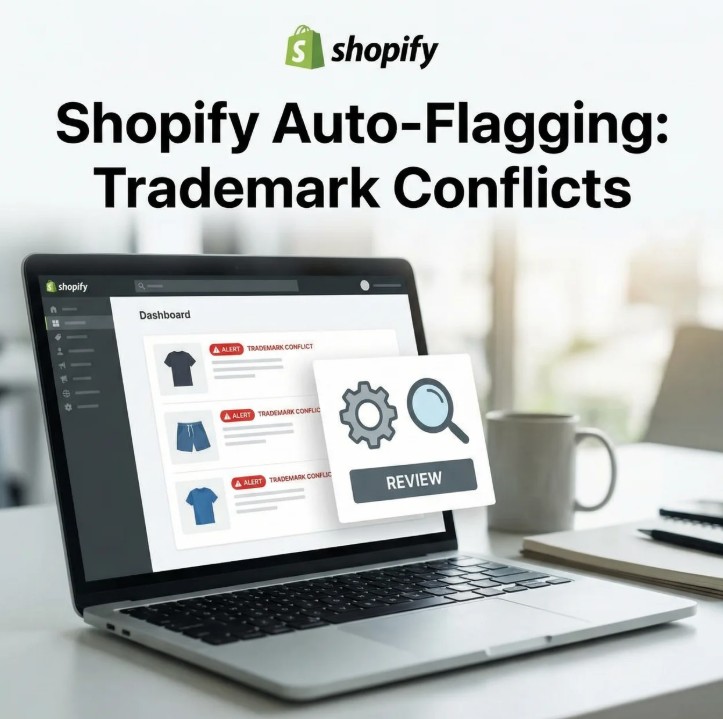
Shopify now operates what amounts to a two-track enforcement system. The first track is the traditional complaint-driven process, where trademark owners submit notices through Shopify's IP reporting form. The second track is proactive — Shopify scanning merchant stores for known brand names, trademarked keywords, and IP-sensitive terms appearing in product titles, descriptions, tags, and store names, then sending compliance emails before any external complaint has been filed.
This explains why sellers who've been operating unchanged for twelve, eighteen, even twenty-four months are suddenly receiving notices. Their listings didn't change. Shopify's scanning approach did.
Advertisement
The platform is also under significantly more pressure to enforce. According to the EUIPO and OECD's 2025 Global Trade in Fakes Report, counterfeit trade now exceeds $1.2 trillion annually, with Shopify ranking among the top three targets for digital brand impersonation. Governments and brand owners are scrutinizing platforms more closely. The Digital Services Act in the EU explicitly requires marketplaces to address illegal content. That pressure flows directly down to merchants.
Need help? Our tools can help you identify potential IP conflicts before they become costly problems. Try a free scan →
What Triggers a Shopify Trademark Flag
The most dangerous misunderstanding among sellers is thinking trademark flags only happen when you're selling obvious fakes. They don't.
Advertisement
Here are the most common trigger scenarios documented in Shopify community threads and legal Q&A forums:
Using a Brand Name in Your Product Title or Description
This is the most common trigger. Sellers — particularly those running print-on-demand stores, fan merchandise, or dropship operations — frequently include recognizable brand names or celebrity names in their product titles to drive search traffic. "Morgan Wallen T-shirt." "Inspired by Nike." "Compatible with Apple AirPods."
Advertisement
Using a well-known name in product copy to attract traffic, when you don't have a licensing agreement or authorized reseller status, can constitute trademark infringement or — in the case of celebrity names — a right of publicity violation. Importantly, right of publicity claims don't require the name to be federally registered as a trademark. An individual's name and likeness carries inherent legal protection.
Selling Branded Products Without Proof of Authorization
If you're reselling genuine, authentic branded products — items you personally bought from Nike.com, Footlocker, an authorized distributor — you may have a legal defense under the first-sale doctrine. But Shopify's platform policy operates above trademark law. Even if you're technically within your legal rights, Shopify may still require you to prove authorized reseller status with documentation. Retail receipts are frequently reported as insufficient. Shopify typically wants wholesale invoices or formal authorization letters from the brand.
Advertisement
Logo Similarity and Trade Dress Triggers
If your product imagery, packaging, or store design bears visual similarity to a registered trademark — a claw-mark logo, a specific color combination, a distinctive typeface treatment — that can trigger trade dress infringement flags, separate from any word mark concern.
Need help? Our tools can help you identify potential IP conflicts before they become costly problems. Try a free scan →
Fan Merchandise and Licensed Character Products
Advertisement
This is where the largest volume of sellers are getting caught. Selling items featuring Disney characters, sports team logos, music artist branding, or TV show imagery without a license is infringement — even if the product is handmade, the item is clearly "fan art," or the item is sold "inspired by" framing. The "inspired by" hedge provides no legal protection against trademark or copyright claims.
The Attestation Form: What It Actually Means
When Shopify flags your store, the typical next step is receiving what's officially called the "Attestation for the Sale of Branded and Trademarked Products." Sellers widely describe the form as confusing, intimidating, and written in language that feels impossible to interpret without a lawyer.
Advertisement
Here's what each checkbox on the form typically corresponds to:
Need help? Our tools can help you identify potential IP conflicts before they become costly problems. Try a free scan →
"I own the rights to the products available on my store" — You created the products yourself and hold the IP.
"I am an authorized reseller of, or have the right to resell, the branded or trademarked products available on my store" — You have formal authorization from the brand (wholesale agreements, distributor agreements, or explicit reseller authorization in writing — not retail receipts).
Advertisement
"The branded or trademarked products available on my Shopify store are authentic used products" — You're selling secondhand genuine items (vintage, thrifted, pre-owned).
"I have removed all branded or trademarked products from my Shopify store which do not meet one of the choices above" — You've cleaned the infringing content and are certifying your store is now compliant.
Two important things to know about signing the form. First, Shopify itself states explicitly in its Help Center that submitting false or bad-faith IP notices is "punishable by law" — and this cuts both ways. Signing the attestation form with inaccurate information creates legal exposure for you. Second, if you've already removed the flagged products and your remaining store is clean, checking the final box and certifying removal is generally the safest path if you can't satisfy one of the other criteria.
Advertisement
If you're unsure which option applies to your situation, this is one of those moments where a quick consultation with an IP attorney is worth the cost — given that your entire store and payment processing capability is at stake.
Why This Is Getting Worse, Not Better
Several converging forces are accelerating Shopify's enforcement posture in 2025 and into 2026.
Advertisement
AI-powered counterfeit scaling. The WIPO Emerging Trends in Online Brand Enforcement Report (2025) documented a surge in AI-driven storefront cloning tools that can replicate entire product catalogs, including brand assets, within hours. Shopify is responding to an increasingly automated threat with increasingly automated detection.
AI commerce channels raising the stakes. ChatGPT Instant Checkout launched in July 2025, currently supporting Etsy with Shopify integration planned. When AI systems start recommending products directly from platform merchant feeds, the brand risk surface area for trademark-conflicting listings expands dramatically. An infringing listing that once sat quietly in a Shopify store can now get AI-surfaced to millions of users. Brand owners are aware of this. Enforcement pressure will increase proportionately.
Need help? Our tools can help you identify potential IP conflicts before they become costly problems. Try a free scan →
Third-party brand protection services. Companies like MarqVision, Red Points, Bustem, and IP Moat have built AI-powered monitoring tools that scan platforms including Shopify continuously and automate takedown requests on behalf of brand owners. A single brand might generate hundreds of automated notices per month. Shopify processes all of them. The volume alone is driving more notices to hit more sellers.
Advertisement
Platform liability exposure. As digital commerce regulation tightens globally — particularly under the EU's Digital Services Act and equivalent frameworks in development elsewhere — platforms face direct liability for failing to act on known IP violations. Shopify's proactive scanning is at least partially a regulatory compliance posture, not just a brand-friendly policy choice.
The Gap Between Trademark Law and Platform Policy
This is the single most important concept for any seller to understand — and the one most consistently missing from everything you'll read about this topic.
Advertisement
What trademark law says you can do and what Shopify's policy allows you to do are not the same thing.
Need help? Our tools can help you identify potential IP conflicts before they become costly problems. Try a free scan →
Under the first-sale doctrine, reselling genuine branded products you legally purchased is generally lawful under U.S. trademark law. Nominative fair use allows you to accurately describe a product using a brand name when it's the most accurate description (e.g., "compatible with iPhone"). These are real legal defenses.
But Shopify is a private platform with its own Acceptable Use Policy. That policy can restrict conduct that is technically lawful. Shopify doesn't need a court order to remove your listing. It doesn't need to adjudicate whether your use constitutes fair use. It can act under its platform rules, and those rules exist in a separate layer above the law.
Advertisement
This means two things. If you receive a flag and believe your use is legally defensible, you have the right to file a counter-notice with Shopify. The platform will send it to the rights holder, who then has the option to escalate to a court — at which point the legal defenses become relevant. But in the meantime, your listing may remain down.
And it means that the safest long-term posture for any Shopify seller is to build their store assuming platform policy is the operative standard — not just the legal standard.
What Sellers Should Do Right Now
Advertisement
Audit your product titles, descriptions, tags, and metadata for any brand names, celebrity names, character names, team names, or trademarked terms you don't have explicit authorization to use. This includes names you added for SEO purposes. Search is not a valid defense.
Know the difference between what you're actually selling. If you're an authorized reseller, locate your wholesale invoices or authorization letters before you need them. If you're selling genuine used items, document their provenance. If you created the products yourself from scratch without licensed brand elements, that's worth confirming clearly in your listing copy.
Understand what the attestation form is before you have to sign it under time pressure. The worst version of this scenario is receiving a 72-hour notice and signing the wrong box in a panic because you didn't want orders to stop processing.
Advertisement
If you received a notice and believe it's a false positive, Shopify's Help Center confirms you can file a counter-response through your Shopify admin. The counter-notice must include your legal name, contact information, the specific content you're contesting, a statement of good faith belief that the removal was a mistake, and your consent to jurisdiction of the relevant federal court. Shopify will forward this to the party that submitted the original notice.
If you're building a new Shopify store, treat trademark research as part of your product development process — not an afterthought. Check whether your product names, store name, and any design elements you're using conflict with existing registered trademarks before your store goes live and before you invest in inventory or marketing.
Need help? Our tools can help you identify potential IP conflicts before they become costly problems. Try a free scan →
The platform enforcement environment for e-commerce is tightening. Shopify is not unique in this — Amazon, TikTok Shop, Etsy, and every major marketplace is facing the same pressures and deploying the same technologies. The sellers who navigate this well are the ones who understand the rules before the email arrives, not after.
Advertisement
This article is for educational and informational purposes only. It does not constitute legal advice. If your store has been flagged or suspended for IP reasons, consult a qualified IP attorney for guidance specific to your situation.