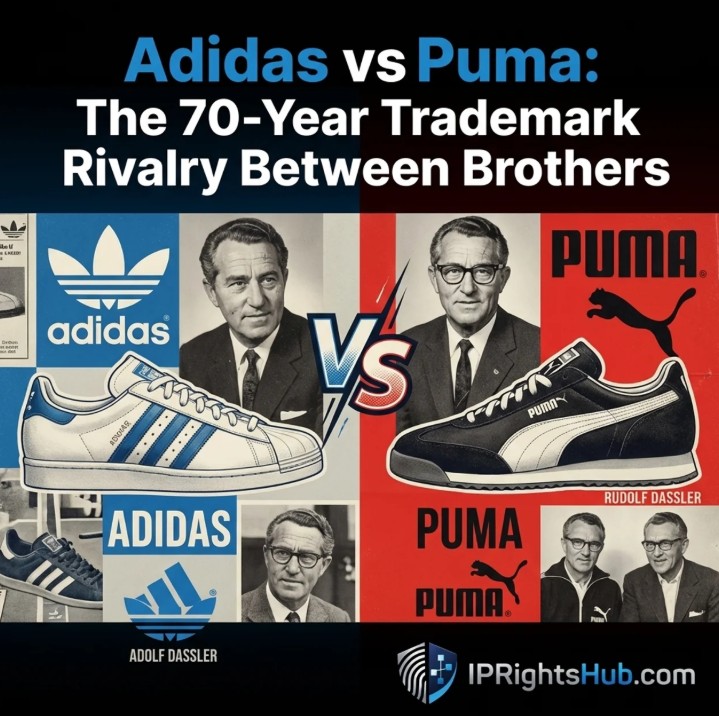
Background: One Workshop, Two Empires
Advertisement
Before Adidas and Puma were rivals, they were the same company.
In the 1920s, brothers Adolf ("Adi") and Rudolf ("Rudi") Dassler built a small shoe factory together in Herzogenaurach, a Bavarian town in Germany. The company — Gebrüder Dassler Schuhfabrik (Dassler Brothers Shoe Factory) — grew steadily through the 1930s, gaining international recognition when US sprinter Jesse Owens wore their spikes to win four gold medals at the 1936 Berlin Olympics.
Advertisement
The brothers had complementary strengths that made the business work. Adi was the craftsman — obsessed with product innovation, materials, and athletic performance. Rudi was the salesman — extroverted, commercially minded, and skilled at building relationships. Together, by the late 1930s, they were producing over 1,000 pairs of shoes per day.
By 1948, they never spoke again.
Need help? Our tools can help you identify potential IP conflicts before they become costly problems. Try a free scan →
What Caused the Split?
Advertisement
The exact trigger remains disputed — and that ambiguity itself is part of what makes this story so instructive. Multiple competing accounts exist:
- The bomb shelter incident (1943): During an Allied air raid, Adi and his wife joined Rudi in a shelter. Adi reportedly muttered "the dirty bastards are back again" — a comment directed at Allied planes. According to multiple historical accounts, Rudi interpreted this as a personal attack on him and his family.
- Rudolf's conscription: Rudi was drafted and served on the front lines. Adi was deemed essential to wartime shoe production and stayed home. Rudi reportedly believed Adi had engineered his conscription — a claim Adi denied.
- The denazification hearings (1945–1946): After Germany's defeat, both brothers appeared before Allied denazification panels. According to historical accounts, each brother reportedly gave testimony that damaged the other's case — a betrayal that, by multiple accounts, proved unforgivable.
- Family tensions at home: Both families shared a villa. Their wives reportedly did not get along. Decades of proximity under pressure had reached its breaking point.
None of these causes has been definitively proven as the single trigger. What is documented is the outcome: in 1948, the brothers dissolved Gebrüder Dassler, split the factory assets and employees between them, and set up competing operations on opposite sides of the Aurach river that cuts through Herzogenaurach.
Advertisement
Rudi established his company — initially named Ruda (from Rudolf Dassler), later rebranded Puma — on the south side of the river in 1948. Adi retained the main factory and registered Adidas AG (from Adi Dassler) in 1949. Adi kept two-thirds of the employees; most reportedly preferred his innovation-first approach.
Need help? Our tools can help you identify potential IP conflicts before they become costly problems. Try a free scan →
They were buried at opposite ends of the same cemetery. The brothers never reconciled.
The Dispute: A Town Divided, a Trademark Born
Advertisement
The split didn't just divide a family. It divided a town.
Herzogenaurach became known internationally as "the town of bent necks" — because residents would look down at a stranger's feet before deciding whether to speak to them. Adidas or Puma shoes signalled which side of the rivalry you were on. Employees from one company were reportedly barred from socialising with, dating, or marrying employees from the other. Schools, bars, bakeries, and football clubs split along brand lines.
The two factories faced each other across the Aurach river. According to Adidas CEO Herbert Hainer — speaking in later years — employees at the time were forbidden from even saying the word "Puma" aloud. Instead, they referred to it only as "the competitor on the other side of the river."
Advertisement
The Three Stripes: The Most Litigated Mark in Sportswear
The trademark story starts with a purchase that has become one of IP law's most cited examples of undervalued assets.
In 1952, Adi Dassler acquired the three-stripe design from Finnish sports brand Karhu Sports — reportedly in exchange for the equivalent of approximately €1,600 and two bottles of whiskey. Karhu had used the stripes functionally on their footwear. Adi saw something different: a visual identity that could become a brand.
Advertisement
He made the stripes white. He put them on everything. He reportedly called Adidas "the three stripes company." By the 1970s, the mark had been formally registered in multiple jurisdictions. By the 1980s, Adidas's three-stripe design had become one of the most recognised visual trademarks on earth.
Puma — built on Rudi's instinct to differentiate and compete — developed its own visual system: the leaping cat logo and what became known as the "formstrip," a single curved stripe running along the side of footwear. Visually distinct. But as both companies grew and their product lines expanded, the line between "inspired by" and "confusingly similar" became a recurring legal battleground.
Need help? Our tools can help you identify potential IP conflicts before they become costly problems. Try a free scan →
Key Issues: The Trademark Disputes
Advertisement
The rivalry between Adidas and Puma did not end with the founders' deaths — it migrated into the courts. What follows is a documented timeline of the key IP disputes.
The 2015–2016 German Stripe Case
In 2015, a German court dismissed Adidas's claim that Puma's three-stripe design on certain products was confusingly similar to its own registered mark. The court found no risk of confusion.
Advertisement
Adidas challenged the ruling. In 2016, a German appellate court reversed the decision, finding that the marks did share characteristics capable of causing consumer confusion. Puma challenged the reversal in 2017, 2018, and again in 2022. According to reporting by IP law publication CITMA, the reversal was upheld across each challenge.
Need help? Our tools can help you identify potential IP conflicts before they become costly problems. Try a free scan →
The 2017 Soccer Cleat Lawsuit (US Federal Court)
In 2017, Adidas filed claims of trademark infringement, unfair competition, trademark dilution, and deception against Puma in the US District Court for the District of Oregon. The complaint centred on Puma's "Evo Power Vigor Camo" soccer cleat, which featured four diagonal stripes on the side.
Advertisement
According to Adidas's complaint, Puma's use of four diagonal stripes constituted "a blatant attempt to free-ride on Adidas's fame as a preeminent soccer brand." Adidas alleged the four-stripe design would cause consumer confusion with its registered three-stripe mark.
Puma disputed the claim. The case drew significant coverage in sports and legal media, with observers noting the irony: two companies co-founded by brothers, now in a US federal court arguing about the difference between three and four stripes.
The "HERZO" Trademark Opposition (2015)
Advertisement
In 2015, Adidas opposed Puma's application at the US Patent and Trademark Office for the trademark "HERZO" — the widely-used local nickname for Herzogenaurach, the town both companies call home. According to IP reporting by CITMA, Adidas challenged the application on the grounds that registration of the term could cause confusion or otherwise conflict with Adidas's established brand identity in the region.
The Boost vs. NRGY Patent Dispute
Adidas introduced its Boost foam cushioning technology in 2013 in partnership with chemical company BASF. Puma introduced its NRGY cushioning technology approximately two years later. According to reporting and industry analysis, the similarities between the formulations triggered legal scrutiny and dispute. Adidas sought an injunction against Puma's NRGY shoe; the court reportedly dismissed this request.
Advertisement
The 2024–2025 Thom Browne Ruling: A Turning Point for the Three Stripes
The most consequential development in the Adidas stripe story in decades did not involve Puma — but its implications for the three-stripe trademark's reach are significant.
Need help? Our tools can help you identify potential IP conflicts before they become costly problems. Try a free scan →
In November 2024, the UK High Court ruled that eight of Adidas's sixteen three-stripe trademark registrations were invalid, finding them to lack registrability under Section 1(1) of the Trade Marks Act 1994. The marks, described as "three parallel equally spaced stripes applied to a garment," were found to lack the clarity and precision required for valid trademark registration.
Advertisement
Adidas appealed. On 23 October 2025, the UK Court of Appeal unanimously upheld the High Court's ruling. Lord Justice Arnold, delivering the leading judgment, found that the relationship between the pictorial representations and the written descriptions of the marks was inconsistent — that descriptions covering multiple variations of the stripe design did not meet trademark registration standards.
As of publication, Adidas retains other valid three-stripe registrations. However, the 2025 ruling represents what legal commentators have described as a judicial pushback against overbroad trademark claims on simple geometric elements — a pattern also observed in US and German courts.
Separately, Adidas has filed more than 90 lawsuits and reached over 200 settlements in cases relating to its three-stripe trademark over a 16-year period, according to reporting by Reuters cited in industry media.
Advertisement
Outcome: What the Courts Have Established
Need help? Our tools can help you identify potential IP conflicts before they become costly problems. Try a free scan →
No single ruling has ended the Adidas-Puma trademark rivalry. The following represents the documented state of outcomes as of early 2026:
- Adidas retains valid three-stripe trademark registrations in multiple jurisdictions, but multiple registrations — particularly in the UK — have been ruled invalid for lack of clarity and registrability
- Courts in the US, Germany, and the UK have all, at various points, pushed back against what they characterised as overbroad stripe-based trademark claims
- Puma prevailed in the Thom Browne-parallel US case (Puma's four-stripe soccer cleat dispute with Adidas resulted in continued competition without a reported final injunction against Puma's design)
- The two companies remain independent publicly traded entities — neither is a subsidiary of the other. Adidas is listed as Adidas AG; Puma trades as Puma SE
- In 2009, Adidas and Puma employees participated in a symbolic friendly football match in Herzogenaurach — widely reported as a gesture of reconciliation between the two companies, 61 years after the split
- Frank Dassler — grandson of Puma founder Rudolf Dassler — grew up wearing Puma shoes and now serves as Adidas's chief legal counsel, according to reporting by The Business Standard. He has publicly described the historical enmity as "history"
Advertisement
Lessons: What This Means for Founders
The Dassler story is not just historical drama. It is a case study in how foundational decisions — about brand identity, IP ownership, and co-founder structure — compound over decades.
1. Your logo is IP from day one
Advertisement
Adi Dassler purchased the three-stripe design for the equivalent of a modest sum and two bottles of whiskey. That asset became the most litigated trademark in sportswear history. If you are building a brand with a visual mark at its centre — a logo, a colour, a pattern, a shape — that asset needs to be registered early, precisely, and in the right classes. Fame alone does not protect a trademark. The 2025 UK ruling confirmed that 75 years of global recognition was not sufficient to save marks that were imprecisely filed.
2. Over-broad IP filings can backfire
Adidas's stripe enforcement strategy — 90+ lawsuits, 200+ settlements — built legal precedent, but it also invited sustained legal challenge. Courts globally have found that filing a trademark with descriptions broad enough to cover every variation of a stripe is not the same as owning every variation of a stripe. The more precisely a mark is defined, the more defensible it is. Ambiguity in the filing becomes ammunition for challengers.
Advertisement
3. Co-founder agreements need IP assignment clauses
When Gebrüder Dassler split in 1948, there were no formal agreements defining who owned what intellectual property. The three-stripe concept emerged after the split — it was Adi's innovation alone. But had Rudi argued a claim, there was no documented pre-agreement to rely on. If you are building a business with a co-founder, an IP assignment clause in your founders' agreement determines who owns the brand if the relationship ends. Without it, the Dassler outcome — mutual legal warfare — becomes more likely.
Need help? Our tools can help you identify potential IP conflicts before they become costly problems. Try a free scan →
4. Rivalry can drive innovation — but it has a cost
Advertisement
Economists and business historians credit the Adidas-Puma rivalry with creating the modern sports marketing industry: athlete endorsements, sponsorship strategy, and the commercial power of associating a product with elite performance were all accelerated by two brothers desperately trying to outdo each other. That competitive pressure produced genuine innovation. But both brothers were so focused on each other that neither paid sufficient attention to a then-small Oregon company called Nike. Nike is now the world's largest sportswear brand. The cost of the feud, measured in lost market share, may never be quantifiable.
5. Simple marks are hard to own — but not impossible
The Adidas case demonstrates that even the simplest visual elements — three parallel stripes — can become legally protectable trademarks with consistent use, global registration, and long-term brand association. It also demonstrates the limits: courts will not allow a brand to claim monopoly ownership of a geometric element simply because it became famous. The Dassler brothers' competing stripe designs forced both brands to develop distinctive identities through use, not just through filing. For founders building visual brands today, the lesson is the same: register early, use consistently, define precisely, and do not rely on brand fame as a substitute for clear IP documentation.
Advertisement
Need help? Our tools can help you identify potential IP conflicts before they become costly problems. Try a free scan →
The Adidas-Puma case represents a class of trademark risk that IP-SAM™ is specifically designed to surface for founders before it becomes a legal dispute.
Visual similarity risk at registration: When Puma filed designs incorporating stripe-based elements, the visual overlap with Adidas's registered marks created an infringement exposure window. IP-SAM™ monitors registered trademark databases continuously — including figurative (design) marks — to flag when a new brand's visual identity conflicts with existing registrations in overlapping goods classes.
Advertisement
Brand name and term monitoring: Puma's 2015 application to register "HERZO" as a trademark triggered an immediate opposition from Adidas. Terms closely associated with an established brand — including geographic terms, nicknames, and shorthand references — can attract challenge even when they appear generic. IP-SAM™ surfaces conflicts at the application stage, not after opposition is filed.
Overbroad filing detection: The 2025 UK ruling against Adidas turned on inconsistencies between the written descriptions and pictorial representations in its own trademark filings. IP-SAM's document review layer flags precisely these structural weaknesses — where the scope of a trademark application may be too broad, too vague, or internally inconsistent — giving brand owners the opportunity to correct before registration rather than defend in litigation.
Ongoing competitive monitoring: The Adidas-Puma rivalry has produced legal disputes across five decades. IP-SAM's continuous monitoring means that when a competitor files a new mark, launches a new product line, or makes a trademark application in your goods class, you receive an alert — not a lawyer's letter six months later.
Advertisement
This case analysis is for educational and informational purposes only. It does not constitute legal advice and should not be relied upon as such. All allegations referenced are claims made by the respective parties and have not necessarily been proven or ruled upon by any court or regulatory body. For trademark protection guidance specific to your situation, consult a qualified IP attorney.
Case status and outcomes may change. IPRightsHub updates case analyses where material developments occur.
Powered by IP-SAM™ — Real-time IP risk intelligence for founders.