The Hollywood Backlash Happened. Here's What Actually Changed.
Advertisement
In February 2026, ByteDance launched Seedance 2.0 to viral success. Within days, the Motion Picture Association (MPA), Disney, Paramount, and SAG-AFTRA sent cease-and-desist letters alleging "unauthorized use of copyrighted works on a massive scale." Senators Welch and Blackburn demanded the tool be shut down. Global launch was paused. Safeguards were promised.
If you read the headlines, you got one story: "China stole Hollywood's IP."
Advertisement
What you didn't get was clarity on what this means for you if you want to use Seedance 2.0 to generate a video for your brand, your YouTube channel, or a client campaign.
Here's the brutal truth: the legal exposure splits into two separate stages. Most articles only cover one. That's why you're still confused.
Need help? Our tools can help you identify potential IP conflicts before they become costly problems. Try a free scan →
Stage 1: Training Data Infringement (ByteDance's Problem — Mostly)
Advertisement
Seedance 2.0 was trained on massive amounts of copyrighted film and video data — without explicit permission from studios.
This is what the MPA, Disney, and SAG-AFTRA are suing over. They're alleging ByteDance ingested their copyrighted works (scripts, filmed content, actor performances) into the model's neural weights without a licensing deal.
Is this infringement? Legally, that's contested. The studios say yes. ByteDance says their training is protected under fair use and Chinese law. As of April 2026, no US court has ruled definitively on whether training an AI model on copyrighted video constitutes infringement, because this is genuinely new legal ground.
Advertisement
Who pays if it goes wrong? ByteDance, potentially. If the studios win, ByteDance could face injunctions, damages, or both. But here's the key: this is a platform-level lawsuit. It's not about individual creators. It's about whether ByteDance had the right to ingest the data in the first place.
Need help? Our tools can help you identify potential IP conflicts before they become costly problems. Try a free scan →
What changes for you: ByteDance says it's adding safeguards (image recognition filters, prompt blocks, etc.). These safeguards don't legally absolve the training data problem. They're a public relations move and a moderation layer. But they do signal that ByteDance is trying to prevent the tool from generating obvious protected IP going forward.
Stage 2: Output Infringement (Your Risk, If You're Not Careful)
Advertisement
Here's where it gets real for creators: even if training data is someday deemed fair use, what you generate and upload is still your responsibility.
Let's say you use Seedance 2.0 to generate a 30-second video of a generic sci-fi battle. Nobody's likeness, nobody's trademarked character. You upload it to YouTube.
Risk level: low. You generated original creative output, even if the underlying neural weights were trained on movies.
Advertisement
Now let's say you use Seedance 2.0 to generate a video of Tom Cruise fighting Brad Pitt. (This actually happened and went viral in February 2026.) You upload it.
Risk level: extremely high. You've now generated a deepfake of real people without their consent, and possibly content that resembles copyrighted movie scenes. This triggers:
Likeness/Publicity Rights Claims — Tom Cruise and Brad Pitt (or their legal teams) can sue for unauthorized use of their image and likeness. This is separate from copyright. This is about using someone's face.
Copyright Claims — If the video visually resembles a copyrighted film (same framing, similar action sequences), the copyright holder can issue a DMCA takedown or sue for infringement.
Platform Strikes — YouTube, Instagram, TikTok automatically flag and demonetize accounts posting deepfakes. They may also terminate your channel.
Advertisement
Who pays if you get sued? You do. ByteDance's terms of service do not protect you from copyright or likeness claims on your generated outputs. You indemnify them; they don't indemnify you.
Training Data vs. Output: The Critical Distinction
Need help? Our tools can help you identify potential IP conflicts before they become costly problems. Try a free scan →
Most articles muddy this distinction. Let me make it crystal clear.
Advertisement
| Stage | What's Happening | Who's Liable | What Changes It |
|---|---|---|---|
| Training Data | ByteDance ingested copyrighted films without permission | ByteDance (in lawsuits from studios) | A court ruling on whether AI training is fair use |
| Output | You generated a video using Seedance and uploaded it | You (if it infringes or deepfakes real people) | What the video contains and where you post it |
The studios suing ByteDance are attacking the training data. That lawsuit doesn't make Seedance 2.0 "illegal to use." It makes the underlying training data ethically and legally contested. But your output is still your liability.
Think of it this way: if a camera manufacturer illegally sourced materials, but you use the camera to photograph your friend, you're not liable for the manufacturer's supply chain problem. You're liable if you post a naked photo of your friend without consent.
Advertisement
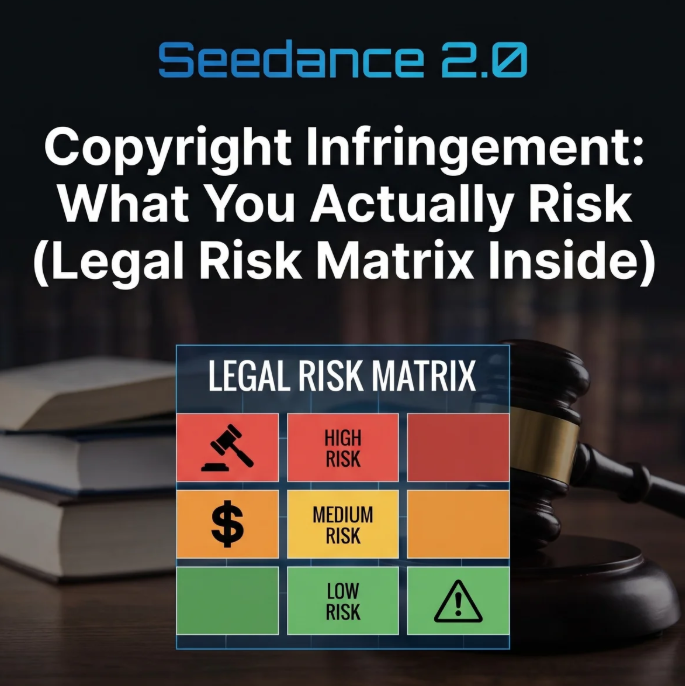
The Real Risk Tiers for Creators (April 2026)
Need help? Our tools can help you identify potential IP conflicts before they become costly problems. Try a free scan →
Based on observed usage, platform enforcement, and studio cease-and-desist patterns, here's where the risk actually sits:
Tier 1: Personal Use, Non-Commercial, Original Characters
Advertisement
- You generate a sci-fi cinematic with a fictional protagonist and generic alien landscape.
- You keep it private or share with friends.
- Risk level: Very Low. No monetization, no commercial exploitation, no recognizable people or IP. Platform won't flag it. Nobody sues over private creative exploration.
Tier 2: Public Posting, Original Characters, No Monetization
- You upload the sci-fi cinematic to TikTok or YouTube without monetization enabled.
- It goes viral because it looks great.
- Risk level: Low-to-Moderate. You're not making money, which reduces commercial damages a copyright holder could claim. But you are distributing it. If a studio believes the visual style closely resembles their IP, they could file a DMCA takedown. YouTube would demonetize; the video gets pulled. You don't get sued, but the content disappears.
Advertisement
Tier 3: Monetized Content, Original Characters
- You enable YouTube monetization or sell the video as stock footage.
- Risk level: Moderate. You're now making commercial use of AI-generated content. If the output visually mimics copyrighted film (same cinematography, same framing, same narrative beats), studios have stronger grounds for a takedown and potential damages claim. YouTube is more aggressive about demonetizing AI-generated content anyway, so you may see revenue blocked.
Tier 4: Client Work, Brand Content, Original Characters
Advertisement
- You sell AI-generated videos as a service to a client (e.g., an ad agency).
- Risk level: High. You're now liable to your client if the video gets a DMCA strike or the studio sues. Your contract likely says you warrant the content is original and non-infringing. If you can't defend it, you're liable for refunds and potentially damages. Most smart agencies are avoiding Seedance 2.0 entirely for client work until legal clarity improves.
Tier 5: Recognizable People or Trademarked Characters
Need help? Our tools can help you identify potential IP conflicts before they become costly problems. Try a free scan →
- You generate a deepfake of a celebrity or a character from Marvel, Star Wars, or Disney.
- Risk level: Extreme. You're now infringing three separate laws: copyright (if the character is trademarked/copyrighted), likeness rights (for real people), and possibly deepfake laws (which some jurisdictions have criminalized). DMCA takedown is guaranteed. Lawsuit is probable. Criminal liability is possible.
Advertisement
What ByteDance's "Safeguards" Actually Do (and Don't Do)
ByteDance announced it would strengthen Seedance 2.0's safeguards after the cease-and-desist letters. Here's what the community has observed in practice (April 2026):
What the safeguards block:
Advertisement
- Explicit prompts naming real celebrities ("generate Tom Cruise")
- Prompts requesting protected IP characters ("Spider-Man", "Mickey Mouse")
- Certain visual keywords tied to famous film franchises
Need help? Our tools can help you identify potential IP conflicts before they become costly problems. Try a free scan →
What they don't block:
- A prompt for "a handsome actor in a red suit fighting villains" (bypasses the Spider-Man block but may generate similar output)
- Training data problems (the safeguards don't change what the model was trained on)
- Liability for what you generate (safeguards don't protect you legally if you upload and monetize)
- Users generating video in unfiltered versions (China domestic version, older API access, third-party platforms like Dreamina and Higgsfield)
Advertisement
Do safeguards make the tool legal? No. They reduce risk by blocking obvious infringing prompts. But they don't absolve you of liability for what you generate and distribute.
The Enforcement Reality in April 2026
Here's what actually happens when a creator posts Seedance-generated content:
Advertisement
Scenario A: Original Output, No Celebrity Likeness
- Platforms: May flag as AI-generated (metadata or manual review). May demonetize on principle (YouTube and TikTok are aggressive about AI content). Unlikely to receive DMCA.
- Studios: Unlikely to pursue unless the visual style is strikingly similar to proprietary films.
- Your outcome: Content stays up, may not monetize. No legal action.
Scenario B: Obvious Deepfake of Real Person
Advertisement
- Platforms: Immediate removal. Account strike. Possible termination.
- Studios / Talent: DMCA takedown guaranteed. Lawsuit probable if you've profited.
- Your outcome: Content removed, account at risk, potential legal liability.
Scenario C: Ambiguous Output (Looks Like It Could Be From a Famous Movie)
Need help? Our tools can help you identify potential IP conflicts before they become costly problems. Try a free scan →
- Platforms: Manual review. If flagged as "likely infringing," demonetization.
- Studios: May file DMCA if they believe there's substantial similarity.
- Your outcome: Video removed or demonetized. Unlikely lawsuit unless you're making significant money.
Advertisement
The key pattern: platforms are more aggressive than studios right now. YouTube and TikTok are demonetizing suspected AI content by default, independent of copyright claims. So your practical risk includes platform enforcement, not just copyright lawsuits.
Common Questions Creators Still Get Wrong
"If I use Seedance 2.0, do I own the generated video?"
Advertisement
Yes. You own the video as a creative work. But ownership doesn't protect you if the video infringes someone else's copyright or likeness. Think of it this way: you own a car, but you can't drive it into someone's house and claim ownership as a defense.
Need help? Our tools can help you identify potential IP conflicts before they become costly problems. Try a free scan →
"Can I monetize Seedance videos if they don't name a celebrity?"
Maybe. If the video is sufficiently original in its output (even if the model was trained on copyrighted data), and you're not infringing anyone's IP, monetization is theoretically possible. But YouTube's AI content policy is strict, and most AI-generated videos get demonetized on principle. Test with non-monetized uploads first.
Advertisement
"Is Seedance 2.0 being banned in the US?"
As of April 2026, no. Senators have called for a shutdown, but legislation hasn't passed. The tool is paused for global rollout, but that's ByteDance's choice, not a US ban. If you're in the US and access the tool through third-party APIs (Dreamina, Higgsfield, others), it's technically available.
"Will my generated videos face lawsuits later?"
Advertisement
If the video is sufficiently original and non-infringing, the legal risk decreases over time. Once a video is old and unprofitable, studios have less incentive to sue. But if you're actively monetizing and a studio identifies infringement, any future takedown or lawsuit is still possible. The safest approach: don't generate recognizable people or trademarked characters.
"What's the difference between copyright and likeness rights?"
Copyright protects creative works (films, music, art). Infringing copyright means copying a protected creative expression.
Advertisement
Likeness/Publicity Rights protect a person's image and identity. Using someone's face without permission (deepfakes, impersonation) infringes likeness rights, separate from copyright.
A deepfake of Tom Cruise fighting Brad Pitt infringes both: it copies visual elements similar to copyrighted films AND uses real people's likenesses without consent.
Need help? Our tools can help you identify potential IP conflicts before they become costly problems. Try a free scan →
"Does Dreamina or Higgsfield have different copyright risk?"
Advertisement
No. These are just platforms offering API access to Seedance 2.0 (or similar models). The underlying copyright and likeness liability is the same. Some third-party platforms claim to have "stronger safeguards," but terms of service don't protect you from copyright claims. You're still liable for what you generate and distribute.
What This Means For Your Next Decision
If you're a creator, marketer, or founder considering Seedance 2.0, here's the practical framework:
Advertisement
Use Seedance 2.0 if:
Need help? Our tools can help you identify potential IP conflicts before they become costly problems. Try a free scan →
- You're generating original, fully fictional creative output
- You have no intent to monetize immediately
- You're comfortable with platform demonetization risk
- You're not generating recognizable people or famous IP characters
- You're testing creatively, not scaling revenue
Don't use Seedance 2.0 if:
Advertisement
- You're building a commercial video service for clients
- Your business plan depends on monetizing AI-generated videos at scale
- You can't afford a DMCA takedown or account termination
- You're generating any deepfakes or celebrity likenesses
- Legal certainty is required for your business model
Monitor for changes if:
- Court cases resolve the "training data fair use" question
- Legislation passes explicitly regulating AI video generation
- ByteDance and studios reach a licensing deal (which would change the training data question)
- Platform policies (YouTube, TikTok) clarify AI monetization rules
Advertisement
The truth is: there's no "legal certainty" on AI-generated video in April 2026. The training data question is unresolved. Output liability is real but enforcement varies by platform and studio. Safeguards reduce risk but don't eliminate it.
What you do with that uncertainty is your call. But at least now you know the difference between ByteDance's liability and yours.
Frequently Asked Questions
Advertisement
Who is legally liable for Seedance 2.0 copyright issues — ByteDance or the user?
Both, in different ways. ByteDance is liable for training data infringement claims (what studios are suing over). Users are liable for output infringement or likeness claims if they generate and distribute copyrighted or celebrity deepfake content. The training data lawsuit doesn't make the tool "illegal"; it makes the underlying dataset contested.
Need help? Our tools can help you identify potential IP conflicts before they become costly problems. Try a free scan →
Can I use Seedance 2.0 for commercial purposes?
Advertisement
Technically yes, but with significant risk. If your generated video is sufficiently original and doesn't infringe anyone's IP or likeness, commercial use is possible. However, platforms like YouTube aggressively demonetize AI content, and studios may file DMCA takedowns if output resembles copyrighted films. Test with non-monetized uploads first.
What happens if I generate a video of a celebrity?
High legal risk. You'd be creating a deepfake without consent, infringing the person's likeness and publicity rights. Platforms will remove it immediately. The person (or their legal team) can sue for damages. If you profited from it, damages are higher. Don't do this.
Advertisement
Is the copyright infringement risk higher on Seedance 2.0 than other AI video tools?
Need help? Our tools can help you identify potential IP conflicts before they become costly problems. Try a free scan →
Seedance 2.0 has the most visible celebrity/IP infringement controversy because it went viral with deepfakes before safeguards. But all AI video generators pose similar copyright risks if used to generate protected content. The risk isn't specific to Seedance; it's inherent to AI video generation until licensing deals are standardized.
Do ByteDance's safeguards protect me from copyright claims?
Advertisement
No. Safeguards reduce the likelihood of generating obvious infringing content, but they don't provide legal indemnification. If you generate content and a studio claims infringement, ByteDance's terms of service make you liable, not them.
What's the difference between "training data" infringement and "output" infringement?
Training data infringement = ByteDance ingested copyrighted works without permission when building the model. Output infringement = you generated a video that infringes someone's copyright or likeness. The first is a platform-level lawsuit. The second is your liability.
Advertisement
Can I be sued personally for uploading AI videos?
Yes, if the video infringes copyright or likeness rights. Studios or rights holders can file DMCA takedowns (non-legal but platform-enforced) or lawsuits (legal action seeking damages). The likelihood depends on how commercially successful the video is and how obvious the infringement is.
What should I include in client contracts if I'm offering Seedance 2.0 services?
Advertisement
Clear indemnification language stating that the client assumes all copyright, likeness, and regulatory liability for content you generate. Include a clause that you warrant the output is original and non-infringing, but that you're not liable for platform enforcement or studio claims. Get legal counsel for this.
Is Seedance 2.0 actually banned or shut down in the US?
Need help? Our tools can help you identify potential IP conflicts before they become costly problems. Try a free scan →
Not yet (April 2026). The global launch was paused, but the tool isn't banned. If you're in the US, you can access it through third-party APIs or waiting for the rollout. Senators have called for a shutdown, but no legislation has passed.
Advertisement
What's the likelihood of a studio suing me for a Seedance video?
Low if your video is original and non-infringing. High if you generated a recognizable deepfake or your video is obviously copying copyrighted film elements. Studios prioritize cases where they can recover damages, so scale (monetization, distribution) matters. A viral non-infringing video is unlikely to be sued; a monetized deepfake is probable.
The Practical Takeaway
Advertisement
ByteDance faces massive copyright liability for how it trained Seedance 2.0. That lawsuit doesn't make the tool illegal for creators. It makes the underlying training data ethically and legally contested.
Need help? Our tools can help you identify potential IP conflicts before they become costly problems. Try a free scan →
Your liability is different. It stems from what you generate and distribute. If you generate original creative output and avoid recognizable people or trademarked characters, your risk is manageable (though platforms may still demonetize). If you generate deepfakes or obvious IP copies, your risk is high.
The safeguards ByteDance added reduce the likelihood of obvious infringement, but they don't protect you legally. And the training data question — whether AI models can be trained on copyrighted content — remains unresolved as of April 2026.
Advertisement
In the meantime, use Seedance 2.0 if you're comfortable with legal ambiguity and platform enforcement risk. Don't use it if your business model depends on certainty or scalable monetization of generated video. And never generate deepfakes or trademarked characters, no matter what platform you use.
That's the actual risk. Everything else is noise.