The Scenario Everyone Skips Over
Advertisement
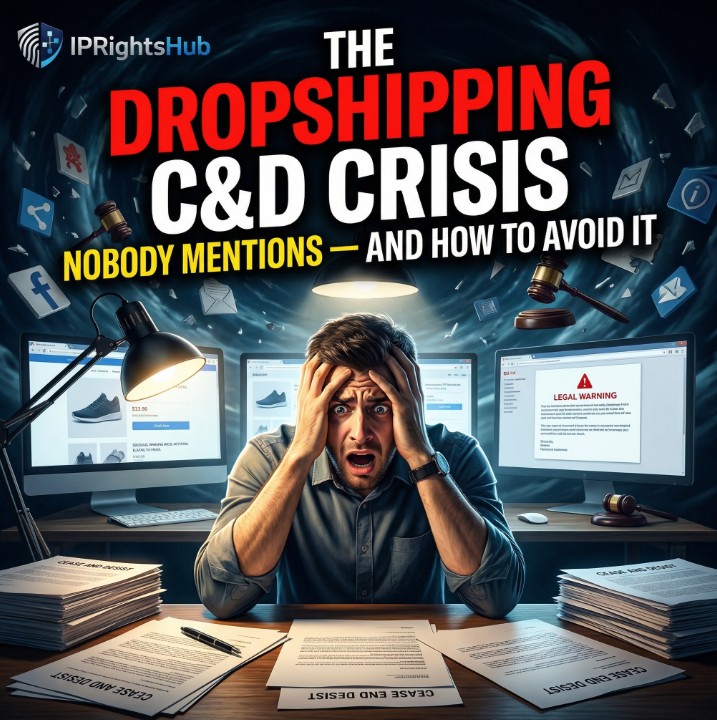
It's 2 AM. Your TikTok product is viral. You've hit $8k in orders in 48 hours. Margins are 40%. You're already daydreaming about the next product launch.
Then your email pings.
Advertisement
"CEASE AND DESIST — TRADEMARK INFRINGEMENT, TRADE DRESS VIOLATION, FALSE ADVERTISING"
The sender claims you copied their packaging. Or their photos. Or their exact product name. Your stomach drops.
Need help? Our tools can help you identify potential IP conflicts before they become costly problems. Try a free scan →
You have three options:
Advertisement
- Shut the product down immediately and lose the revenue you just tasted.
- Ignore it, hope they go away, and watch your ad account get disabled, your Shopify store flagged, and your PayPal frozen "within days."
- Rebrand the product, keep selling, and pray they don't escalate.
Nobody in the dropshipping space talks about what you actually do in that moment. And that's the real problem.
Dropshipping itself isn't dead. But the way most people have been taught to do it — copy the winning product, clone the lifestyle images, bid on the brand name in ads — is being systematically dismantled by automated IP enforcement, brand monitoring tools, and platform penalties that move at machine speed.
Advertisement
This isn't theory. This is happening right now to Shopify sellers launching their first viral product.
Need help? Our tools can help you identify potential IP conflicts before they become costly problems. Try a free scan →
Why Now? IP Enforcement Just Got Weaponized
For 15 years, dropshipping worked because brand enforcement was slow, expensive, and manual. A big DTC brand might have 3–5 lawyers handling hundreds of infringing stores. They'd pick the biggest ones. The rest escaped unnoticed.
Advertisement
That model is dead.
In 2024–2026, three things converged:
1. AI-Powered Image Matching (Automated Takedown)
Advertisement
Tools like Google Lens, TinEye, and brand-specific monitoring platforms now scan the internet in real time for copied product photos, packaging, and lifestyle imagery. When a brand sees their $50 product listed on Shopify for $19.99 using their exact photos:
- Automated DMCA bot fires immediately (within hours, not weeks)
- Platform (Shopify, TikTok, Facebook) gets the DMCA complaint
- Your listing is suspended before you even know it happened
Sellers are reporting that this happens before they see the C&D letter itself.
Advertisement
2. Full-Stack Consequences (Ad + Payment + Platform)
One decade ago: You got a cease and desist, you removed the listing, you moved on.
Need help? Our tools can help you identify potential IP conflicts before they become costly problems. Try a free scan →
Today: One infringing product cascades across your entire stack.
Advertisement
Real example from r/dropshipping:
"Not only did he get cease and desist letters pretty quickly, but also managed to get his ad account permanently disabled, PayPal closed down his account, and then Shopify started disabling his stores within days."
Why? Because once a brand files a DMCA takedown, it lands in databases that payment processors and ad networks subscribe to. Your account gets flagged automatically. Shopify sees the chargeback pattern. PayPal sees the dispute ratio spike. Facebook sees the DMCA notice in its system.
Advertisement
Your business doesn't just lose one product. It loses infrastructure.
Need help? Our tools can help you identify potential IP conflicts before they become costly problems. Try a free scan →
3. Brand Monitoring Is Commodity-Priced
Services like Brand.ai, Loom, and Tradewizard now cost $99–$300/month and scan millions of e-commerce listings daily. Every mid-market DTC brand uses at least one. When a brand sees 15 dropshippers selling their protected design:
Advertisement
- They don't pick one to sue. They file batch DMCA takedowns.
- They report to platforms in bulk.
- They deploy automated enforcement.
Dropshipping at scale is now visible at scale.
The Three Ways You Get C&D'd (And How They Each Feel Different)
Advertisement
Not all cease and desist letters are equal. The risk level depends on what you copied, and understanding which category you're in is the difference between a recoverable mistake and a business-ending escalation.
Type 1: Photo/Asset Copyright Infringement (Copyable? Yes)
What triggered it: You used the brand's Instagram photo, TikTok video, or product lifestyle shot as your product page image.
Advertisement
What they claim: Copyright infringement.
Likelihood of escalation: Medium. Photo takedowns are common but not all brands pursue them hard.
Need help? Our tools can help you identify potential IP conflicts before they become costly problems. Try a free scan →
What usually happens:
Advertisement
- Shopify removes the listing automatically (DMCA)
- You reupload with different photos (your own, or supplier generics)
- Business continues, different product or same product, new creative
Real costs: 3–7 days of revenue loss while you re-photograph or find supplier shots. Your Facebook ad account might get a warning.
Recovery path: Upload new product photos from supplier or hire a photographer for $20–50 on Fiverr. Relist the same product. Many sellers do this 2–3 times per product launch.
Advertisement
Type 2: Trade Dress / Packaging Design Infringement (Trickier)
Need help? Our tools can help you identify potential IP conflicts before they become costly problems. Try a free scan →
What triggered it: The product itself looks identical to the brand's version — same shape, same colors, same logo placement, same packaging language. You're selling the generic "white-label" version but presenting it as if it's the brand's design.
What they claim: Trade dress infringement, trademark dilution, false advertising.
Advertisement
Likelihood of escalation: High. Trade dress claims carry more legal weight.
What usually happens:
- DMCA takedown + listing suspension
- Cease and desist letter arrives (legal threat, not just platform notice)
- If you ignore: Facebook ad account disabled, PayPal holds funds, Shopify disables store
- If you comply: Product is dead, brand is marked as "avoid"
Advertisement
Real costs: Loss of the entire product. 5–10 days of business disruption. Possible temporary payment processor freeze.
Recovery path: Pivot to a genuinely different visual approach (different packaging, different product angle, or abandon the product entirely and move to the next).
Type 3: Trademark + Endorsement Confusion (Fatal)
Advertisement
What triggered it: You're bidding on their brand name in Google Ads. Or your product title says "As Seen On" their brand. Or your product description implies the brand endorses it. Or you're selling what looks like an official product but isn't.
What they claim: Trademark infringement, false advertising, and potentially unfair competition.
Need help? Our tools can help you identify potential IP conflicts before they become costly problems. Try a free scan →
Likelihood of escalation: Very high. This is the nuclear option for brands.
Advertisement
What usually happens:
- Multiple DMCA takedowns (across listings, ads, social)
- Cease and desist letter from a lawyer (not an automated email)
- Ad accounts suspended (Facebook, Google, TikTok all see the claim)
- Shopify disables your store for "violation of intellectual property terms"
- PayPal and Stripe freeze accounts (chargeback risk due to false endorsement)
Real costs: Permanent loss of the product. Possible loss of 2–3 stores. Funds frozen for 180 days. Brand becomes off-limits long-term.
Advertisement
Recovery path: Start fresh account. New email. New payment processor. New Shopify store. Accept that this brand is now a black box.
Need help? Our tools can help you identify potential IP conflicts before they become costly problems. Try a free scan →
The Dark Truth: What Gurus Don't Say About Their Case Studies
Every "I made $50k dropshipping in 30 days" case study conveniently launched 3–10 years ago.
Advertisement
Here's why that matters:
Many of those strategies would be shutdown within a week if launched today.
Example: The "Facebook movie clip product" (dropshipper finds a viral clip from a movie, adds a product, markets it to obsessed fans):
Advertisement
- 2015–2018: Worked great. You'd find a clip with 10M views, launch a related product, hit profitability in 3–5 days.
- 2019–2021: Getting riskier. Studios started monitoring for this exact pattern.
- 2024–2026: Movie studios now use automated copyright scanning. You get DMCA takedown before your first $100 in sales.
The issue: Gurus are still teaching 2015 tactics in 2026 markets.
The old game was: Find a winning product → Copy it exactly → Scale ads → Hope you cash out before getting caught.
Advertisement
The new game is: Find a product category with real demand → Create original creative → Keep your own visual identity → Scale carefully without IP red flags.
It's more work. But it's sustainable.
Need help? Our tools can help you identify potential IP conflicts before they become costly problems. Try a free scan →
How to Spot a High-Risk Product BEFORE You Get C&D'd
Advertisement
This is where most sellers fail: they don't evaluate IP risk until they receive the letter.
Use this framework before you spend $500 on ads:
Step 1: Check If the Product Has Strong Brand Ownership
Advertisement
Ask yourself:
Need help? Our tools can help you identify potential IP conflicts before they become costly problems. Try a free scan →
- Is there a dominant brand that owns this product design?
- Do they actively protect their IP (sue other sellers, file DMCA takedowns)?
- Is the product design distinctive (hard to copy naturally)?
How to research:
Advertisement
- Search the product name + "lawsuit" or "+ knockoff"
- Check if the brand has registered trademarks (USPTO TESS database)
- Look at their social media — do they talk about fakes?
- Google Image search the product — how many clones exist?
Red flags that mean SKIP:
- Branded products (Nike, Apple, Sony)
- Celebrity-endorsed products (any "As Seen On TV" type item)
- Patented designs (check USPTO)
- Products with distinctive packaging (hard to make "your own" version)
- Products where the brand actively pursues sellers (you'll see YouTube videos about C&D stories)
Advertisement
Step 2: Evaluate Your Sourcing Risk
If you're sourcing from AliExpress or generic supplier catalogs, the product is likely:
- Already listed by 50+ other dropshippers
- Already flagged by brand monitoring systems
- Already in enforcement queues
Advertisement
Lower-risk sourcing:
- Direct relationships with local/regional manufacturers (you control the design)
- Private label / white-label arrangements (supplier-approved, documented)
- POD/print-on-demand (you own the IP of the design)
- Exclusive distributor agreements (supplier gives you written permission)
Need help? Our tools can help you identify potential IP conflicts before they become costly problems. Try a free scan →
Higher-risk sourcing:
Advertisement
- AliExpress/DHgate mass suppliers
- Reverse-engineering copies
- Products sourced from other dropshippers' stores
- Anything you don't have supplier permission to resell
Step 3: Audit Your Creative (Before Launch)
Copyable elements (high risk):
Advertisement
- Product photos from brand or competitors
- Packaging or design mockups you didn't create
- Lifestyle photos showing the product in branded contexts
- Product titles that mention the brand or competitive positioning
- Ad copy that implies endorsement or direct comparison
Need help? Our tools can help you identify potential IP conflicts before they become costly problems. Try a free scan →
Original elements (low risk):
- Photos you took yourself
- Mockups your designer created
- Your own product description language
- Unique value positioning that doesn't reference competitors
- Audience-specific angles ("Best for engineers," "Tested by cyclists")
Advertisement
One-minute audit: Open your product page and ask: Could I point to this and prove I created every visual and every word? If not, reduce the risk.
What Actually Happens When You Get a C&D: The First 48 Hours
Let's say you've launched a product, it's getting traction, and a C&D arrives. Here's the real playbook:
Advertisement
Hour 1–2: Panic Pause (Normal)
You've received a formal letter claiming infringement. Your instinct is to panic-delete everything.
Don't do that yet.
Advertisement
Read the letter carefully. Note:
- What specific claims are they making? (trademark, copyright, trade dress, false advertising?)
- What action are they demanding? (stop selling, remove from ads, reimburse customers?)
- Who sent it? (automated DMCA notice, brand lawyer, or platform notice?)
- What's the deadline? (usually 10–30 days)
Need help? Our tools can help you identify potential IP conflicts before they become costly problems. Try a free scan →
Hour 2–6: Consult (If It Looks Serious)
Advertisement
If the letter is from a lawyer (not an automated system), and the claims are specific:
Get a 30-minute consultation with an IP lawyer, not a generalist.
Cost: $150–300 for 30 mins. Worth it to understand your actual exposure.
Advertisement
What to tell them:
Need help? Our tools can help you identify potential IP conflicts before they become costly problems. Try a free scan →
- The exact claims in the letter
- What you're selling and where you sourced it
- What creative you used (photos, packaging, text)
- Whether you have any permission from the supplier or brand
What they'll tell you:
Advertisement
- Whether the claims have legal merit (sometimes they don't)
- Whether responding is worth it (usually not; responding signals you're a real business and invites escalation)
- What the real risk is (do you have assets they can go after?)
Hour 6–12: Decision Point
Path A: Comply Immediately
Advertisement
- Remove the product listing
- Remove all ads
- Don't respond to the letter
- Wait 30 days to make sure there's no lawsuit
Pros: 90% of C&D threats end here. They got what they wanted.
Cons: Lost revenue on that product. Time wasted. Have to move to next product.
Path B: Pivot the Creative Only
Advertisement
- Keep the product, change all visuals
- Remove any mention of the brand
- Relaunch with totally different positioning
- Monitor for second C&D
Pros: Keep the product if demand is real.
Cons: If the product design itself is protected (trade dress), this doesn't solve it. Second C&D incoming.
Need help? Our tools can help you identify potential IP conflicts before they become costly problems. Try a free scan →
Path C: Ignore (Not Recommended)
Advertisement
- Do nothing
- Keep selling as-is
- Hope they don't escalate
Pros: Possible short-term revenue if it takes time for enforcement.
Cons: They almost always escalate. Ads get disabled, PayPal freezes funds, Shopify disables store. Not worth it.
Hour 12–48: Execution
Advertisement
If you choose Path A (comply): You stop selling, document it, and move on.
Need help? Our tools can help you identify potential IP conflicts before they become costly problems. Try a free scan →
If you choose Path B (pivot): You need new product photos or creative within 24 hours. This is where having a Fiverr designer on speed-dial saves you. $20–50 for new mockups or lifestyle photos, upload within hours, relaunch ads.
The goal: Get to a state where the claim doesn't apply anymore. If they can't point to the infringing element on your page, the C&D becomes moot.
Advertisement
The Real Dropshipping Landscape in 2026 (Honest Assessment)
Is dropshipping dead? No.
Is it exactly as easy as 2015 YouTube courses say? Absolutely not.
Advertisement
Here's what's actually happening:
What's Declining (The Old Model)
- Launching generic, low-quality products copied from top sellers
- Using competitor photos and creative without modification
- Bidding on competitor brand names in ads
- Selling products with heavy IP risk (branded, celebrity-endorsed, patented)
- Assuming one viral product will sustain you for months
Advertisement
What's Growing (The New Model)
- Private label products (you control the design)
- Niche products with underserved audiences (lower competition, less enforcement)
- High-ticket items ($100+, where margins allow for customer service and quality control)
- Building personal brand alongside product brand
- Selling into underserved geographic markets (EU, AU, CA where local suppliers dominate)
- Hybrid fulfillment (mix of dropshipping + POD + warehoused inventory)
Need help? Our tools can help you identify potential IP conflicts before they become costly problems. Try a free scan →
The difference: Old model = maximize volume, hope you cash out before the enforcement wave. New model = sustainable, slower growth, less legal risk.
Advertisement
The numbers: According to recent market research, the global dropshipping market reached $351.8 billion in 2024 and continues growing at 23.4% annually.
But that growth isn't coming from cookie-cutter Shopify stores copying TikTok trends. It's coming from:
- Suppliers automating fulfillment
- Brands expanding to dropshipping partners
- Regional suppliers entering global markets
- Integrated supply chain tech making it harder for bad actors
Advertisement
Takeaway: Dropshipping is maturing. The money is moving to people who treat it like a real business (sourcing, design, customer service, IP compliance) instead of a get-rich-quick hack.
Need help? Our tools can help you identify potential IP conflicts before they become costly problems. Try a free scan →
How to Protect Your Store (Operational Checklist)
Use this framework to reduce your C&D risk to near-zero:
Advertisement
Before You Launch Any Product
- Search the product + trademark in USPTO TESS database — is it registered?
- Google Image reverse search the product — how many clones exist?
- Check if the brand sues small sellers (Reddit, YouTube, Shopify forums)
- Confirm you have written permission from your supplier to resell (screenshots, email)
- Create 100% original product photos or hire a photographer
- Write original product description (don't copy competitor copy)
- Don't use any brand name in your product title (except generic category names)
- Don't bid on competitor brand names in ads
- Build a unique value prop that doesn't reference competitors
Ongoing Monitoring (After Launch)
Advertisement
- Set up Google Alerts for your product name + "cease and desist"
- Monitor your Shopify metrics for DMCA takedowns (check Notifications)
- Track your ad account health (policy violations, disabled campaigns)
- Respond immediately if Shopify flags your store (don't ignore notices)
- Keep supplier contact info and documentation on file (proof of permission)
- Have a backup Shopify account ready (don't put all eggs in one store)
If You Get Hit
- Don't panic-delete; read carefully what they're claiming
- Understand if it's automated (DMCA bot) or lawyer-sent (escalated)
- Get a 30-min consultation if it's lawyer-sent
- Comply or pivot the creative within 48 hours
- Document everything (keep the C&D, your response, any revised assets)
Advertisement
Frequently Asked Questions
Is dropshipping illegal?
Need help? Our tools can help you identify potential IP conflicts before they become costly problems. Try a free scan →
No. Dropshipping itself is perfectly legal. Selling counterfeit, unauthorized, or infringing products is illegal. The issue isn't the business model; it's the execution. If you're selling genuine products you have permission to resell, with original creative, you're fine.
Advertisement
How common are cease and desist letters for Shopify dropshippers?
More common than gurus admit, less common than pessimists claim. Based on r/dropshipping and Shopify community forums, roughly 5–15% of sellers who scale a product to $1k+/day will receive at least one C&D in their first 2 years. The rate is much lower if you follow the risk-reduction framework above.
If I get a cease and desist, do I have to shut down my store?
Advertisement
No. You have to address the specific claim in the letter. If they claim trademark infringement based on your product name, change your product name. If they claim copyright infringement based on photos, change your photos. If they claim trade dress infringement (the design itself), you probably need to pivot the product. Full store shutdown is rare unless you've been ignoring multiple notices.
Need help? Our tools can help you identify potential IP conflicts before they become costly problems. Try a free scan →
Can I sell the same product as a big DTC brand if I source it differently?
Legally? Maybe. Practically? It's risky. If the product design is trademarked or trade-dressed (distinctive shape, color, packaging), you can't sell an identical version and claim it's "your own." You can sell the same product category (e.g., portable phone chargers) but you need to make it visually distinct and not position it as similar to the brand's version.
Advertisement
What's the difference between dropshipping a generic product and dropshipping a branded product?
Generic (lower risk): Phone screen protectors, USB cables, phone cases. Generic category, no single brand owns it, many suppliers, competition is about price and quality.
Branded (higher risk): Anything positioned as "like the Dyson hairdryer but cheaper" or selling a celebrity-endorsed product or selling what looks like an official product but isn't.
Advertisement
Generic products have lower margins but way lower enforcement risk. Branded products have higher margins but higher C&D risk.
What happens if I ignore a cease and desist?
Usually (not always):
Advertisement
- Takedown escalates (DMCA → lawsuit threat)
- Ad networks get the complaint and disable your accounts
- Payment processors see the pattern and freeze funds
- Shopify disables your store
- You lose momentum and can't recover the account
Ignoring a C&D is rarely worth it. The cost of compliance (removing one product) is lower than the cost of escalation (losing accounts, time, reputation).
Need help? Our tools can help you identify potential IP conflicts before they become costly problems. Try a free scan →
Can I get my ad account back after a cease and desist shuts it down?
Advertisement
Depends on the platform and the claim. Facebook and Google rarely reverse account disables for IP violations. You can create a new account, but you'll be flagged by the same system if you repeat the behavior. If you've fixed the issue (removed the infringing product, changed creative, proved compliance), the new account often survives. If you immediately re-list similar products, it gets disabled again.
Is it true that dropshipping is "dead" because of Trump tariffs?
Tariffs make dropshipping more expensive, not impossible. A 25–60% tariff on Chinese goods raises your cost of goods by that percentage. That shrinks margins on low-ticket items ($5–15 cost base) dramatically. High-ticket items ($50+ cost base) are less affected. Dropshipping shifted upmarket, not died. The old "cheap gadget dropshipping" model is weakening; premium and niche dropshipping is growing.
Advertisement
The Takeaway: Play Long-Term
Need help? Our tools can help you identify potential IP conflicts before they become costly problems. Try a free scan →
Dropshipping isn't dead. It's harder, slower, and more professional now.
The winners in 2026 are:
Advertisement
- People who understand IP risk — they evaluate products before launch instead of after C&D
- People who build original creative — they don't rely on stealing competitor photos
- People who scale sustainably — they grow from $500/day to $5k/day over months, not weeks
- People who treat it like a business — they have supplier agreements, customer service, brand strategy, not just ads
The losers are still trying to play the 2015 game: find winner → copy exactly → scale fast → cash out.
That game is over.
Advertisement
The question isn't "Is dropshipping dead?" It's "Can you adapt to how it actually works in 2026?"
If you can — evaluate IP risk, create original assets, source responsibly, handle enforcement maturely — you can still build a 6–7 figure dropshipping business.
If you can't — if you're relying on copying and hoping — you'll spend your time and ad budget feeding the cease and desist machine.
Advertisement
The choice is yours. But now you know what you're actually up against.