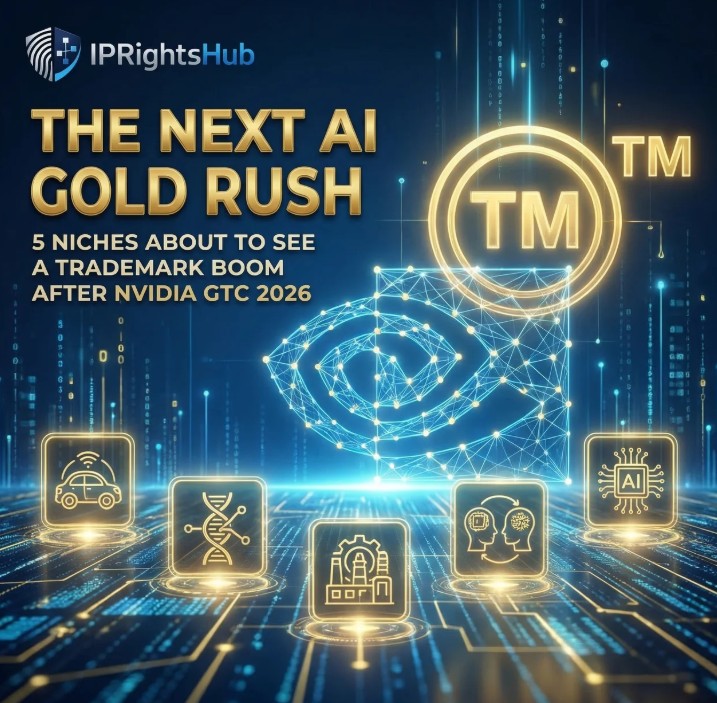
The Jensen Huang Effect: Why GTC Always Triggers a Naming Rush
Advertisement
Every year, NVIDIA's GTC conference does something that no legal brief or IP newsletter ever captures: it creates tens of thousands of new companies.
Not directly. But Jensen Huang walks out in his leather jacket, announces something seismic — $1 trillion in demand through 2027, humanoid robots commercially viable, agentic AI as "the new operating system" — and within weeks, the startup ecosystem reshuffles. New niches crystallise. Developer communities pivot. Venture money flows into categories that didn't have names six months ago.
Advertisement
And every single one of those new companies needs a brand name.
GTC 2026, held in San Jose from March 16–19, was the biggest signal yet. Huang declared the "inference inflection has arrived." He unveiled Vera Rubin, the next-generation chip architecture. He put Disney's Olaf robot onstage — powered by NVIDIA's Jetson and Isaac platform — as a demonstration that physical AI has crossed from research lab to entertainment and industrial reality. He announced Uber deploying NVIDIA-powered robotaxi fleets across 28 cities by 2028. He confirmed $150 billion in new venture investment flowing into AI-native startups in the past year — the largest in human history.
Need help? Our tools can help you identify potential IP conflicts before they become costly problems. Try a free scan →
That's not an AI boom. That's a naming crisis waiting to happen.
Advertisement
Here are the five niches that are about to generate the most trademark filings, the most brand collisions, and the most rebranding nightmares in Q2 and Q3 2026.
Niche 1: Agentic AI Platforms
This is the most immediately saturated space, and it's only getting worse.
Advertisement
At GTC 2026, Jensen Huang declared: "Every company in the world today needs to have an OpenClaw strategy." OpenClaw — NVIDIA's newly announced open-source framework for building AI agents — was described as "the open source operating system of agentic computers." Within hours, developer communities were forking it, building on it, and naming things on top of it.
Need help? Our tools can help you identify potential IP conflicts before they become costly problems. Try a free scan →
We've already seen where this leads. In early 2025, an Austrian indie developer launched an AI agent project called Clawdbot — a name combining "Claude" (Anthropic's LLM) with "claw." The project went viral in developer circles almost overnight. Days later, Anthropic's trademark team came calling. The name was too phonetically similar to "Claude," operated in the same AI software category, and the developer had to rename. Twice. The project became Moltbot, then OpenClaw (coincidentally, the same name NVIDIA just placed front-and-centre at GTC 2026). During the rebrand chaos, scammers hijacked the old social accounts within seconds of the name change going public.
This story is not an outlier. It's a preview.
Advertisement
With hundreds of agentic AI tools now launching weekly — all operating in the same Class 9 (downloadable software) and Class 42 (SaaS) trademark space, many using similar naming conventions like compound tech words, mythological references, or "AI/Agent/Forge" suffixes — the namespace is mathematically running out. The USPTO has already begun issuing Office Actions citing "Agentic" itself as a generic industry descriptor, which means startups trying to trademark names built around that word face rejection on descriptiveness grounds alone.
The naming collision patterns to watch: anything sounding like an existing major LLM brand (Claude, GPT, Gemini, Grok), any variation of OpenClaw/NemoClaw given NVIDIA's new positioning, and "agent + [generic noun]" constructions that are already crowded. NVIDIA's own Nemotron, Cosmos, and Isaac brands are now registered or pending — building anything adjacent to that family without a clearance search is a significant risk.
Niche 2: Humanoid Robotics
Advertisement
The humanoid robotics sector went from speculative to commercially viable at GTC 2026. NVIDIA's Isaac GR00T N1.7 — an open reasoning model purpose-built for humanoids — was declared "now commercially viable for real-world deployment." Goldman Sachs projects global humanoid robot shipments of 50,000–100,000 units in 2026 alone, growing toward a $38 billion market by 2035.
With Figure AI already at a $39 billion valuation, Tesla Optimus in factory deployment at BMW, Agility Robotics' Digit working in GXO warehouses, and dozens of YC-backed startups building humanoid infrastructure, the number of new companies naming, branding, and filing is accelerating fast.
The trademark problem in this niche is specific: everyone is reaching for the same naming pool. Greek and Latin mythology. Physics and astronomy terms. Action verbs suggesting strength or movement. The names Atlas, Nexus, Helix, Nova, Cosmos, Isaac, Titan, and Orion are either already registered, pending, or in active use across multiple overlapping classes. When Nio (the Chinese EV maker) recently filed to extend its AI voice assistant trademark "NOMI" into humanoid robots, it was a signal of how aggressively established players are pre-registering in this space before it matures.
Advertisement
OpenAI's own trademark filings in early 2025 already hinted at humanoid robots and smart wearables. Multiple automotive companies building level-4 autonomy on NVIDIA's Drive Hyperion platform — BYD, Hyundai, Nissan, Geely — will be launching branded humanoid and autonomous products that need IP protection across multiple jurisdictions simultaneously.
For any startup in this space, the multi-class problem is unusually acute. A humanoid robotics company typically needs protection in Class 7 (industrial machines), Class 9 (software and firmware), and Class 42 (AI SaaS) simultaneously — and potentially Class 40 (manufacturing services) if they're building robot-as-a-service models. Most trademark guidance online treats this as a simple "file in Class 9" situation, which is dangerously incomplete.
Need help? Our tools can help you identify potential IP conflicts before they become costly problems. Try a free scan →
Niche 3: Sovereign AI Infrastructure
Advertisement
This is the niche that almost nobody in the IP community is talking about, yet it may generate the most filings over the next 18 months.
At GTC 2026, sovereign AI was everywhere. Nations across the EU, Middle East, and Asia are investing over $100 billion annually into domestic AI factories — data centres and inference infrastructure that operates under national rather than US-hyperscaler control. NVIDIA's Feynman architecture includes "sovereign-grade" security features by design. Germany's TechQuartier is running a "Sovereign Supercharged Sandbox" platform. France, Singapore, Japan, Brazil, and India all have active sovereign AI model development underway using NVIDIA's open Nemotron framework.
Every one of these national AI initiatives produces product names, platform brands, and model family names that need trademark protection — in their home jurisdiction and often internationally. The cross-border complexity here is unlike anything in a standard SaaS startup's IP playbook.
Advertisement
A startup building AI infrastructure for government clients faces a different trademark landscape than a B2C app. Their names need to clear not just USPTO but EUIPO, UKIPO, and national registers in target markets. The Madrid Protocol provides a mechanism for this, but the strategic question of which classes to file in, and in which order, for an AI product that spans sovereign cloud infrastructure, security tooling, and agentic software simultaneously, is one that generic trademark guides don't address.
Need help? Our tools can help you identify potential IP conflicts before they become costly problems. Try a free scan →
The naming collision pattern here is different too. Sovereign AI companies tend to use national language references, geographic identifiers, and terms suggesting security, sovereignty, or national alignment. These create a unique conflict zone where a company building a "national AI" product in one country may be stepping on similar marks filed defensively by competitors in adjacent markets.
Niche 4: AI Drug Discovery and Synthetic Biology
Advertisement
The healthcare and life sciences sector's AI moment is, in Jensen Huang's own words, a "transformer moment for biology." NVIDIA's BioNeMo platform — announced and expanded at GTC 2026 — provides foundation models for biomedical research. Novo Nordisk, Viva Biotech, and Manifold Bio are listed as launch partners. NVIDIA's Inception program now has over 5,000 healthcare and life sciences startups enrolled, with the startup ecosystem capturing over 85% of healthcare AI spending.
The trademark urgency in this niche comes from a specific dynamic: biotech and pharma companies have historically been among the most aggressive trademark filers in the world. They file early, they file broad, and they litigate. An AI drug discovery startup entering this space is not just competing with other AI companies for namespace — they're entering an IP environment shaped by decades of aggressive pharmaceutical brand strategy.
The naming conventions don't help. AI biotech startups gravitate toward names suggesting intelligence, biology, precision, and molecular action — words like "helix," "nexus," "synapse," "atlas," "nova," "manifest," "viva," and "genesis" are all either in active use or registered across pharmaceutical, biotech, and now AI software classes. The overlap between Class 5 (pharmaceuticals), Class 9 (AI software), and Class 42 (research SaaS) creates a collision zone unlike any other sector.
Advertisement
There's also a specific AI-generated asset problem here. Startups using AI tools to generate their company names and logos face an additional layer of risk: generative systems are trained on existing data and tend to produce names and visual styles that echo existing marks. A biotech startup that used an AI naming tool and an AI logo generator, then launched without a professional clearance search, faces compound exposure — potential infringement and potential inability to register their own assets because they lack provable human creative authorship in the design elements.
Niche 5: Autonomous Vehicle and Robotaxi Platforms
The autonomous vehicle space got a major GTC 2026 push. Uber and NVIDIA confirmed a robotaxi fleet deployment across 28 cities on four continents by 2028. Nissan, BYD, Hyundai, Geely, and Isuzu are all building level-4 autonomous vehicles on NVIDIA's Drive Hyperion program. The Alpamayo 1.5 model handles video, ego-motion, and natural language for full autonomy.
Advertisement
For the AI startup layer — the companies building software, safety systems, sensor fusion, data pipelines, fleet management, and passenger interfaces on top of this infrastructure — the trademark landscape is intensely competitive and rapidly crowding.
The specific risk here is the combination of physical product naming (the vehicle, the robot, the platform) with software branding (the app, the agent, the interface) in a regulated environment. Autonomous vehicle companies operate across Class 9, Class 12 (vehicles), Class 38 (telecommunications/connectivity), and Class 42. The interaction of these classes, combined with the international nature of deployment (a San Francisco robotaxi company is commercially active in Germany the moment a German user books through their app), means that "file in your home country and expand later" is not a viable strategy.
Need help? Our tools can help you identify potential IP conflicts before they become costly problems. Try a free scan →
The OpenAI vs "Open AI" case — where a US District Court judge in 2025 permanently barred a smaller company from using "Open AI" and the open.ai domain after OpenAI had established brand recognition — is the closest precedent this sector has for what happens when a late-mover, even one with earlier domain registration, runs into a better-resourced company's trademark enforcement. The same dynamic is playing out in the AV space, just more quietly.
Advertisement
The Patterns Every Founder Should Recognise
Across all five of these niches, a few consistent failure modes show up in the research and in real cases.
The domain trap. Founders check domain availability and assume brand safety. They're not the same. Owning [yourname].ai does not create trademark rights, does not block a third party from registering the same word in Class 9 or 42, and — as the OpenAI ruling showed — can actively work against you in litigation if a larger competitor establishes brand recognition under the same name.
Advertisement
The descriptive name trap. Names containing "AI," "Agentic," "GenAI," or functional descriptors are increasingly difficult to register. The USPTO has already begun treating "Agentic" as a generic industry term. A startup that builds its identity around a descriptive name, invests in branding, raises funding, and then discovers the name is unregistrable or already defended by someone else is looking at a rebrand at the worst possible time.
Need help? Our tools can help you identify potential IP conflicts before they become costly problems. Try a free scan →
The AI-generated name trap. Generative naming tools are trained on existing brand data. They produce names that feel distinctive but are frequently phonetically or visually similar to existing marks. They also create ownership questions — if your logo was entirely generated by an AI tool, the copyright position may be complicated, which can affect downstream trademark registration.
The single-class filing trap. An AI startup building a product that spans downloadable software (Class 9), SaaS (Class 42), and physical hardware or robotics (Class 7 or 12) needs protection in all relevant classes — not just the one that seemed most obvious. Filing in Class 42 alone for a product that ships hardware leaves you exposed on the physical product side.
Advertisement
The delay trap. In US trademark law, an "Intent-to-Use" application allows you to establish priority before you've launched or generated revenue. The number of founders who discover this mechanism after a competitor files under the same name is substantial. In fast-moving niches like the ones GTC 2026 just turbocharged, the window between "this niche is emerging" and "this niche's namespace is saturated" is now measured in weeks, not years.
What Q2 2026 Looks Like From Here
The $150 billion venture investment figure Jensen Huang cited at GTC 2026 is not evenly distributed. It's concentrated in the exact five niches above. Agentic AI, humanoid robotics, sovereign AI infrastructure, AI biotech, and autonomous vehicles are where the capital is flowing, where the YC and a16z logos are appearing, and where the GTC stage appearances are happening.
Advertisement
That same concentration is what makes the trademark situation acute. Five thousand plus healthcare AI startups, hundreds of agentic AI platforms, dozens of humanoid robotics companies launching commercially — all reaching for similar names, all operating in overlapping trademark classes, all launching fast because speed is the primary competitive signal in this environment.
The Clawdbot story — an indie developer who went viral, got hit with a C&D, renamed twice, had his accounts hijacked, and then ended up on a GTC stage — is not a cautionary tale about being careless. It's a story about how fast things move when a niche heats up. The developer was caught in the blast radius of someone else's established trademark. It cost him months and goodwill he'd built in a community.
For founders building in any of these five niches right now, the question isn't whether to think about trademarks. It's whether to think about them before launch or after traction — and the evidence from the past 18 months is pretty clear on which timing tends to work out better.