The Name That Cost a Café Its Signature Drink
Advertisement
In 2016, Coffee Culture Café & Eatery — a Canadian chain with locations in New York — launched a blended iced beverage it called the "Freddoccino." The drink quickly became one of its bestsellers, reportedly accounting for a significant portion of in-store revenue.
Starbucks did not think it was a compliment.
Advertisement
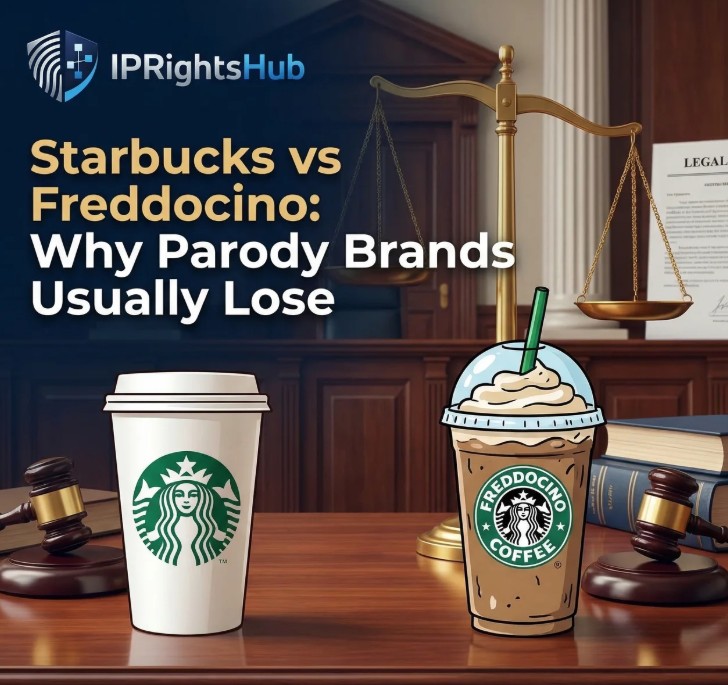
The coffee giant filed a federal lawsuit alleging that "Freddoccino" infringed its trademark on "Frappuccino" and that the branding created a likelihood of confusion among consumers. What followed became a textbook case in why parody brands — even clever, clearly joke-intended ones — almost always lose when they compete commercially in the same space as the famous mark they're riffing on.
Background: The Frappuccino Mark and Why It Has Unusual Strength
Need help? Our tools can help you identify potential IP conflicts before they become costly problems. Try a free scan →
Starbucks acquired the Frappuccino trademark in 1994 when it purchased The Coffee Connection. The mark has since become one of the most commercially recognised beverage trademarks in the world, registered across dozens of categories globally.
Advertisement
Under U.S. trademark law, famous marks like Frappuccino receive a category of protection beyond standard infringement: dilution protection. This matters enormously. Dilution claims do not require Starbucks to prove consumers are confused — only that the allegedly infringing mark tarnishes or blurs the distinctiveness of the famous one. That is a substantially lower bar, and it is the bar Coffee Culture was measured against.
The Dispute: What Made "Freddoccino" a Legal Target
According to Starbucks' filing, the company alleged that the "Freddoccino" mark shared multiple characteristics that made confusion likely and dilution arguable:
Advertisement
- Phonetic structure: Both names begin with "Fr–", contain four syllables, end in "–ccino," and aurally evoke a European-style cold coffee beverage.
- Product category overlap: Both marks were applied to blended iced coffee drinks — the same product category, sold in café environments.
- Commercial positioning: According to Starbucks' claims, the Freddoccino was marketed and presented in a way consistent with its commercial premium coffee positioning, not as an obvious joke or satirical commentary on Starbucks.
- Packaging signals: Starbucks alleged that branding elements on the Freddoccino product — including what the filing characterises as a fake ™ symbol — further blurred the lines rather than clarifying parody intent.
Need help? Our tools can help you identify potential IP conflicts before they become costly problems. Try a free scan →
This last point is critical. A parody defense in trademark law requires that the mark simultaneously evoke the original and clearly distance itself from it. By allegedly using a mark symbol and deploying the Freddoccino within the same product vertical with similar aesthetics, Coffee Culture's branding arguably failed the second half of that test.
Key Legal Issues: Why Parody Failed Here
Advertisement
1. The Source Identifier Trap
This is the issue no one explains clearly, and it's the one that kills most commercial parody defenses.
Trademark law does not protect creative expression — it protects consumers from confusion about the source of goods. The moment a parody mark is used to identify the source of a commercial product, it is functioning as a trademark, not as commentary. And the moment it functions as a trademark, First Amendment parody protections largely evaporate.
Advertisement
A 2023 Supreme Court decision — Jack Daniel's Properties, Inc. v. VIP Products LLC — reinforced this principle explicitly. The Court held that when a mark is used as a source identifier for commercial goods, it does not receive special First Amendment protection simply because it is humorous or parodic. This ruling confirmed the trajectory that the Freddoccino case exemplified: comedy does not neutralise commercial use.
2. Same Category, Same Consumer
Courts applying the likelihood-of-confusion test weight product proximity heavily. A parody of Frappuccino used on, say, a comedy T-shirt or a satirical magazine is categorically different from a parody mark used on a blended iced coffee drink sold in a café.
Advertisement
When the parody product and the original product compete for the same consumer in the same purchase context, the "obviously a joke" argument becomes much harder to sustain. The consumer standing in a queue at Coffee Culture is in the same mindset as a Starbucks customer — they are choosing a coffee drink, not consuming satire.
3. Famous Mark Dilution: No Confusion Required
Need help? Our tools can help you identify potential IP conflicts before they become costly problems. Try a free scan →
Because Frappuccino qualifies as a famous mark under the Trademark Dilution Revision Act, Starbucks did not need to prove that consumers were actually confused. The dilution claim stands on the argument that even association between Freddoccino and Frappuccino — even subconscious brand blurring — harms the distinctiveness of the original mark.
Advertisement
This is the multiplier that founders consistently underestimate when they parody major consumer brands. Standard infringement requires confusion. Dilution only requires proximity to a famous mark in a way that blurs its uniqueness. These are meaningfully different standards, and the second one is far easier for a major brand to argue.
The Outcome: A Quiet Rebrand
The case did not reach a full trial ruling. According to available records, Coffee Culture ultimately dropped the Freddoccino name as part of what the parties characterised as a resolution of the dispute. The exact terms were not publicly disclosed, which is typical of trademark settlements involving brand compliance rather than large financial damages.
Advertisement
The practical outcome: Coffee Culture had to rename one of its most commercially successful drinks, reprint menus, potentially adjust packaging, and absorb the legal costs of responding to a federal complaint — all without a single ruling ever confirming they were legally in the wrong.
Need help? Our tools can help you identify potential IP conflicts before they become costly problems. Try a free scan →
This is how parody brands usually lose. Not in court. Before it.
Dumb Starbucks: The Case That Confuses Everyone
Advertisement
In 2014, comedian Nathan Fielder opened a pop-up coffee shop in Los Angeles called "Dumb Starbucks" for an episode of his TV series. The store used Starbucks' logo, green colour scheme, and store format — but added the word "Dumb" to everything.
Starbucks did not sue. The store was ultimately closed by the Los Angeles County Health Department over a permit issue, not by Starbucks' legal team.
Many founders read this and conclude: add a modifier, you're fine. That is the wrong lesson.
Advertisement
Dumb Starbucks survived Starbucks' lawyers for a very specific set of reasons that are nearly impossible to replicate in a commercial context:
- It was explicitly part of a TV production, giving it expressive/artistic framing
- It operated for days, not months or years
- It sold no food or coffee for money — the products were given away as "free samples," with the legal argument that the store itself was the "artwork"
- Fielder's team had legal counsel who constructed the parody framing deliberately and carefully
A café that names a menu drink "Freddoccino" and charges £5.50 for it across four locations for years does not share any of these characteristics. The commercial scale, the commercial intent, and the commercial duration all work against the parody defense.
Advertisement
What This Means for Founders
If you are considering a brand name, product name, or menu item that riffs on a famous trademark, here is the honest assessment the research and case history supports:
Need help? Our tools can help you identify potential IP conflicts before they become costly problems. Try a free scan →
High-risk signals — all present in the Freddoccino case:
Advertisement
- The name shares syllable count, sound pattern, or ending with a famous mark
- Your product directly competes in the same category as the famous mark
- The mark is used commercially and continuously, not as a one-time stunt
- The branding does not actively, visually, and verbally disclaim affiliation
Lower-risk territory — what successful expressive parodies have in common:
- Non-competing product category (dog toys, not whiskey; artwork, not coffee)
- Temporary or stunt-based deployment with clear artistic context
- Active and prominent distancing from the original in the presentation itself
- No use of the mark as a commercial source identifier
Advertisement
The practical reality: even if your parody defense would eventually succeed in court, the litigation cost of getting there against a major brand is typically $150,000–$500,000+ in legal fees. Most indie founders cannot sustain that. The lawsuit itself is the penalty, regardless of the outcome.
Need help? Our tools can help you identify potential IP conflicts before they become costly problems. Try a free scan →
IP-SAM™ Insight: How This Risk Gets Detected Early
The Freddoccino situation is precisely the type of conflict IP-SAM™ is built to flag — ideally before a product name reaches menus, packaging, or marketing spend.
Advertisement
IP-SAM™ continuously monitors trademark filings, brand registrations, and similarity signals across categories. For a mark like "Freddoccino" being considered in the food and beverage space, IP-SAM™ would surface:
- Phonetic similarity alerts — the shared "Fr–" opening, four-syllable structure, and "–ccino" ending against registered marks in Class 30 and 43 (food products and café services)
- Famous mark proximity flags — Frappuccino's registration status and fame-tier would trigger elevated risk scoring, not standard infringement scoring
- Category overlap detection — same-product-category deployment would move the risk rating from amber to red
The goal is not to replace legal counsel — it is to give founders the signal they need to ask the right question before the menu is printed, not after the federal filing arrives.
Advertisement
This case analysis is for educational and informational purposes only. It does not constitute legal advice and should not be relied upon as such. All allegations referenced are claims made by the respective parties and have not necessarily been proven or ruled upon by any court or regulatory body. For trademark protection guidance specific to your situation, consult a qualified IP attorney.
Case status and outcomes may change. IPRightsHub may update case analyses where material developments occur.
Powered by IP-SAM™ — Real-time IP risk intelligence for founders.