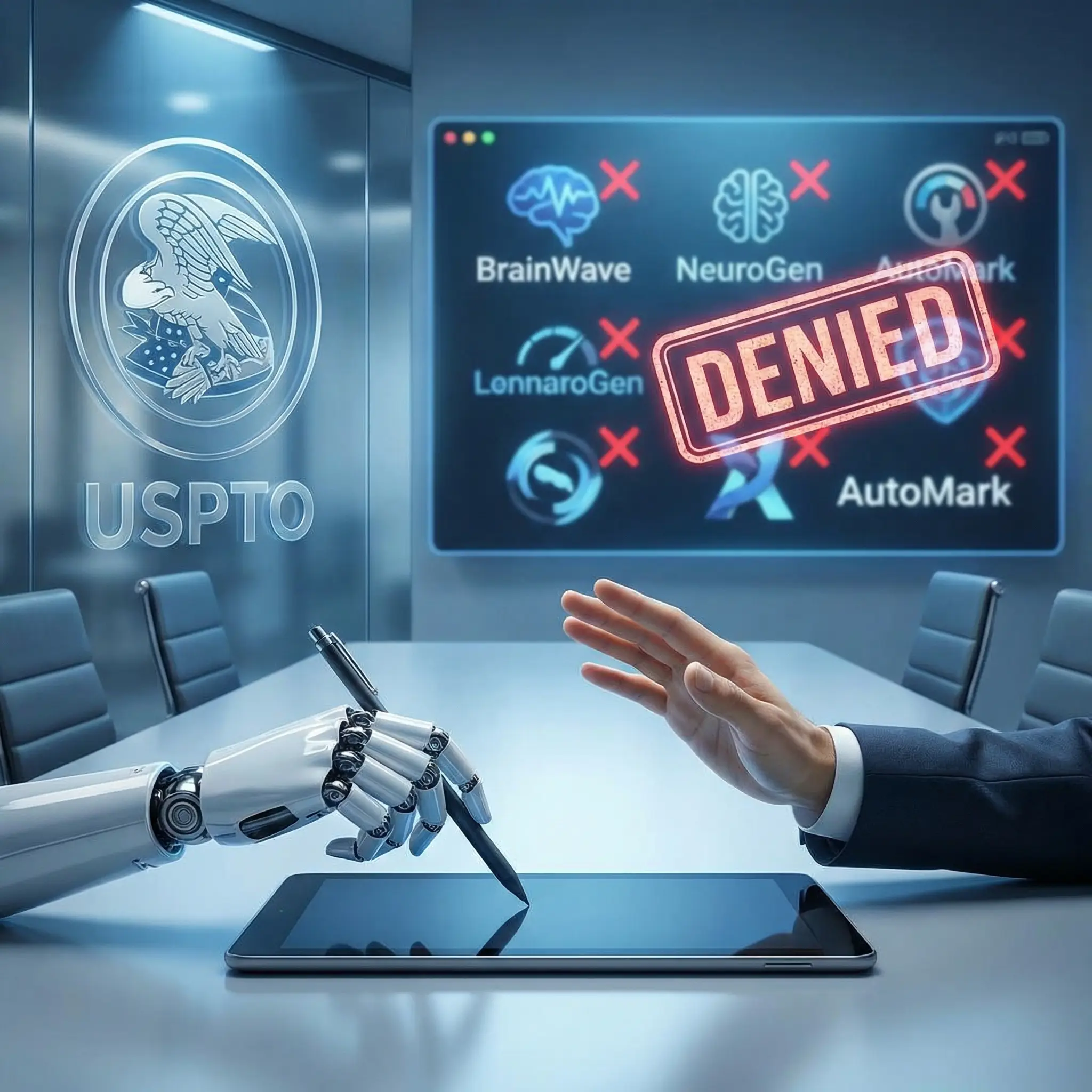
Why AI-Generated Brand Names Keep Getting Rejected by the USPTO (With Real 2025 Examples)
Advertisement
Founders are using AI tools to name their businesses faster than ever. ChatGPT, Claude, Namelix, Brandmark — you describe your product in a sentence and get a list of names in seconds. It feels like a cheat code.
Then, eight months after filing a trademark application, the USPTO sends back an office action. Rejected. "Merely descriptive." Or: likelihood of confusion with an existing mark. Or both.
Advertisement
This is happening at scale right now — and the reason is worth understanding before you spend $350 on a filing fee, let alone build a brand around a name.
The short version: the USPTO doesn't reject names because AI generated them. It rejects them for the same reasons it always has. The problem is that AI tools, by design, are almost perfectly optimized to produce names that fail those exact tests.
Need help? Our tools can help you identify potential IP conflicts before they become costly problems. Try a free scan →
What Actually Gets a Trademark Rejected
Advertisement
The USPTO evaluates every trademark application on a set of long-established legal standards. The two most common rejection reasons are:
1. Merely descriptive (Section 2(e)(1))
A name can't be trademarked if it simply describes what the product does, what it contains, or what it's for. "Fast Invoice App" for an invoicing app is descriptive. So is "CloudStore" for cloud storage software. The logic is fair: you can't monopolize words that every competitor needs to describe their product.
2. Likelihood of confusion
If your proposed mark is too similar to an already-registered trademark — phonetically, visually, or conceptually — in a related category, the USPTO will refuse it. Similar enough doesn't mean identical. Examiners have broad discretion here.
Advertisement
Neither of these is new. Neither targets AI. But here's what's new: millions of founders are now using tools specifically designed to produce names that describe their products clearly and memorably — and those are precisely the names trademark law rejects.
Need help? Our tools can help you identify potential IP conflicts before they become costly problems. Try a free scan →
The Mechanism Nobody Explains
AI naming tools are trained on massive datasets of existing brand names, product descriptions, and naming conventions. Their job is to predict what name fits a given product. "Fitting" is the goal.
Advertisement
That's the problem.
Ask an AI to name a fast project management app and it'll give you things like: FlowTask, Sprintly, SwiftProject, TaskFlow, AgileHub. These feel great. They're clean, modern, easy to say. They clearly communicate what the product does.
That's exactly what makes them unregistrable.
Advertisement
Under trademark law, the most protectable names are the ones that don't describe the product at all. "Apple" for computers. "Amazon" for retail. "Slack" for team messaging. These names are arbitrary — they have nothing to do with what the product does, which makes them stronger as source identifiers.
The spectrum runs like this, from strongest to weakest for trademark purposes:
- Fanciful — invented words with no prior meaning (Kodak, Xerox, Häagen-Dazs)
- Arbitrary — real words used in unrelated contexts (Apple, Amazon, Stripe)
- Suggestive — hints at the product without describing it (Netflix, Airbnb, Lyft)
- Descriptive — directly describes a feature or quality (high rejection risk)
- Generic — the common name for the product itself (unregistrable)
Advertisement
AI naming tools cluster their outputs around the suggestive-to-descriptive range because that's where human branding intuition lives. It's not a flaw in the tools — it's what they're built to do. The issue is that "sounds like a good brand name" and "can be legally registered as a trademark" are two very different standards.
OpenAI Couldn't Even Trademark Its Own Name
Need help? Our tools can help you identify potential IP conflicts before they become costly problems. Try a free scan →
The most concrete example of this problem happening to a real company — arguably the most recognizable AI company on earth — is OpenAI's trademark applications for "GPT" and "ChatGPT."
Advertisement
In May 2025, the USPTO rejected OpenAI's application to register "GPT" as a trademark. The reasoning: GPT (Generative Pre-trained Transformer) had become a generic term used across the industry to describe a category of AI models, not a unique brand identifier. Competitors, open-source projects, and researchers all use "GPT" to describe their own technology. OpenAI popularized the term, but that very popularity made it impossible to own.
Shortly after, the USPTO also issued a final refusal on "ChatGPT," finding it merely descriptive under Section 2(e)(1). The examiner's reasoning: "ChatGPT" directly describes the product — a chat interface powered by GPT technology. It tells you exactly what it is. Which means it can't function as a source identifier for trademark purposes.
OpenAI appealed the ChatGPT rejection to the Trademark Trial and Appeal Board (TTAB), arguing the name has acquired distinctiveness through its massive market presence. The TTAB decision is still pending. But the underlying lesson stands: even global brand recognition doesn't automatically fix a descriptive naming problem.
Advertisement
For a startup founder with no marketing budget and no five-year use history to lean on, the calculus is even harsher.
Need help? Our tools can help you identify potential IP conflicts before they become costly problems. Try a free scan →
The Specimen Trap Most Founders Miss
There's a second, less-discussed way AI creates trademark filing problems — and this one can get an application rejected and flag potential fraud.
Advertisement
When you file a trademark application with the USPTO (particularly an "in use" application), you're required to submit a specimen showing the mark being used in commerce. Think: a product label, a website screenshot with the mark displayed, packaging.
Many founders are submitting AI-generated mockup images as their specimens. The USPTO has explicitly stated that AI-generated images cannot serve as specimens of use because they don't reflect real-world commercial activity. If the product doesn't actually exist yet, the specimen has to reflect that. Submitting an AI-rendered product image as proof of real use is considered a misstatement of fact — which triggers the USPTO's duty of candor rules and, in serious cases, can constitute fraud.
This isn't a fringe scenario. It's happening because design-forward AI tools make it trivially easy to generate photorealistic product mockups that look exactly like what a specimen should look like. The problem is they're not real.
Advertisement
What to Do Before You File Anything
The fix isn't to stop using AI tools for naming. It's to understand what you're actually getting from them — brainstorming material, not filing-ready trademarks — and run the output through a distinctiveness filter before you invest in the name.
Check where your name falls on the spectrum. Before you get attached to a name, ask: does this name describe my product's features, function, or quality? If the answer is yes — even partially — you're in risky territory. Names that hint at what you do without describing it directly (suggestive) are your sweet spot.
Advertisement
Run a real TESS search — but don't stop there. The USPTO's Trademark Electronic Search System only shows exact and close matches you explicitly search for. Examiners look at phonetic similarities, conceptual similarities, and related-category conflicts that a basic keyword search won't surface. A name that looks clear on TESS can still fail examination.
Don't use AI-generated images as specimens. If you're filing an "in use" application, your specimen needs to show the mark on a real product, real packaging, or a real website. Screenshots of an actual live site work. AI mockups don't.
Need help? Our tools can help you identify potential IP conflicts before they become costly problems. Try a free scan →
Consider intent-to-use filings if the product isn't launched yet. A 1(b) intent-to-use application lets you establish your filing date without needing to show use immediately. You'll still need to submit an actual specimen later, but it protects your priority date while you build.
Advertisement
The name doesn't have to be meaningless — it has to be non-descriptive. Arbitrary and fanciful names are strongest, but plenty of suggestive names get registered. The test is whether a consumer would need to use imagination or thought to connect the name to the product. If the connection is immediate and obvious, the name is probably descriptive.
The Bigger Shift Happening Right Now
The USPTO is not standing still on AI. In January 2025, the office released an AI Strategy explicitly addressing how AI tools affect trademark examination and IP policy. One outcome: as the office adopts more AI-powered examination tools, borderline applications — especially those with generic prompts producing weak, descriptive names — are expected to face more scrutiny, not less.
Advertisement
The AI era is creating a naming crisis in slow motion. Founders are generating brand names faster than ever. The names sound good. They test well with audiences. And a significant percentage of them will fail the legal standard that's been in place since the Lanham Act was written in 1946.
Need help? Our tools can help you identify potential IP conflicts before they become costly problems. Try a free scan →
Understanding that gap — between "name that resonates" and "name that registers" — is the most practical IP education a founder can get before launch.
Not sure if your brand name has what it takes to pass USPTO examination? Use IPRightsHub's free trademark similarity scanner to check for existing conflicts before you file.