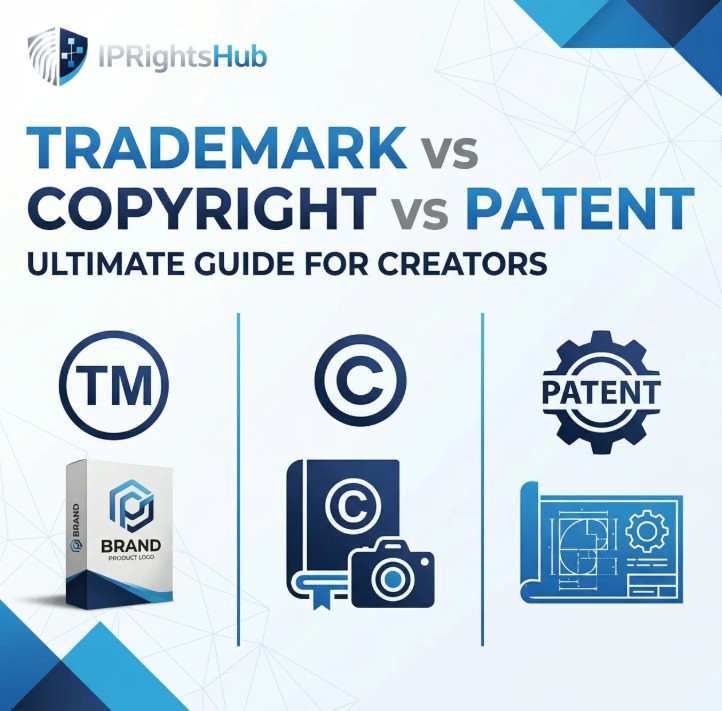
Most articles about trademark, copyright, and patent will give you three clean definitions and call it done. You'll learn that trademarks protect brand identifiers, copyright protects creative expression, and patents protect inventions. And you'll close the tab still not knowing what to do with your logo, your app name, your game mechanic, or your merch line.
Advertisement
This guide is built differently. It starts from your assets — the actual things you've built or are building — and maps each one to the protection it actually needs. Including the overlaps, the timing questions, and the edge cases every other guide skips.
The Three Types of IP Protection (Plain English)
Advertisement
Before the decision logic, here are the definitions. Short, quotable, and precise.
Copyright protects original creative expression. The moment you create something original and fix it in a tangible form — write it, record it, code it, draw it — copyright exists automatically. You don't file for it. You don't register it. It's yours.
Need help? Our tools can help you identify potential IP conflicts before they become costly problems. Try a free scan →
Copyright covers: written content, artwork, music, video, code, photographs, graphic design, and any other original creative output. It does not cover ideas, concepts, facts, titles, names, or slogans.
Advertisement
Trademark protects brand identifiers used in commerce. A trademark is any word, phrase, logo, symbol, or combination that distinguishes the source of goods or services. Unlike copyright, trademark rights are earned through use — specifically, use in commerce. Registration with your national trademark office (UK IPO, USPTO, EUIPO) strengthens your rights and makes them publicly searchable, but common law trademark rights exist from the moment you start using a mark in the market.
Trademark covers: brand names, logos, slogans, product names, domain names used as brand identifiers, and in some cases distinctive packaging or product shapes. It does not cover generic terms, purely descriptive phrases (before they acquire distinctiveness), or inventions.
Patent protects novel, non-obvious inventions. A patent gives you a time-limited monopoly on how something works — a process, a machine, a composition of matter, a method. In exchange, you publicly disclose the invention. Patent protection requires filing an application, examination, and grant — it doesn't arise automatically.
Advertisement
Patents cover: new mechanisms, functional methods, chemical formulas, manufacturing processes, and in some jurisdictions, software methods that produce a technical effect. They do not cover abstract ideas, laws of nature, naturally occurring substances, or pure algorithms (with important caveats for software).
Need help? Our tools can help you identify potential IP conflicts before they become costly problems. Try a free scan →
Why the Definitions Alone Don't Help
Here's the real problem. Most creators aren't building one type of asset. They're building a brand that includes all of the following at once:
Advertisement
- A name (brand identity)
- A logo (both artwork and brand identifier)
- Written content (guides, posts, documentation)
- Code or product functionality (a novel method or process)
- Packaging or product design (potentially both protected and protectable)
Each layer of that stack potentially falls under a different IP category. And the definitions don't tell you which protection to prioritise, how much each costs, or what you actually lose if you skip a step.
That's what the rest of this guide covers.
Advertisement
What You Already Own (Without Filing Anything)
Before spending a pound or dollar on IP registration, know what you already have.
You already own copyright on everything original you've created and fixed in tangible form. Your blog posts, your app's source code, your brand illustrations, your product photography, your written documentation. Copyright is automatic. You don't need to mail yourself anything (that "poor man's copyright" idea has no legal standing). You don't need to register.
Advertisement
What you gain from copyright registration (in the US, UK, and most jurisdictions): a public record of ownership, the ability to sue for statutory damages (US only), and a stronger position if a dispute ends up in court. Registration is cheap — around £30–£90 in the UK, $45–$65 in the US — and worth doing for any asset you expect to have commercial significance.
You may already have common law trademark rights if you're actively using a brand name or logo in commerce. Selling a product, offering a service, running a website with customers — these create common law trademark rights in the geographic area where you're trading. They're not listed on any register, and they're harder to enforce, but they exist.
Need help? Our tools can help you identify potential IP conflicts before they become costly problems. Try a free scan →
What you don't yet have: the national priority date that comes with trademark registration, the ability to block imports at the border (UK/US), or the presumption of nationwide ownership that a registered trademark gives you.
Advertisement
The Overlap Everyone Gets Confused By: Logos
A logo is the most common example of an asset that lives in two IP categories simultaneously.
Your logo is automatically copyrighted the moment your designer (or you) creates it — it's original artistic work. That copyright belongs to whoever created it. If you hired a freelancer and didn't include a work-for-hire clause or IP assignment in your contract, the designer owns the copyright, not you. That's not a hypothetical risk — it's a common problem.
Advertisement
Your logo can also be trademarked as a brand identifier. This is a separate right. Trademark registration protects the logo in connection with specific goods or services. Copyright protects the artistic work itself.
Need help? Our tools can help you identify potential IP conflicts before they become costly problems. Try a free scan →
In practice, you want both. The copyright stops people copying the design. The trademark stops people using a confusingly similar logo in your market, even if theirs looks different enough to avoid copyright infringement.
Action point for founders: If you had a freelancer design your logo, get an IP assignment in writing before you register anything. Otherwise you may be building a trademark on top of IP you don't fully own.
Advertisement
The Overlap Nobody Talks About: Software
Software sits at the messiest intersection of IP law. Here's how it actually works.
Your source code is copyrighted automatically. The code itself — the specific expression — is protected as a literary work from the moment it's written.
Advertisement
The user interface design (visual layout, icons, interaction patterns) is also copyrightable as artistic work, though it's harder to enforce because functionality limits how different UI can be.
The app name and logo are trademarkable. This is separate from the code.
A novel technical method your software uses — if it produces a concrete technical effect and isn't purely abstract — may be patentable. Software patents are granted in the US and UK, though the bar is high and costs are significant (typically £5,000–£20,000+ in legal and filing fees, before maintenance costs). Most early-stage founders should not prioritise software patents.
Advertisement
What this means for app founders: You have copyright protection on your code and UI automatically. Trademark your app name early. Consider a patent only if you have a genuinely novel method with serious commercial significance — and budget for it properly.
What Protects a Title?
Need help? Our tools can help you identify potential IP conflicts before they become costly problems. Try a free scan →
This one trips up creators constantly. Titles are not copyrightable in most jurisdictions. A book title, an album title, a podcast title — copyright does not protect these. The US Copyright Office explicitly states that titles, names, short phrases, and slogans are not protected by copyright.
Advertisement
Can a title be trademarked? Yes, under specific conditions. A title used as a brand identifier for a series of works — or for merchandise, events, or other commercial goods — can function as a trademark. A single book title generally can't. A series of books under a consistent title can. A podcast title used on merchandise or live events can.
If you're building a brand around a title (a YouTube channel, a podcast, a newsletter), treat it as a trademark question from the start.
The Pre-Launch Decision: What to File First
Advertisement
Most founders waste money filing in the wrong order or at the wrong time. Here's the practical framework.
Need help? Our tools can help you identify potential IP conflicts before they become costly problems. Try a free scan →
Before you launch anything
Run a trademark clearance search on your brand name. This is not optional. It takes 30–60 minutes using free tools (UK IPO, USPTO TESS, EUIPO eSearch) or a paid service. If someone else already has a registered trademark for your name in your category, you need to know before you build on it.
Advertisement
You're not filing yet — just checking. If the name is clear, continue.
At or before launch
File a trademark application for your brand name. In the UK, standard filing is £170 for one class, £50 per additional class. In the US, it's $250–$350 per class. This is the most important IP action for most early-stage founders.
Advertisement
If you're in the US and not ready to launch but want to lock in your priority date, file an Intent to Use (ITU) application. This lets you reserve a trademark before you start selling, which is particularly useful for product launches and campaigns with long lead times.
Don't wait until you have revenue before filing. Trademark priority in most jurisdictions goes to first-to-file or first-to-use — and being second costs more to fix than filing early.
After launch, as you produce content
Advertisement
Copyright is automatic — you don't need to do anything for basic protection. Consider formal registration for your most commercially valuable content assets.
Only when commercially justified
Need help? Our tools can help you identify potential IP conflicts before they become costly problems. Try a free scan →
File for a patent if: you have a novel, non-obvious invention; you've done a freedom-to-operate search; and you've spoken with a patent attorney. Patent applications take 2–4 years to grant and cost tens of thousands of pounds in professional fees. They're not a first-year founder priority in most cases.
Advertisement
A Creator Launching a Product: What IP Applies to What
Here's a worked example. A founder is launching a skincare brand called Lumé with:
- A brand name: Lumé
- A logo: stylised wordmark with a botanical icon
- A product: a serum with a novel ingredient delivery method
- Packaging: custom box artwork and printed inserts
- A website with written guides and photography
Advertisement
Here's how IP maps across each asset:
Need help? Our tools can help you identify potential IP conflicts before they become costly problems. Try a free scan →
| Asset | IP Type | Auto or File? |
|---|---|---|
| Brand name "Lumé" | Trademark | File (UK IPO / USPTO) |
| Logo (wordmark + icon) | Copyright + Trademark | Auto (copyright); File (trademark) |
| Serum formula | Patent (possibly) | File only if novel + non-obvious |
| Delivery mechanism | Patent (if novel) | File with attorney |
| Box artwork | Copyright | Auto |
| Written product guides | Copyright | Auto |
| Photography | Copyright | Auto |
| Website content/code | Copyright | Auto |
The action list for this founder, in order: trademark clearance search, trademark application for "Lumé" + logo, consult a patent attorney about the delivery mechanism, ensure IP assignment is in place with any freelancers, register copyright on the most valuable creative assets.
Advertisement
Common Mistakes That Cost Founders Later
Assuming an LLC registration protects your name. Registering a company name at Companies House or as an LLC at state level does not give you trademark rights. Someone can file a trademark for the same name and force you to rebrand.
Assuming buying a domain means you own the brand. A domain registration has no bearing on trademark rights. If someone has a prior registered trademark for your brand name, a domain alone won't protect you.
Advertisement
Skipping IP assignment with contractors. If a freelancer created your logo, your app UI, or any other creative work without a written IP assignment, they own the copyright. This needs to be fixed before you trademark anything built on top of it.
Filing trademarks in the wrong classes. Nice Classification has 45 classes. Filing in the wrong one means you have no protection where you actually trade. If you're selling software, file in Class 42. Clothing, Class 25. Food products, Class 30. Get the classification right from the start.
Waiting until there's a problem. Common law rights exist, but enforcing them is expensive and uncertain compared to a registered trademark. File early. The £170 UK filing fee is cheap insurance.
Advertisement
Frequently Asked Questions
Can a logo be both copyrighted and trademarked?
Need help? Our tools can help you identify potential IP conflicts before they become costly problems. Try a free scan →
Yes. A logo is automatically copyrighted as original artistic work from the moment of creation. It can also be registered as a trademark to protect it as a brand identifier in commerce. These are separate rights — copyright protects the design itself, trademark protects its use as a brand identifier in connection with specific goods or services. You want both.
Advertisement
Can you copyright an idea?
No. Copyright does not protect ideas, concepts, facts, methods, or systems. It protects only the specific, original expression of an idea. If you describe a method in a document, the writing is copyrighted — but the method itself is not. Methods may be patentable if novel and non-obvious.
Does registering a trademark protect my copyright too?
Advertisement
No. Trademark and copyright are separate legal rights. Registering a trademark gives you rights over your brand identifier in commerce. Copyright arises automatically over original creative works. Neither registration substitutes for the other.
Need help? Our tools can help you identify potential IP conflicts before they become costly problems. Try a free scan →
When should I file a trademark — before or after launch?
Before launch if possible, particularly if you're in the US where an Intent to Use application lets you lock in a priority date before trading. In the UK, you must be using or intending to use the mark, and registration goes through examination. Filing early protects your priority date and gives you a searchable public record before others can file similar marks.
Advertisement
Does a patent protect a business name?
No. Patents protect inventions — novel, non-obvious processes, machines, compositions, or methods. Business names are protected by trademark. These are distinct systems with no overlap.
Can you trademark a YouTube channel name?
Advertisement
Yes, if the channel name is used as a brand identifier in commerce. Ad-supported content qualifies as use in commerce in the US (the channel generates revenue). A channel with merch, live events, or paid products has even clearer commercial use. File in the appropriate class for media or entertainment services.
What happens if I don't register my trademark?
You retain common law rights in the area where you actively trade — but these are harder to enforce, not publicly searchable, and don't prevent someone else from registering the same name nationally or in other markets. Without registration, you can't record your mark with customs (to block counterfeit imports), and you start from a weaker position in any dispute.
Advertisement
Is software copyrighted or patented?
Both, potentially. Source code is automatically copyrighted as a literary work. Novel software methods that produce a concrete technical effect may be patentable. The interface design and artwork are copyrightable. The app name and logo are trademarkable. Most early-stage software founders rely on copyright (automatic) and trademark (file early); software patents are a later-stage decision.
Need help? Our tools can help you identify potential IP conflicts before they become costly problems. Try a free scan →
The Practical Takeaway
Advertisement
The three IP systems — trademark, copyright, patent — exist because they protect fundamentally different things. Copyright covers what you made. Trademark covers how your brand is identified in the market. Patent covers how your invention works.
Most founders launching a brand need: a trademark clearance search before committing to a name, a trademark application at or before launch, and an IP assignment in any contract with freelancers.
Copyright protection comes automatically with everything you create. Don't pay a lawyer to "register your copyright" on basic content — focus those fees on trademark and, if relevant, patent advice.
Advertisement
The overlap cases — logos, software, titles — each follow consistent logic once you understand which layer of IP applies to which layer of the asset. Map your assets, file in the right order, and you won't be rebranding at revenue.