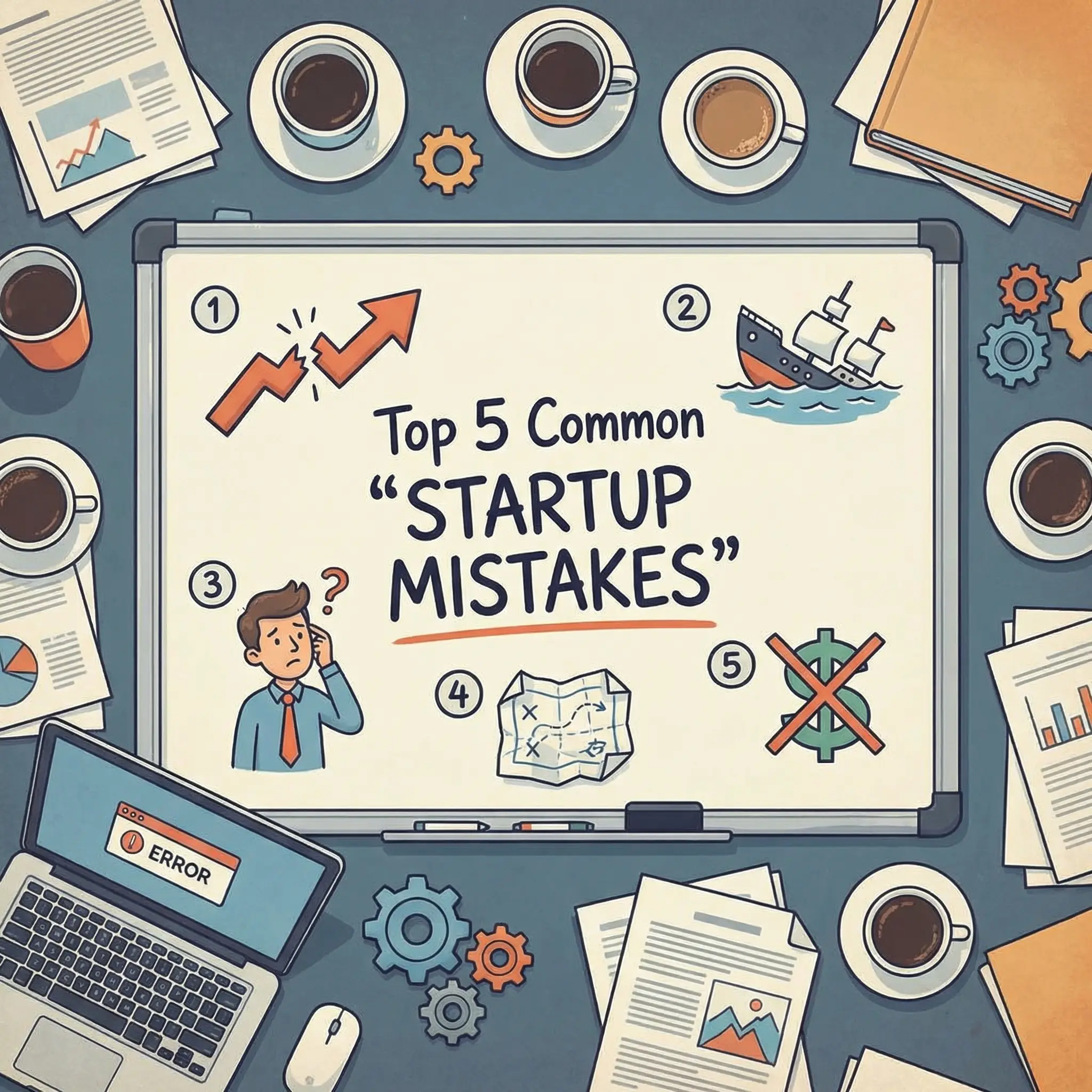
The 10 Most Common Startup Mistakes to Avoid in 2026
Advertisement
Most first-time founders don’t fail because they are lazy or unintelligent. They fail because common startups mistakes create a specific kind of pressure: move fast, make big bets with limited information, and build while the ground is still shifting under you. That combination produces predictable mistakes — and the same patterns show up repeatedly across founder communities and “post-mortem” discussions.
This article is a practical overview of common startup mistakes, written to be easy to skim and useful at any stage. It does not assume you are raising venture capital, building a tech product, or following a specific playbook. Instead, it focuses on what founders consistently report as the errors that actually kill momentum: weak customer validation, premature scaling, feature overload, unclear roles, and burnout-driven decision-making.
What are the most common mistakes first-time startup founders make?
Advertisement
The most common mistakes cluster into a few categories:
• Skipping customer validation and building in isolation
• Overbuilding features before solving one core problem
• Scaling too early without repeatable demand
• Ignoring distribution and assuming “good product markets itself”
• Hiring too soon or too late without clear roles
• Running out of runway due to unclear priorities and spending
• Burnout and decision fatigue from chaotic workflows
These mistakes often stack. For example, building without talking to customers leads to feature overload, which slows shipping, which delays feedback, which burns runway, which forces rushed marketing or premature scaling. The result is not one catastrophic error, but compounding friction.
Why do founders build without talking to customers regularly?
Need help? Our tools can help you identify potential IP conflicts before they become costly problems.Try a free scan →
One of the most repeated founder regrets is spending weeks or months building before getting meaningful feedback. This happens for understandable reasons:
• Building feels productive and safe compared to sales conversations
• Founders assume they already understand the user problem
• Feedback feels “unreliable” compared to the founder’s vision
• People confuse early interest (“cool idea”) with real demand
The practical issue is not whether you talk to customers once. It’s whether you build a habit of talking to them regularly, especially while the product is still flexible. Founders who do this early tend to discover the real objections, the real alternatives people use, and the real trigger that makes someone switch.
A useful mental model: startups don’t fail from lack of effort. They fail from effort aimed at the wrong target.
Advertisement
How does “more features” become a trap?
Many founders equate progress with functionality: more screens, more settings, more integrations, more polish. In reality, feature expansion before clarity can become a form of avoidance.
Feature overload becomes a trap when:
• The core value is still unclear, but the roadmap keeps growing
• You are building “just in case” features instead of “must-have” features
• You are trying to satisfy every user type instead of one ideal user
• You measure productivity by output, not by learning
The consequence is simple: your product becomes harder to explain, harder to adopt, and harder to finish. People rarely quit because your MVP is missing 20 features. They quit because they don’t understand what problem it solves in 10 seconds.
What does “scaling too early” look like in practice?
Advertisement
“Scaling too early” is a phrase founders hear often, but many aren’t sure what it means day-to-day. In practical terms, premature scaling happens when you invest heavily into growth before you have reliable signals that the product is working.
It can look like:
• Spending on ads before you know what message converts
• Hiring a big team before workflows are stable
• Building complex systems before the demand is repeatable
• Expanding into multiple segments before one segment is satisfied
The problem isn’t ambition. The problem is converting uncertainty into fixed costs. Growth is expensive. If the offer, onboarding, or retention is not stable, scaling multiplies the weaknesses.
Need help? Our tools can help you identify potential IP conflicts before they become costly problems.Try a free scan →
Why do startups underestimate distribution?
A frequent theme in founder discussions is the belief that if the product is good, users will arrive naturally. This is rarely true.
Distribution includes:
• How people discover you
• Why they trust you
• What makes them try you today
• What keeps them coming back
Ignoring distribution leads to a painful pattern: the founder builds quietly, launches to silence, then assumes the product is bad — when the real issue is that no one had a reason to notice, try, or share it.
Even strong products often need a distribution strategy that matches the audience. What works for developers may not work for local services. What works on social may not work in search. What works with a community may fail with paid ads.
Advertisement
When do hiring mistakes usually happen?
Hiring mistakes often happen at two extremes:
Hiring too early
Advertisement
This happens when founders try to “buy speed” before they have clarity. If the product direction changes weekly, early hires can become misaligned through no fault of their own. The business ends up paying for capacity without knowing what to build.
Hiring too late
This happens when founders do everything themselves for too long, then hit a ceiling. Support, sales, onboarding, marketing, and operations all suffer because one person cannot do them well simultaneously.
In both cases, the root issue is usually role clarity. Hiring works best when the startup knows what work needs to happen repeatedly and what outcomes define success.
Advertisement
Why do founders run out of runway even when they’re working hard?
Runway disappears when spending outpaces learning.
Many founders think the only “runway risk” is obvious costs like payroll or ads. In reality, runway is also lost through time: months spent building the wrong thing, weeks spent polishing the wrong UI, or long cycles without feedback.
Common runway drains include:
• Building before validating demand
• Overengineering infrastructure early
• Paying for tools that don’t reduce real workload
• Marketing experiments without a clear hypothesis
• Switching strategy frequently without finishing loops
Working hard does not protect runway if the work is not producing decisions, learning, or revenue.
Need help? Our tools can help you identify potential IP conflicts before they become costly problems.Try a free scan →
How do unclear roles and responsibilities slow a startup down?
Advertisement
When there are multiple founders or early team members, unclear responsibilities create invisible friction:
• Tasks get duplicated or ignored
• Decisions take too long
• Accountability becomes vague
• Conflict becomes personal instead of operational
This shows up as “burnout” or “slow execution,” but the cause is often structural. Startups move fastest when each critical area has an owner — not because one person does everything, but because someone is responsible for the outcome.
What role does burnout play in startup mistakes?
Burnout is rarely just “working too much.” It often comes from working in a way that produces constant uncertainty: unclear priorities, constant context switching, and emotional highs and lows tied to metrics you can’t control.
Burnout increases mistakes because it changes decision-making:
• You become reactive instead of deliberate
• You chase quick wins that don’t compound
• You avoid hard conversations with customers
• You stop shipping consistently
Many “strategy mistakes” are actually exhaustion mistakes. When energy is low, founders choose whatever feels immediately relieving, not what is strategically correct.
Advertisement
How can you tell which mistakes matter most at your stage?
Need help? Our tools can help you identify potential IP conflicts before they become costly problems.Try a free scan →
A common problem in generic “startup mistakes” lists is that they treat every mistake as equal. In practice, different mistakes dominate at different stages:
Pre-launch and MVP
Advertisement
• Not talking to customers regularly
• Overbuilding features
• Avoiding shipping and feedback loops
Early traction
• Ignoring distribution and marketing
• Unclear onboarding and weak retention
• Premature complexity in product and operations
Advertisement
Scaling
• Hiring without role clarity
• Scaling spend before repeatable conversion
• Expanding markets before one market is stable
This stage view helps founders focus. The goal is not perfection — it’s avoiding the mistakes that are most likely to kill momentum right now.
Conclusion
Advertisement
Common startup mistakes are common because they feel reasonable in the moment. Building feels safer than selling. Features feel like progress. Growth feels like survival. Hiring feels like acceleration. But many of these moves become dangerous when they happen before the startup has clear signals of demand and repeatability.
The most useful way to think about startup mistakes is not as moral failures, but as predictable failure modes. If you can identify which stage you’re in and which mistakes dominate that stage, you reduce risk without becoming slow or overcautious.
A startup that learns quickly, stays close to users, and resists premature scaling is not guaranteed to win — but it avoids many of the failures that end the journey early.