Why trademark searches get skipped
Advertisement
In early-stage projects, founders often move fast. Names are chosen quickly, domains are bought immediately, and products go live before legal checks feel necessary. A trademark search is frequently postponed or skipped entirely, especially when budgets are tight and momentum feels more valuable than caution.
The issue is not that founders are careless. It is that the costs of skipping a trademark search are rarely visible upfront. They tend to appear later, when a brand already has users, revenue, or recognition. This article explains those hidden costs in practical terms, without legal jargon or sales framing.
What is a trademark search, in simple terms?
Advertisement
A trademark search is a process for checking whether a name, logo, or brand identifier is already in use or registered in a way that could create conflict.
This usually involves more than typing a name into a search engine. Trademark systems record variations, phonetic similarities, related categories of goods or services, and prior registrations that may not show up in normal web results.
The purpose of a trademark search is not to guarantee zero risk, but to surface obvious conflicts before a name becomes expensive to change.
Why founders assume a search is optional
Need help? Our tools can help you identify potential IP conflicts before they become costly problems.Try a free scan →
Many founders believe a trademark search can be skipped because of one or more assumptions:
• Owning a domain feels like proof of safety
• A quick Google search shows no obvious competitors
• The business is “too small” to attract attention
• Common law use is assumed to be enough protection
These assumptions often hold temporarily. Problems arise when the business grows, advertising begins, or visibility increases. At that point, names that once felt safe become visible to others with existing rights.
Advertisement
The cost most founders expect: registration fees
When people think about trademark costs, they usually think about registration fees. These are relatively easy to see and plan for.
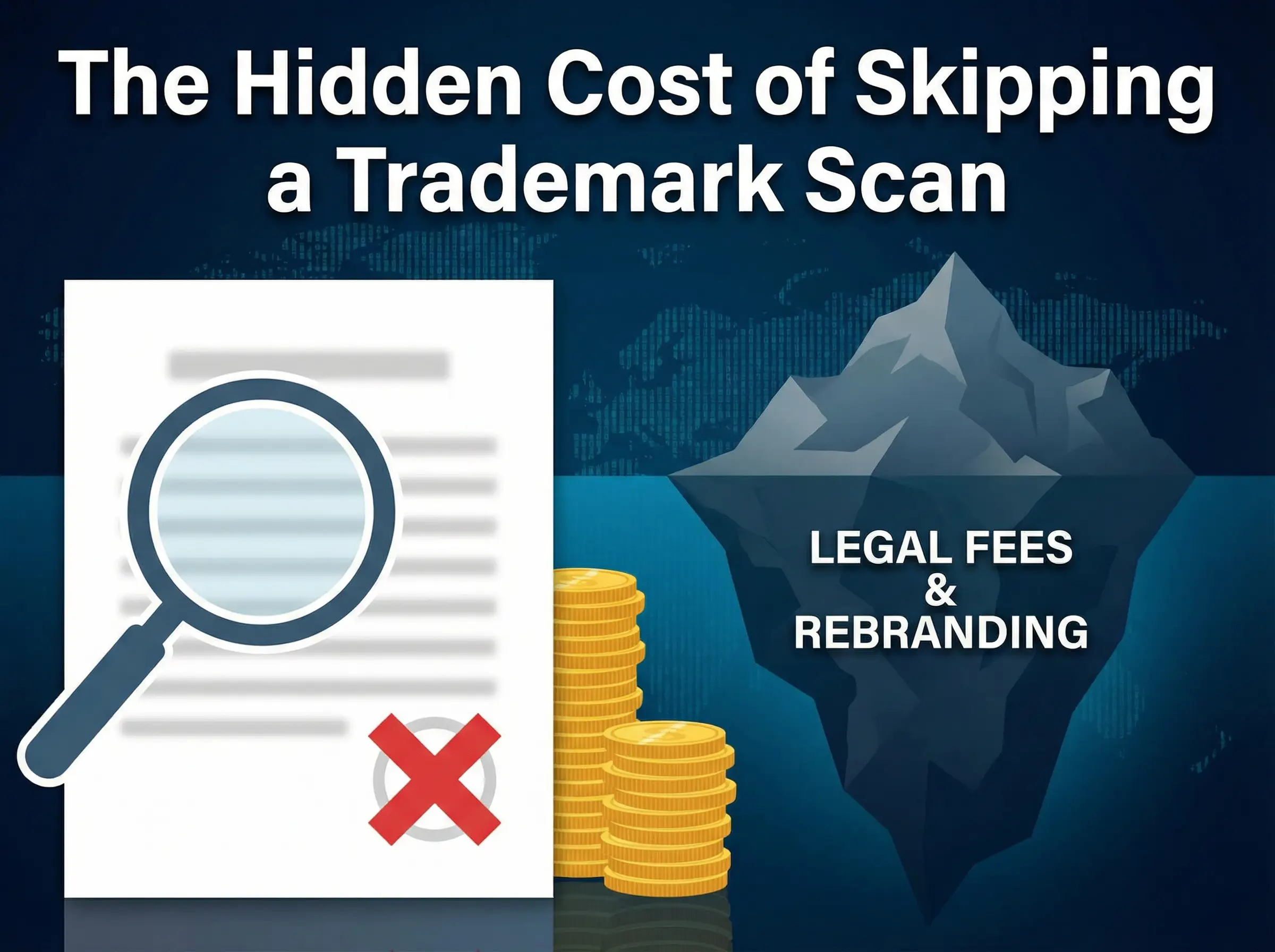
Because registration has a clear price tag, it feels optional. Founders often decide to delay until revenue justifies the expense. What is less obvious is that registration costs are usually the smallest category in the overall risk profile.
The hidden cost of rebranding after launch
Advertisement
Rebranding is one of the most common consequences of a skipped trademark search.
If a conflict arises after launch, changing a name is no longer a simple swap. Costs can include:
• New domain purchases and redirects
• Updated logos, design assets, and packaging
• App store re-submissions or website rebuilds
• Lost recognition from existing users or customers
Even when no legal action occurs, the operational cost of changing a name mid-stream often exceeds the cost of an early search by a wide margin.
Need help? Our tools can help you identify potential IP conflicts before they become costly problems.Try a free scan →
Demand letters and dispute stress
Another hidden cost is time and emotional energy.
Founders frequently describe the shock of receiving a demand letter or infringement notice after months or years of operating without issue. These communications often arrive without warning and create immediate uncertainty.
Even when disputes do not escalate, founders must pause operations to understand their position, gather information, and decide how to respond. This distraction alone can slow growth during critical phases.
Advertisement
Legal consultation costs appear later, not earlier
Skipping a search does not eliminate legal costs. It shifts them to a later stage, where they are harder to control.
When conflicts arise post-launch, founders often need professional input quickly. At that point, urgency limits options. Advice becomes reactive rather than preventative, and decisions are made under pressure rather than planning.
This is why many legal costs associated with trademarks appear unexpectedly, even for teams that never intended to engage in disputes.
Domain ownership does not eliminate trademark risk
Advertisement
A recurring misconception is that owning a domain protects a brand from trademark issues.
Domains and trademarks operate under different systems. A domain registration does not override existing trademark rights, and trademark conflicts can still arise even when a domain was registered first.
In some cases, domain ownership becomes part of the dispute itself, adding complexity rather than protection.
Why a simple Google search is not enough
Many founders rely on surface-level checks: search engines, social media platforms, or app stores. While useful, these checks do not capture the full picture.
Trademark conflicts often involve:
• Similar spellings or pronunciations
• Related product categories
• Older registrations with limited online presence
Because trademark systems focus on legal classification rather than popularity, conflicts can exist even when a name appears unused online.
Advertisement
The false sense of security from poor-quality searches
Another hidden risk comes from low-quality or misleading trademark search services.
Founders sometimes receive reports that appear comprehensive but rely on limited databases or superficial checks. These reports can create a false sense of safety, leading teams to proceed confidently into avoidable conflicts.
Community discussions frequently highlight frustration with services that promise certainty where none exists.
Need help? Our tools can help you identify potential IP conflicts before they become costly problems.Try a free scan →
What happens when a conflict appears after traction
Advertisement
Conflicts that arise after a brand gains traction carry additional costs that are rarely discussed early.
These can include:
• Investor concerns about brand stability
• Paused marketing campaigns
• Reduced negotiating leverage in disputes
• Internal confusion among teams and users
At this stage, the question is no longer “Is this name available?” but “How much damage will changing it cause?”
Why trademark searches do not guarantee zero risk
It is important to clarify what a trademark search does not do.
No search can guarantee complete protection across all markets, industries, or future uses. Trademark systems evolve, new filings appear, and interpretations change.
The value of a search lies in risk awareness, not certainty. It helps founders make informed decisions rather than blind ones.
Advertisement
When the cost of skipping becomes visible
Need help? Our tools can help you identify potential IP conflicts before they become costly problems.Try a free scan →
The cost of skipping a trademark search rarely appears immediately. It becomes visible when:
• Marketing spend increases
• Public visibility grows
• Competitors or rights holders notice the brand
• Expansion into new markets begins
At that point, options narrow and costs rise.
Conclusion: the real cost is delayed clarity
Advertisement
Skipping a trademark search does not remove risk. It delays understanding it.
For founders, the hidden cost is not just financial. It is uncertainty at the worst possible moment—when a brand already matters. Early searches do not eliminate every problem, but they replace surprise with foresight.
That shift alone is often the most valuable outcome.