Tesla Has a $5B Vehicle It Can't Name. Here's Why.
Advertisement
On October 10, 2024, Elon Musk stepped on stage at Tesla's "We, Robot" event in Hollywood and unveiled the Cybercab to a global audience. The reveal was cinematic. The name was everywhere.
What wasn't anywhere? A trademark application.
Advertisement
Eighteen days later, a French beverage company called Unibev — known primarily for hard seltzers — filed a trademark application for "Cybercab" in the vehicle category. Tesla didn't file until November. By then, the door was closed.
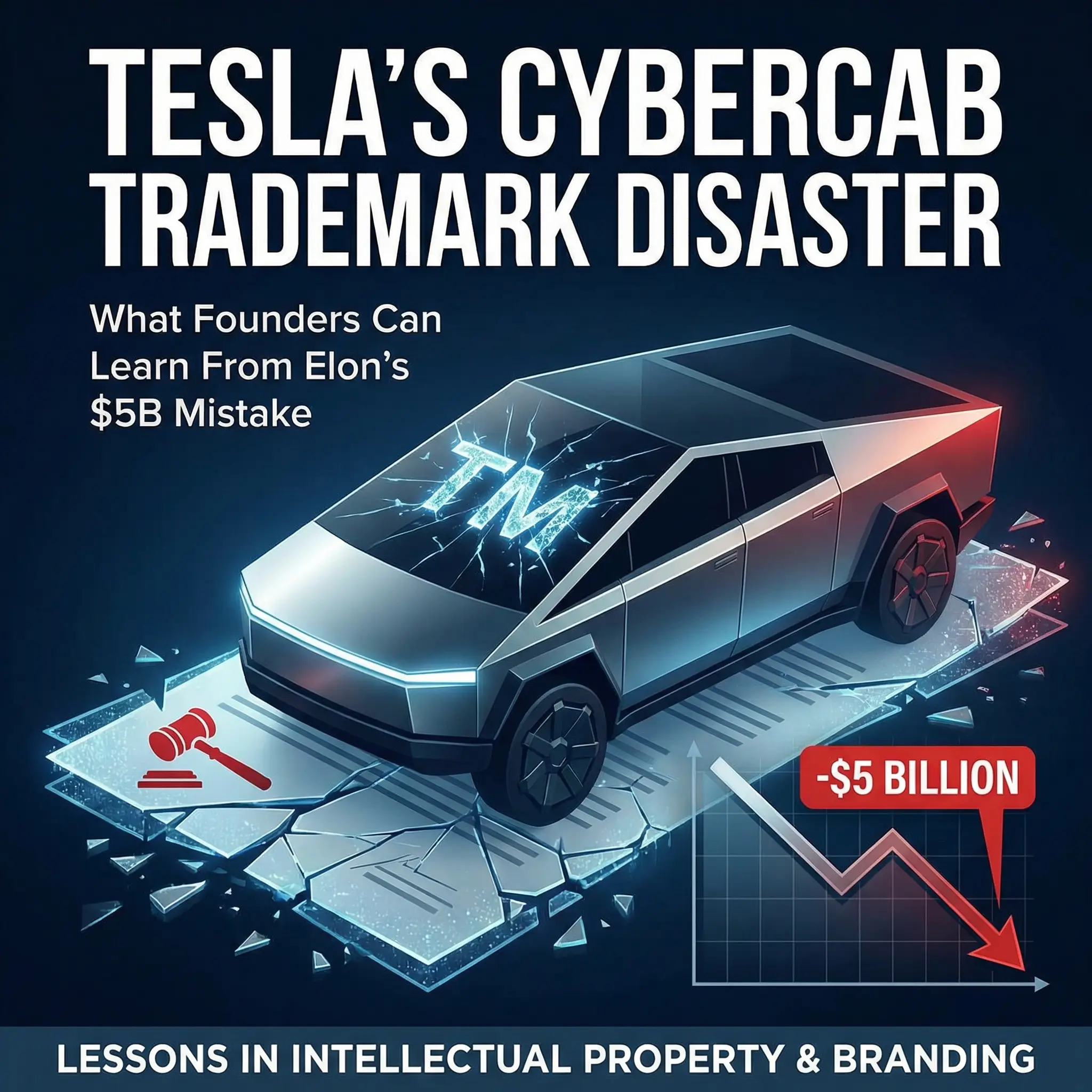
As of February 2026, Tesla's Cybercab trademark remains suspended by the USPTO. Mass production is scheduled for April. And the company now has until March 14, 2026 to decide whether to fight, pay, or rebrand.
Need help? Our tools can help you identify potential IP conflicts before they become costly problems. Try a free scan →
This is not a story about bad luck. It's a story about a process failure that every founder — at any budget, at any scale — can learn from right now.
Advertisement
How a Seltzer Company Beat Tesla to Its Own Name
To understand what happened, you need to know about something called Paris Convention priority.
When a company files a trademark in one country, they can use that filing date to claim priority in other countries — as long as they file internationally within six months. Unibev had filed a "Cybercab" application in France back in April 2024, months before Tesla even held the "We, Robot" event.
Advertisement
When Musk announced the name publicly and Unibev's team spotted the gap — no US filing — they immediately filed in the vehicle category in the US, claiming their April 2024 French filing as priority. That move leapfrogged Tesla entirely.
Need help? Our tools can help you identify potential IP conflicts before they become costly problems. Try a free scan →
Tesla's November 2024 US filing was legally irrelevant. Unibev had priority. The USPTO suspended Tesla's application on November 14, 2025.
What makes this worse: Unibev is not a random opportunist. The company holds three US trademarks for "Teslaquila" — the name Tesla tried to use for branded tequila years ago. They also hold "Cybertaxi" and "Cyber Van." This is a coordinated trademark operation that specifically monitors Tesla's announcements for unprotected names.
Advertisement
The Double Failure Nobody's Talking About
Tesla didn't just lose Cybercab. They also had their backup name rejected.
In May 2025, the USPTO refused Tesla's trademark for "Robotaxi" — declaring it "merely descriptive." Under US trademark law, you cannot own a word that simply describes what a product is. "Robotaxi" describes a robotic taxi. Rejected.
Advertisement
So Tesla now has:
- "Cybercab" — blocked by a squatter
- "Robotaxi" — too generic to own
- "Cybercar" and "Cybervehicle" — just filed in January 2026, currently under examination, and considered weak by trademark attorneys
Two completely different failure modes. One product. No ownable name — weeks before launch.
Advertisement
The $350 Fix That Would Have Prevented Everything
Here's what makes this story so instructive for founders: the solution costs $350 and is specifically designed for exactly this situation.
Need help? Our tools can help you identify potential IP conflicts before they become costly problems. Try a free scan →
It's called an Intent-to-Use (ITU) trademark application.
Advertisement
Under US law, you don't need to have launched a product — or even announced the name publicly — to file for trademark protection. An ITU application lets you:
- Lock your priority date before anyone else can file
- Keep the name confidential — no public disclosure required at filing
- File based on genuine intent to use the name in commerce
Had Tesla's legal team filed an ITU application for "Cybercab" the morning of the "We, Robot" event — or ideally, weeks before — Unibev's October 28 filing would have been irrelevant. Tesla would have had priority. Story over.
Advertisement
Instead, one of the richest companies on Earth is now negotiating with a French seltzer brand over the right to use the name of its own vehicle.
Need help? Our tools can help you identify potential IP conflicts before they become costly problems. Try a free scan →
What This Means If You're Building Right Now
The Tesla situation feels extreme, but the underlying mistake is one of the most common IP errors founders make:
Advertisement
Treating trademark as an afterthought rather than a pre-launch step.
Most founders assume that registering an LLC protects their brand name. It doesn't. An LLC gives you the right to do business under a name in a specific state — it does not give you trademark ownership. Someone can file a USPTO trademark for your brand name even if you have an active LLC, and they can do it while you're sleeping.
Others assume that because they're using the name publicly, they have rights. In the US, you do build some "common law" rights through use — but those rights are geographically limited (only where you've actively traded), difficult to prove in a dispute, and completely invisible to anyone running a trademark database search. For practical purposes, if it's not filed, it doesn't exist.
Advertisement
The Real Cost of Waiting
Here's the number founders need to internalize: a USPTO trademark application costs $250–$350 per class at filing. That's it. That's the proactive cost.
The reactive cost — fighting a squatter, negotiating a buyback, or rebranding entirely — runs anywhere from $10,000 for a basic opposition filing to well over $500,000 in legal fees and settlement costs for a contested dispute. Apple famously paid $60 million to settle the iPad trademark in China. Tesla is likely heading toward a Unibev payout that will dwarf any filing fee they could have paid in 2024.
Advertisement
For a solo founder or early-stage startup, a forced rebrand isn't just expensive — it can be terminal. You lose SEO equity, brand recognition, social following, and any press coverage built around the original name. Everything starts from zero.
How an Intent-to-Use Application Actually Works
Need help? Our tools can help you identify potential IP conflicts before they become costly problems. Try a free scan →
The Intent-to-Use (ITU) application is the tool that founders in stealth mode or pre-launch should know cold. Here's how it works in plain terms:
Advertisement
Step 1 — File before you announce. You don't need a live product, a website, or even a single customer. You just need a genuine intention to use the name commercially in the future. File the ITU application the day before your launch announcement, or ideally weeks before.
Step 2 — Your priority date is locked. The moment the USPTO receives your application, that date becomes your legal priority date. Anyone who files after that — even the day after — is legally behind you, regardless of when they started using the name or how big they are.
Step 3 — You have up to three years to "use" the name. After filing, the USPTO gives you time (through extensions) to actually launch and prove commercial use. You're not racing against a hard deadline from day one.
Advertisement
Step 4 — File a Statement of Use when you're live. Once your product or service is operating, you submit evidence of real commercial use and the trademark proceeds to registration.
Need help? Our tools can help you identify potential IP conflicts before they become costly problems. Try a free scan →
Tesla could have filed an ITU application for "Cybercab" the morning of the "We, Robot" event — or the week before — for $350. Unibev's October 28 filing would have been legally irrelevant. The Paris Convention priority from France wouldn't have mattered. The entire dispute would never have existed.
The Pre-Launch IP Checklist Every Founder Needs
Advertisement
Before you announce a product name publicly — to press, to investors, to anyone — run this sequence:
- Search USPTO TESS for exact matches and similar-sounding names, including marks in adjacent trademark classes
- Search WIPO Global Brand Database if you have any international ambitions — what's clear in the US may be blocked in the EU or UK
- Check domain availability and social handles — losing your .com the day of launch is a smaller but equally painful version of this problem
- Run a trademark similarity check to catch names that sound like yours even if they're spelled differently — "likelihood of confusion" is the USPTO's standard, not exact match
- File your ITU application before any public announcement — this single step is the difference between owning your brand and negotiating to use it
- Avoid descriptive or generic names — if your product name simply describes what the product does (like "Robotaxi" for a robotic taxi service), it cannot be trademarked. Build distinctiveness into the name from day one
Frequently Asked Questions
Advertisement
Do I need to have a product launched before I can file a trademark?
No. In the US, you can file an Intent-to-Use (ITU) trademark application before your product exists commercially. You need a genuine intention to use the name, but you don't need customers, a website, or revenue. This is the single most important piece of trademark knowledge for founders in pre-launch mode — file before you announce, not after.
What's the difference between registering an LLC and registering a trademark?
Advertisement
An LLC registration gives you the legal right to operate a business under a name in a specific state. It does not give you trademark ownership. Trademark registration with the USPTO gives you exclusive rights to use a name for specific goods or services across the entire United States, and the legal standing to stop others from using confusingly similar names. You need both — they protect different things.
How does trademark squatting work and is it legal?
Need help? Our tools can help you identify potential IP conflicts before they become costly problems. Try a free scan →
Trademark squatting is the practice of filing trademark applications for names that belong to other brands — typically after a public announcement, press release, or product reveal — before the original company gets around to filing. In the US, it exists in a legal grey area; it's not illegal to file a trademark, but applications made in "bad faith" can be challenged. In practice, squatters count on the target company settling rather than fighting a lengthy legal battle. The best defence is filing before they have a window to act.
Advertisement
What does "likelihood of confusion" mean in a trademark rejection?
"Likelihood of confusion" is the USPTO's standard for refusing a trademark application when an existing registered mark is similar enough that consumers might confuse the two brands. It doesn't require the names to be identical — similar-sounding names in related industries can trigger the refusal. Tesla's Cybercab application was blocked partly on this basis, in addition to Unibev's priority filing. This is why a thorough trademark clearance search — including phonetically similar names — is essential before you commit to a brand name.
How much does it cost to fight a trademark squatter vs filing proactively?
Advertisement
Filing proactively via a USPTO trademark application costs $250–$350 per class. Fighting a squatter after the fact typically starts at $10,000 for a basic TTAB opposition and can escalate to $100,000–$500,000+ for full litigation or a negotiated buyback. Apple paid $60 million to resolve the iPad trademark dispute in China. Tesla's eventual Unibev settlement, if reached, is expected to run into the millions. The math is not close.
Need help? Our tools can help you identify potential IP conflicts before they become costly problems. Try a free scan →
The Real Lesson Isn't About Tesla
Tesla will likely settle with Unibev. They have the resources to pay whatever it costs. The Cybercab will probably still be called the Cybercab.
Advertisement
But for founders who don't have that safety net — for the solopreneur who spent six months building around a brand name, the startup that printed merchandise and ran ads before filing — the outcome of this kind of mistake is often fatal to the brand entirely.
The window between "naming your product" and "announcing it to the world" is the most important trademark moment in your company's life. What you do in that window determines whether you own your brand or whether you're one opportunistic filing away from losing everything you built it around.
Tesla had 18 days and missed them. You now know not to.