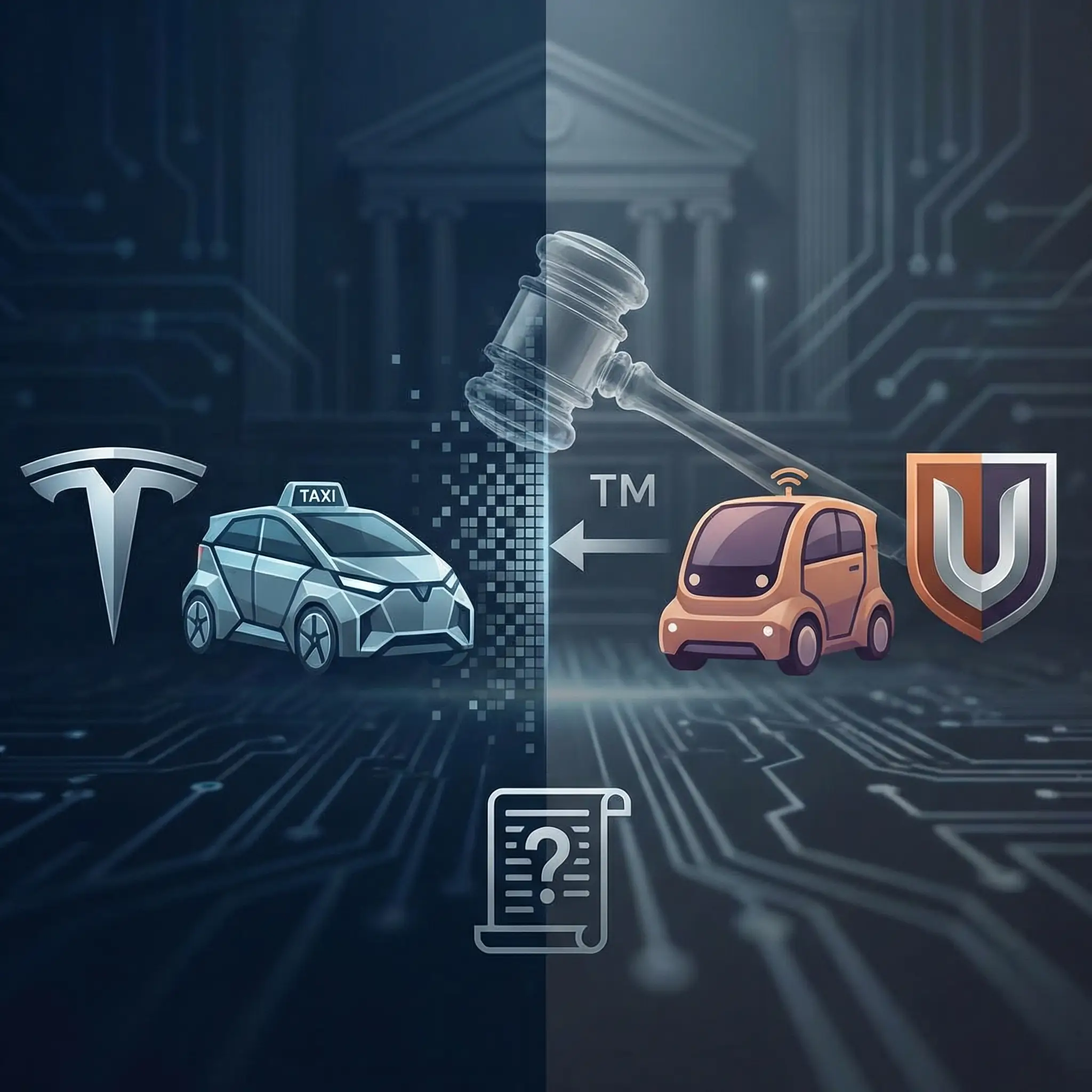
What Happened: The Cybercab Trademark Timeline
Advertisement
On October 10, 2024, Elon Musk walked on stage at Tesla's "We, Robot" event and introduced the world to the Cybercab — a steering-wheel-free, two-seat autonomous robotaxi that Tesla positioned as the future of urban transport.
What Tesla did not do that day, or in the weeks that followed, was file a trademark application for the name.
Advertisement
That window of inaction cost them. On October 28, 2024 — just 18 days after the global reveal — a French beverage wholesale company called UNIBEV filed a USPTO trademark application for "Cybercab" in the vehicle category (Classes 12 and 39, covering vehicles, cars, and air vehicles).
Tesla finally filed its own application in November 2024.
Need help? Our tools can help you identify potential IP conflicts before they become costly problems.Try a free scan →
Under USPTO rules, first to file takes priority. UNIBEV was first. Tesla's application was formally suspended on November 14, 2025, with the USPTO instructing: "Action on this application is suspended until the prior-filed application(s) below either registers or abandons."
Advertisement
Tesla — a company currently ramping production of the Cybercab at Gigafactory Texas with volume production targeted for April 2026 — does not legally own the name of the product it is building.
Who Is UNIBEV?
UNIBEV is a French beverage wholesaler known primarily for hard seltzers. Its principal, Jean-Louis Lentali, has no documented history in vehicle manufacturing, autonomous transport, or any adjacent industry.
Advertisement
This is not, however, UNIBEV's first intersection with Tesla's brand. The company holds three existing US trademarks for "TESLAQUILA" — the name Tesla attempted to use for its branded tequila — and has also filed applications for "CYBERQUAD" and "CYBERTAXI."
Need help? Our tools can help you identify potential IP conflicts before they become costly problems.Try a free scan →
There is also one additional detail that Tesla's legal team flagged in its February 2026 opposition filing: Lentali personally follows Elon Musk's family, as well as SpaceX, on social media.
According to Tesla's February 2026 opposition filing, this pattern is deliberate and documented — not an opportunistic one-off, but what Tesla characterizes as an alleged serial trademark acquisition strategy targeting its brand family. UNIBEV has not publicly responded to these characterizations.
Advertisement
The USPTO Suspension: What It Actually Means
A common point of confusion in media coverage is treating "suspended" as equivalent to "rejected." They are not the same.
Suspended means Tesla's application is on hold — it cannot proceed — pending the outcome of UNIBEV's prior-filed application. Tesla has not lost the trademark yet. But it cannot register it, and cannot stop UNIBEV from pursuing its own registration, until the dispute is resolved.
Advertisement
Rejected (or "refused") would mean the USPTO found Tesla's application inherently unregistrable — which is what happened to "Robotaxi," deemed too descriptive under Section 2(e)(1) of the Lanham Act.
Tesla faces both problems simultaneously: "Robotaxi" was refused as generic. "Cybercab" is suspended due to a competing prior-filed application — one Tesla alleges was filed in bad faith.
There is a third layer. The USPTO also cited a "Likelihood of Confusion" with an existing registration for "CYBERCARS" — a separate blocking issue that would exist even without UNIBEV. Tesla's "Cyber-" prefix strategy has, in some ways, created its own IP cage.
Advertisement
The French Filing: The Part Most Coverage Gets Wrong
The October 28 US filing date is the date most articles cite. But UNIBEV's legal advantage may run deeper.
Need help? Our tools can help you identify potential IP conflicts before they become costly problems.Try a free scan →
UNIBEV first filed for "Cybercab" in France on April 29, 2024 — six months before Tesla's reveal event.
Advertisement
Under the Madrid Protocol and international trademark priority rules, a French filing can establish priority in the United States if a subsequent US application is filed within six months of the original. This means UNIBEV's effective priority date may be April 2024, not October 2024 — predating even Tesla's product announcement.
If that international priority holds, Tesla's argument that UNIBEV filed in bad faith knowing about the Cybercab reveal becomes significantly harder to prove.
Tesla's Legal Response: The 5-Count Opposition
Advertisement
After a period of negotiations and a 30-day extension, Tesla filed a 167-page, 5-count formal opposition at the USPTO's Trademark Trial and Appeal Board (TTAB) on February 18, 2026. The five counts allege:
Need help? Our tools can help you identify potential IP conflicts before they become costly problems.Try a free scan →
- Fraud on the USPTO — Tesla alleges UNIBEV told the trademark office no other entity was using "Cybercab" for similar goods, and that this statement was knowingly false given the global media coverage of the reveal two weeks prior.
- No bona fide intent to use — UNIBEV has no history, infrastructure, or apparent plans to manufacture or sell vehicles. Without a genuine commercial intent, a trademark application can be invalidated.
- Likelihood of confusion with CYBERTRUCK — Tesla argues its registered CYBERTRUCK marks extend to the CYBER- brand family.
- Dilution of Tesla's famous CYBERTRUCK marks — A separate dilution claim protecting famous marks from association damage.
- False suggestion of a connection with Tesla — UNIBEV's use of "Cybercab" falsely implies a relationship with Tesla that does not exist.
The fraud count is the sharpest legal weapon Tesla has. If Tesla's allegation holds — that UNIBEV made a knowingly false statement to the USPTO when global news coverage makes that claim difficult to sustain — the application could potentially be voided regardless of the priority date. No court has ruled on this yet.
Advertisement
That said, TTAB proceedings are not fast. A contested opposition typically takes 12 to 24 months to resolve. Tesla begins volume Cybercab production in April 2026. These timelines are in direct conflict.
The Alternative Name Problem
During Tesla's Q4 2025 earnings call on January 29, Musk publicly floated "Cybercar" and "Cybervehicle" as potential Cybercab alternatives, citing regulatory concerns around "Cab" and "Taxi" terminology in certain US states. Tesla's legal team filed trademark applications for both names within 37 seconds of each other immediately after the call.
Advertisement
Trademark experts note this created its own problem. "Cybercar" is phonetically and visually similar to UNIBEV's own "Cybercab" application, potentially triggering further confusion claims. "Cybervehicle" is widely considered a branding disaster. And "Robotaxi" — Tesla's third option — was already rejected by the USPTO as too generic.
Tesla is in production on a vehicle it cannot legally name, with no clean alternative available.
What This Means for Founders
Advertisement
The Cybercab dispute is not just a Tesla story. It is a precise, real-time demonstration of the risk that every founder faces when they announce a product name before securing the trademark.
The lesson is not simply "file faster." The full picture is more specific:
Need help? Our tools can help you identify potential IP conflicts before they become costly problems.Try a free scan →
File before you announce — not after. The moment a product name becomes public, squatters, competitors, and opportunists can file first. USPTO priority is first-to-file, not first-to-use.
Advertisement
A name is not protected by fame or prior use alone. Tesla had been using "Cybercab" publicly since October 2024. It still lost priority. Public use and trademark registration are entirely separate legal concepts.
"Descriptive" names can't be trademarked. Words that describe what a product does — "Robotaxi," "Email," "App Store" — often cannot receive trademark protection. Strong marks are arbitrary, fanciful, or suggestive. Weak marks are descriptive or generic.
Alleged serial squatters monitor public filings and events. According to Tesla's opposition filing, UNIBEV allegedly tracked Tesla's brand announcements across years and filed systematically across TESLAQUILA, CYBERQUAD, CYBERTAXI, and CYBERCAB. Whether intentional or coincidental — that determination is for the TTAB to decide — the real-world impact on Tesla is the same: a competitor holds priority on a critical product name.
Advertisement
International filings can preempt US protection. A trademark filed in France can establish US priority under the Madrid Protocol within a six-month window. Global brand protection is not optional for companies with international ambitions.
Need help? Our tools can help you identify potential IP conflicts before they become costly problems.Try a free scan →
TTAB disputes are slow; product launches are not. Tesla has a real business problem right now: it is producing a car it cannot legally name at scale. This is not hypothetical risk. This is operational damage.
For solo founders and early-stage startups, the cost of a USPTO trademark application ($250–$350 per class) is trivially small compared to the cost of rebranding, litigation, or buying back a squatted name.
Advertisement
IP-SAM™ Insight: How This Risk Gets Caught Early
The Tesla-UNIBEV situation contains several risk signals that IP-SAM is designed to surface before a launch, not after.
Existing "Cyber-" mark conflicts — A pre-filing trademark clearance scan would have identified both the CYBERCARS registration and the risk of "likelihood of confusion" with other CYBER-prefix marks across vehicle classes. This is a known pattern in the USPTO database.
Advertisement
International priority exposure — IP-SAM monitors international trademark databases including WIPO and the Madrid Protocol registry. An April 2024 French filing for "Cybercab" in vehicle classes would appear as a priority risk flag before the US filing window closed.
Alleged serial squatter detection — Tesla's opposition filing characterizes UNIBEV's pattern of filing TESLAQUILA, CYBERQUAD, CYBERTAXI, and CYBERCAB as a coordinated strategy. Regardless of how the TTAB ultimately rules on intent, the filing pattern itself is a detectable signal. IP-SAM's monitoring layer tracks entity-level filing behavior, not just individual marks — enabling pattern-based alerts when a single entity begins accumulating applications across a brand family.
Post-announcement filing gap — The period between a public announcement and a trademark filing is measurable and legally dangerous. IP-SAM's pre-launch scanning is designed for the window that Tesla skipped: before the name goes public, not after.
Advertisement
The Cybercab case is ongoing. The March 14, 2026 TTAB deadline for Tesla's opposition is active. The outcome — settlement, litigation win, or forced rebrand — will be one of the most watched IP cases in the autonomous vehicle era.
What is already certain is the lesson: the trademark office does not care who announced the name first. It cares who filed first.
Need help? Our tools can help you identify potential IP conflicts before they become costly problems.Try a free scan →
This case analysis is for educational and informational purposes only. It does not constitute legal advice. For trademark protection guidance, consult a qualified IP attorney.
Advertisement
Powered by IP-SAM™ — Real-time IP risk intelligence for founders.