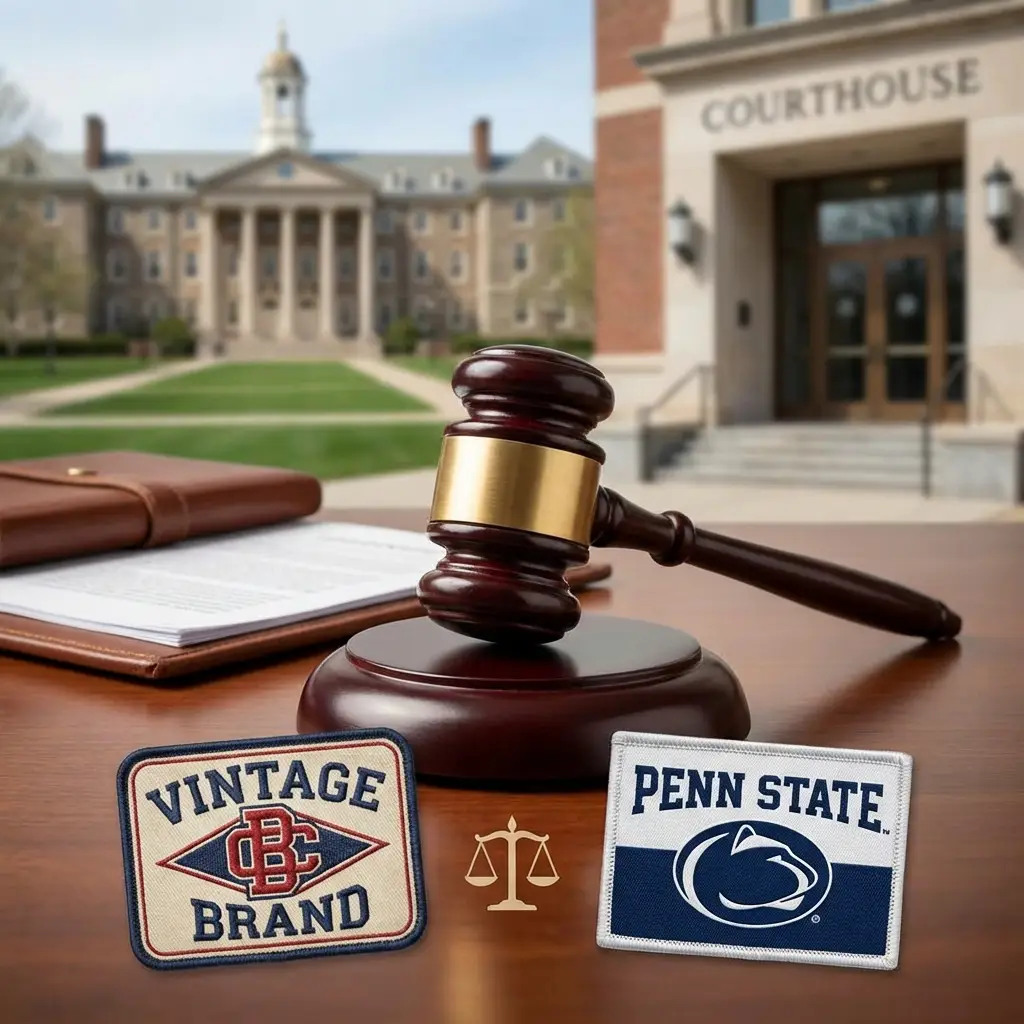
Penn State v. Vintage Brand: When Nostalgia Meets Trademark Law
Advertisement
College Merch, Retro Logos & the Line Between Fan Culture and Infringement
Case at a Glance
Advertisement
| Case Name | The Pennsylvania State University v. Vintage Brand LLC, et al. |
| Case Number | 4:21-cv-01091 — U.S. District Court, Middle District of Pennsylvania |
| Filed | 2021 |
| Trial | May–November 2024 (six-day jury trial) |
| Jury Verdict | November 19, 2024 — Willful infringement; $28,000 in damages |
| Injunction | Granted July 2025 — Vintage Brand prohibited from further use of Penn State marks |
| Current Status | Post-verdict motions denied October 31, 2025. Third Circuit appeal anticipated. |
| Marks at Issue | PENN STATE, THE PENNSYLVANIA STATE UNIVERSITY, Nittany Lion logo designs |
| Risk Type | Ornamental use defense, consumer confusion, print-on-demand infringement |
Background
Need help? Our tools can help you identify potential IP conflicts before they become costly problems.Try a free scan →
Penn State University has operated a formal trademark licensing program since at least 1983. Through an exclusive licensing agent, the university manages hundreds of commercial relationships with manufacturers and retailers who pay royalties to use Penn State names, logos, and imagery on merchandise. According to court filings, this program generates significant revenue reinvested into university operations, programming, and student support.
Advertisement
Vintage Brand LLC is an online retailer specializing in retro-inspired sports merchandise — throwback tees, vintage hats, mugs, koozies, magnets, and similar products. The company's stated mission, per court records, was to build the world's largest collection of historic sporting tickets, retro programs, and rare decals, translated into consumer merchandise.
From 2018 to 2021, Vintage Brand offered products featuring imagery sourced from old Penn State sports memorabilia — scanning historical materials and printing the resulting designs on blank apparel and products sold directly to consumers. According to the complaint, Penn State-themed products generated less than $25,000 in revenue during that window. Vintage Brand subsequently removed Penn State-themed products from its storefront before the verdict.
Penn State filed suit in 2021. The case drew immediate attention across the trademark and collegiate licensing industries because it raised a fundamental question no federal appellate court had squarely addressed: when a consumer buys merchandise bearing a university's logo, do they believe the university made or authorized it — or are they simply buying something they find decorative?
Advertisement
The Dispute
Need help? Our tools can help you identify potential IP conflicts before they become costly problems.Try a free scan →
Penn State's Position
Penn State alleged that Vintage Brand was a serial infringer that exploited the university's brand equity without authorization or royalty payments. According to Penn State's filings, Vintage Brand used targeted advertising — including Google Dynamic Ads directed at consumers searching for Penn State merchandise — to intercept customers seeking officially licensed products.
Advertisement
Penn State argued that expert survey evidence showed approximately 1-in-3 consumers (33%) who viewed Vintage Brand's products believed they were affiliated with or licensed by the university. The university further argued that its marks are not merely decorative symbols — they are source identifiers with decades of consumer recognition built through sustained investment.
Penn State also named Vintage Brand's manufacturer, Prep Sportswear (Sportswear, Inc.), and its owner as defendants, arguing each played an active role in the alleged infringement.
Vintage Brand's Defense
Advertisement
Vintage Brand did not dispute selling products that incorporated Penn State imagery. Its defense rested on several arguments that, if accepted, would have significantly altered the landscape for fan merchandise sellers everywhere.
Ornamental use: Vintage Brand argued its designs functioned merely as decorative elements expressing consumer affinity for the university — not as trademarks identifying who made the product. Under this theory, consumers buy the products to show support for Penn State, not because they believe Penn State manufactured or approved them.
Public domain imagery: Vintage Brand argued that the specific designs reproduced from old memorabilia were old enough to have lost copyright protection, making them freely usable by anyone.
Advertisement
Disclaimers: The company pointed to prominent notices displayed throughout its website stating that products were "not affiliated with, licensed, or sponsored by any college, team or league."
The defense framed the issue as one of consumer psychology: do fans buy retro college merchandise because they think the school made it, or simply to express their identity and connection to the institution?
Need help? Our tools can help you identify potential IP conflicts before they become costly problems.Try a free scan →
Key Legal Issues
Advertisement
1. The Ornamental Use Defense
Trademark law does not protect marks used purely as ornamentation — decorative features that do not signal to consumers who made or stands behind a product. Vintage Brand argued that university logos on fan merchandise are inherently ornamental: consumers know they're buying from a third party to express their fandom, not because they believe the school produced it.
The court allowed this defense to go to the jury — and the jury rejected it, finding that Penn State's marks did function as source identifiers in the merchandise context. This was the case's most consequential legal question.
Advertisement
2. The Circuit Split: The Bigger Unresolved Story
Need help? Our tools can help you identify potential IP conflicts before they become costly problems.Try a free scan →
Prior to this case, U.S. courts were divided on how to analyze trademark infringement in fan merchandise contexts:
- Fifth Circuit (per se rule): Any use of a university or team's marks on apparel constitutes infringement, because consumers inherently associate those marks with the institution.
- Ninth Circuit (fact-intensive approach): Courts must examine specific circumstances to determine whether consumer confusion actually exists in each case.
Advertisement
The Middle District of Pennsylvania rejected the per se rule and required Penn State to prove actual likelihood of confusion — a harder standard. Penn State proved it anyway. But this means the legal question remains unsettled nationally. A Third Circuit ruling — or eventual Supreme Court review — could establish binding precedent either way.
3. Three Types of Consumer Confusion
The court affirmed that trademark liability can arise from three distinct confusion theories, all of which were at play:
Advertisement
- Point-of-sale confusion — the consumer believes they are purchasing an officially licensed product at the moment of purchase
- Initial interest confusion — the consumer is drawn to a product because of brand association, even if they later discover it is unlicensed
- Post-sale confusion — third parties who see someone wearing or using the product believe it is officially licensed
4. The Manufacturer Liability Sub-Ruling
A notable split ruling emerged regarding Prep Sportswear, the entity that physically printed and shipped products. The court granted Prep Sportswear's motion for judgment as a matter of law on direct infringement — finding that manufacturing alone was insufficient to establish direct liability. Penn State moved for reconsideration, arguing Prep Sportswear was also the exclusive distributor, a role the Lanham Act explicitly covers. This issue is part of the expected Third Circuit appeal.
Advertisement
Outcome
After a six-day jury trial and deliberations, the jury returned a verdict of willful trademark infringement against Vintage Brand, awarding Penn State $28,000 in compensatory damages. The jury rejected all of Vintage Brand's affirmative defenses, including ornamental use, aesthetic functionality, and nominative fair use.
Need help? Our tools can help you identify potential IP conflicts before they become costly problems.Try a free scan →
In July 2025, the court granted Penn State a permanent injunction prohibiting Vintage Brand from using "the Penn State Word and Logo Trademarks, or any design that resembles those Trademarks, notwithstanding any differences in color, orientation, or other minor visual elements." The court denied Penn State's request for attorneys' fees but approved an award of costs.
Advertisement
On July 9, 2025, Vintage Brand filed a motion for judgment as a matter of law, or in the alternative, a new trial. On October 31, 2025, Chief Judge Matthew W. Brann denied that motion, finding the jury's verdict supported by substantial evidence.
⚠️ Case Status — February 2026: A Third Circuit appeal is widely anticipated by trademark legal observers. This district court verdict is not binding national precedent. The core legal question — per se rule vs. fact-intensive approach — remains unresolved at the appellate level. IPRightsHub will update this analysis when the appeal is filed or decided.
Lessons From This Case
Advertisement
Trademarks Don't Expire Like Copyrights
Need help? Our tools can help you identify potential IP conflicts before they become costly problems.Try a free scan →
One of the most persistent misconceptions this case exposes: the fact that an image is old, appears in historical materials, or has entered the public domain for copyright purposes does not mean the underlying trademark has expired. Penn State maintained active trademark registrations covering not just current logos but historical versions of its marks. Trademarks remain enforceable as long as they are actively used and maintained — regardless of age.
Disclaimers Alone Don't Create Legal Safety
Advertisement
Vintage Brand displayed prominent, repeated disclaimers across its website and individual product pages. The jury found willful infringement anyway. Under the consumer confusion framework, a disclaimer that consumers may not read carefully — or that appears after an initial brand association is already formed — may be insufficient. A disclaimer can be a relevant factor, but it is not a safe harbor.
The Cost-Risk Math Is Unfavorable for Small Sellers
Vintage Brand generated less than $25,000 in Penn State-related revenue between 2018 and 2021 — and has been in multi-year federal litigation ever since. The damages award of $28,000 is modest, but the legal costs of defending a case at this level, across multiple parties and years, are substantial. For print-on-demand sellers operating at small scale, this case illustrates that revenue exposure and legal exposure can be dramatically mismatched.
Advertisement
Platform-Level Enforcement Is Coordinated and Escalating
Penn State is not acting alone. According to court records and public reporting, at least a dozen universities — including Purdue, Stanford, UCLA, Arizona, Arizona State, Cal Berkeley, Colorado, Oregon, Oregon State, USC, Utah, Washington, and Washington State — have filed similar suits against Vintage Brand. This pattern signals coordinated enforcement across collegiate licensing programs, not isolated action by one institution.
What This Means for Founders
Advertisement
If you sell, plan to sell, or are considering selling any merchandise featuring names, logos, mascots, or visual elements associated with universities, sports teams, entertainment franchises, or other established brands — this case directly maps to your risk profile.
The Penn State v. Vintage Brand verdict sends a clear signal to the print-on-demand and custom merchandise ecosystem: the ornamental use defense is harder to win than most sellers assumed. The combination of factors Vintage Brand relied on — public domain imagery, disclaimers, historical rather than current marks, and a fan-expression framing — did not collectively protect the company from an infringement finding.
Need help? Our tools can help you identify potential IP conflicts before they become costly problems.Try a free scan →
For founders building merchandise businesses, fan gear platforms, or POD storefronts, the practical risk framework has shifted. The key questions are no longer just "is this exact logo registered?" but also:
Advertisement
- Would a consumer reasonably associate this product with the institution?
- Does the design evoke the brand even if it doesn't copy it exactly?
- Is there an active licensing program that consumers might assume you're part of?
The injunction's language — covering "any design that resembles those Trademarks, notwithstanding any differences in color, orientation, or other minor visual elements" — is particularly significant. Stylistic modifications to trademarked designs may not constitute sufficient legal distance.
Founders operating in adjacent spaces — lifestyle brands that reference cultural institutions, Etsy sellers offering school-themed items, app developers building sports fan experiences — should factor the evolving consumer confusion standard into their product decisions, particularly if they operate at scale or derive significant revenue from institution-adjacent designs.
Advertisement
How IP-SAM™ Detects This Risk
Need help? Our tools can help you identify potential IP conflicts before they become costly problems.Try a free scan →
The Penn State v. Vintage Brand case illustrates exactly the type of brand exposure IP-SAM is built to surface early — before a cease and desist arrives, and long before a jury renders a verdict.
Visual Similarity Detection
Advertisement
IP-SAM's logo and trademark scanning tools analyze the visual and conceptual relationship between a proposed design and existing registered marks. For cases like Vintage Brand's, IP-SAM would flag designs that share distinctive visual elements — typefaces, mascot shapes, color combinations, compositional patterns — with active trademark registrations, even when the proposed design draws from older or modified versions of those marks.
Trademark Status Intelligence
IP-SAM queries USPTO trademark databases to surface the registration status of marks across relevant classes, including apparel (Class 25) and promotional goods (Classes 16 and 21). Founders can see not just whether a mark is currently registered, but whether the mark owner has a documented enforcement history — a critical signal when evaluating real-world risk exposure.
Advertisement
Consumer Confusion Risk Scoring
Beyond exact-match comparisons, IP-SAM evaluates the broader likelihood of consumer association — incorporating mark strength, market category, and design similarity to generate a risk score founders can act on. This mirrors the multi-factor analysis courts apply when determining consumer confusion likelihood under the Lanham Act.
In a scenario like Vintage Brand's, an early IP-SAM scan would have surfaced Penn State's active trademark portfolio, flagged the visual overlap in proposed designs, and surfaced the licensing program as an active enforcement indicator — giving the founder the information to make a fully informed go/no-go decision before significant time and money were invested.
Advertisement
This case analysis is for educational and informational purposes only. It does not constitute legal advice and should not be relied upon as such. All allegations referenced are claims made by the respective parties and have not necessarily been proven or ruled upon by any court or regulatory body. For trademark protection guidance specific to your situation, consult a qualified IP attorney.
Case status and outcomes may change. IPRightsHub will update this analysis where material developments occur.
Powered by IP-SAM™ — Real-time IP risk intelligence for founders. | iprightshub.com