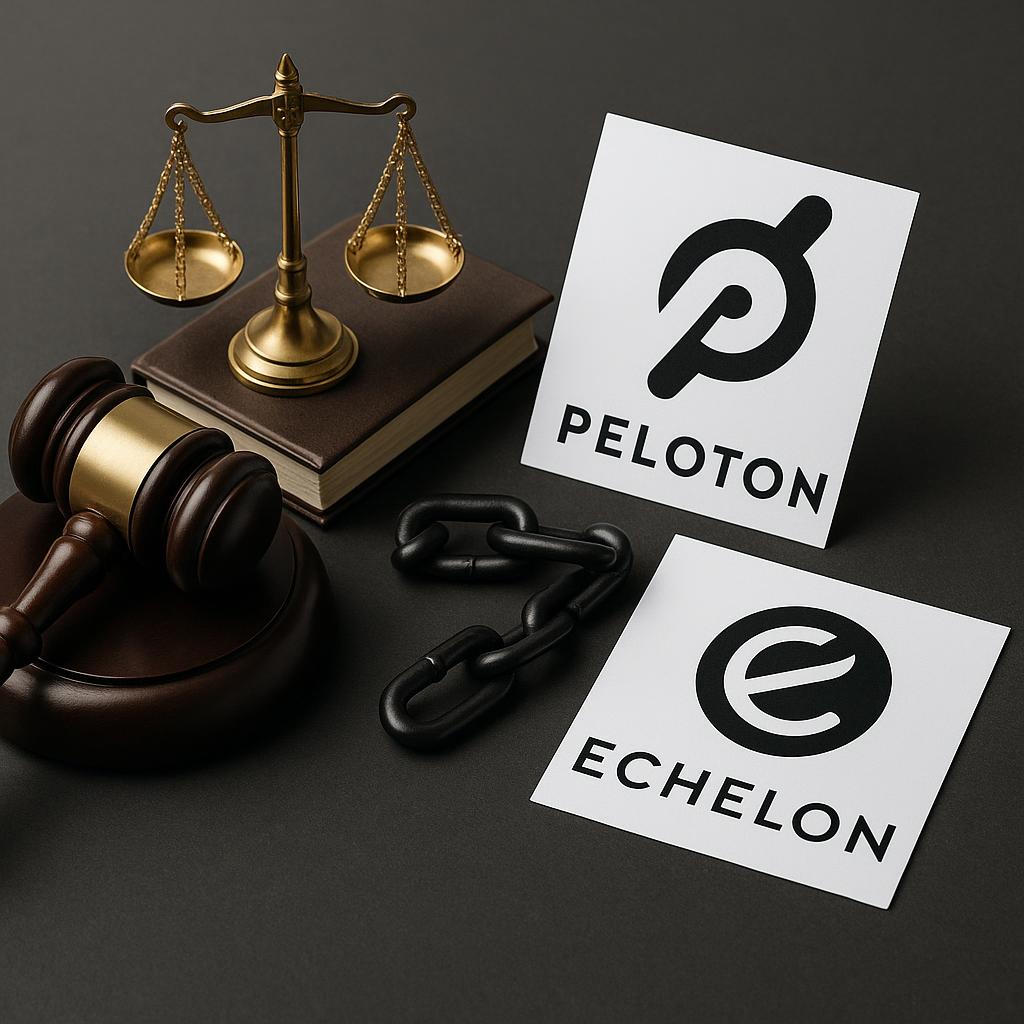
Peloton vs. Echelon: When a Fitness Brand War Becomes an IP War
Advertisement
In October 2019, Peloton Interactive filed a lawsuit in Delaware federal court against Echelon Fitness, a rival maker of connected stationary bikes. The complaint didn't allege one problem. It alleged four: patent infringement, trademark infringement, trade dress infringement and dilution, and false advertising. What followed was a three-year legal battle that touched nearly every layer of intellectual property law — and ended with Echelon surrendering a trademark, ceasing use of core technology, and watching two Peloton patents get voided in the process.
This case is one of the most instructive IP disputes in consumer tech and fitness history. Not because of its size, but because of its scope.
Advertisement
Background: Two Connected Bike Companies, One Very Similar Playbook
Peloton launched in 2012, pioneering the connected at-home fitness category — a stationary bike paired with live and on-demand instructor-led classes, a leaderboard that let riders compete in real time, and a subscription model. By 2019, it had gone public and was defending a carefully built brand identity.
Need help? Our tools can help you identify potential IP conflicts before they become costly problems.Try a free scan →
Echelon entered the market later, positioning itself as the more affordable alternative. Its product: connected bikes with streaming classes, a competitive leaderboard, and a subscription service. Its marketing framing was explicit — Echelon actively compared itself to Peloton in advertising, presenting the two as interchangeable options at different price points.
Advertisement
That comparative positioning set the stage for everything that followed.
The Dispute: Four Claims, One Filing
1. Patent Infringement — The Leaderboard Technology
Advertisement
Peloton's most technically specific claim involved its patented leaderboard technology. The patents in question — including USPTO Registration Nos. 10,322,315 and 10,022,590 — covered systems that allowed users to compete against other riders taking the same class, both live and on-demand, with outputs displayed in real time in a synchronized leaderboard format.
Need help? Our tools can help you identify potential IP conflicts before they become costly problems.Try a free scan →
Echelon's app included a substantially similar feature. Peloton argued this constituted direct infringement of its inventions.
2. Trademark Infringement — Logo, Coloring, and Font
Advertisement
Peloton's trademark complaint focused on visual brand identity: the allegation that Echelon had copied Peloton's logo design, coloring system, and typography in ways that created brand confusion at the point of consumer purchase and in marketing materials.
This is not a claim of naming similarity. It is a claim of trade identity mimicry — that the overall look and feel of Echelon's brand was engineered to evoke Peloton in the consumer's mind.
3. Trade Dress Infringement and Dilution
Advertisement
Separately from its registered trademark claims, Peloton asserted trade dress infringement — protection that covers the overall visual impression of a product or brand, independent of specific registered marks. Trade dress can encompass product shape, packaging, color schemes, and the combined commercial impression a brand creates.
Peloton argued that Echelon's visual presentation was so aligned with its own that an ordinary consumer could reasonably confuse the source or affiliation of the two products.
4. Slogan Theft — "Never Ride Alone"
Advertisement
Perhaps the most instructive element of the entire case is the slogan dispute. Peloton alleged it had been using the phrase "Never Ride Alone" since late 2013 as a core part of its brand identity and marketing language.
Echelon — or more specifically, its parent company — filed for federal trademark registration of that identical phrase in August 2018, nearly five years after Peloton had begun using it.
Need help? Our tools can help you identify potential IP conflicts before they become costly problems.Try a free scan →
On January 15, 2020, Peloton filed a petition for cancellation of Registration No. 5,721,525 for the service mark "NEVER RIDE ALONE," alleging that Echelon's registration was obtained through knowing and intentional misrepresentation. Rather than contest the cancellation, Echelon filed a voluntary surrender of the registration.
Advertisement
Under U.S. trademark law, prior use in commerce establishes rights — registration is not required. A party that has been using a mark since 2013 will typically prevail against a party that registered it in 2018, particularly where the original user can demonstrate continuous commercial use.
The Counterattack: Echelon Fights Back
This was not a one-directional dispute. Echelon did not simply absorb the claims.
Advertisement
In 2020, Echelon filed a petition with the Patent Trial and Appeal Board (PTAB) seeking to invalidate several of Peloton's patents, arguing they covered "abstract ideas" rather than novel inventions. The federal judge hearing the primary case initially agreed with Peloton that the patents covered genuine innovations — solutions to the specific problem of rider engagement and real-time competitive class mechanics.
Need help? Our tools can help you identify potential IP conflicts before they become costly problems.Try a free scan →
But in 2022, the PTAB completed its review and determined that the challenged claims in both USPTO Patent Nos. 10,322,315 and 10,022,590 were unpatentable — finding that Echelon had demonstrated the relevant claims were obvious based on prior existing patents. Peloton had narrowed both patents during the review, leaving only portions subject to examination, and the judges ruled against them.
This was a significant win for Echelon on the patent front, demonstrating that IP battles are not inherently one-sided — and that smaller parties can successfully challenge the IP of established incumbents.
Advertisement
The Outcome: Settlement, Surrender, and a Technology Concession
In November 2022, Peloton and Echelon announced a global settlement of all pending litigation. Key terms made public:
- All pending legal actions were dismissed
- Echelon agreed to cease using Peloton's patented leaderboard technology in on-demand classes — a direct operational concession
- The "Never Ride Alone" trademark registration had already been surrendered in 2020
- Two of Peloton's patents had been voided by the PTAB
Advertisement
Neither company disclosed financial terms. The public framing from both sides was resolution-forward. But the IP ledger tells a more nuanced story: Echelon lost its slogan, lost its leaderboard capability in on-demand contexts, but successfully invalidated two of the patents used against it. Peloton secured behavioral change from a competitor without winning cleanly on every front.
The dispute ran approximately three years and involved multiple federal court filings, PTAB proceedings, and separate petitions for cancellation at the USPTO — a significant resource expenditure for any company, let alone one attempting to compete on price.
Key Legal Concepts at Play
Advertisement
Trade Dress — Protection for the overall visual identity of a brand or product, including color, typography, layout, and combined aesthetic impression. Does not require registration to exist as a legal right, though registration strengthens enforceability.
Likelihood of Confusion — The primary legal standard for trademark and trade dress infringement. Courts and the USPTO assess whether an ordinary consumer would be confused about the source, sponsorship, or affiliation of two products given the similarity of their marks and the relatedness of the goods or services.
Need help? Our tools can help you identify potential IP conflicts before they become costly problems.Try a free scan →
Prior Use in Commerce — In the United States, trademark rights originate from actual use, not registration. A party that has used a mark in commerce before a competing party's registration date will generally prevail in a cancellation proceeding, particularly where registration was obtained in bad faith.
Advertisement
Patent Invalidity Challenge — Any party sued for patent infringement may petition the PTAB to review the validity of the asserted patents. If the reviewing judges determine the claims are obvious or anticipated by prior art, the patent claims are voided. This is a powerful defensive tool that smaller companies can and do use.
What This Means for Founders
The Peloton/Echelon case is not primarily a story about two large companies fighting. It is a story about what happens when a brand is built adjacent to another brand's identity without sufficient differentiation at the IP level.
Advertisement
On naming and slogans: Phrase prior use establishes rights. If your brand uses a tagline, document when you started using it. If a competitor later registers it — even successfully — that registration can be challenged and cancelled if your prior use is provable.
Need help? Our tools can help you identify potential IP conflicts before they become costly problems.Try a free scan →
On visual identity: Trade dress claims do not require a registered trademark. If your brand's color system, typography, or overall aesthetic creates consumer confusion with an established competitor's brand, that exposure exists whether or not either party has filed specific design registrations.
On app features and technology: Core product mechanics — leaderboards, comparison systems, interactive class structures — can be patented. Before building features inspired by competitors' products, a patent clearance review for the relevant technology class is worth the investment.
Advertisement
On competitive comparison marketing: Explicitly comparing your product to a competitor in advertising — especially on price — increases legal surface area. If the comparison is inaccurate or misleading, it can become the basis for additional claims beyond trademark and patent.
On fighting back: Echelon's successful invalidation of two Peloton patents demonstrates that IP disputes are negotiable at the technical level. A well-funded legal team can challenge the validity of claims used against you, sometimes successfully. Settlement terms often reflect the state of both parties' IP stacks at the time of negotiation.
On timeline and cost: This dispute ran from October 2019 to November 2022 — over three years. For a company competing on price in a capital-intensive hardware category, three years of litigation alongside normal operations represents a material strategic burden.
Advertisement
How IP-SAM™ Detects This Risk
The Peloton/Echelon dispute involved signals that were visible in the public IP record long before the lawsuit was filed. IP-SAM™ continuous monitoring is designed to surface exactly this category of risk.
Trademark Similarity Monitoring — IP-SAM scans active USPTO filings and registered marks for names, slogans, and design elements that are confusingly similar to your protected brand identity. The "Never Ride Alone" scenario — a competitor registering your slogan — is precisely the type of event IP-SAM is built to detect and flag before the registration solidifies.
Advertisement
Trade Dress Proximity Alerts — IP-SAM monitors new brand registrations and marketplace entrants for visual identity patterns that overlap with your established brand presentation, including color systems and typography signals embedded in logo filings.
Patent Landscape Scanning — IP-SAM tracks patent filings in your product's relevant technology classes. Had either party been monitoring the other's patent activity continuously, the filing of new patents and the PTAB review proceedings would have been visible in near-real time, enabling earlier and more informed legal strategy.
Need help? Our tools can help you identify potential IP conflicts before they become costly problems.Try a free scan →
Slogan and Phrase Watching — IP-SAM includes phrase and tagline monitoring against the USPTO trademark register, flagging new applications that match or are phonetically similar to phrases associated with your brand — giving you the window to act before a registration is granted.
Advertisement
The Peloton/Echelon case lasted three years because both parties were reacting to events as they happened. IP-SAM is built for the world before the lawsuit arrives.