Can You Trademark a Color? A Plain-English Guide (With Real Examples)
Advertisement
Yes — but probably not in the way you think. And almost certainly not as a new or small brand.
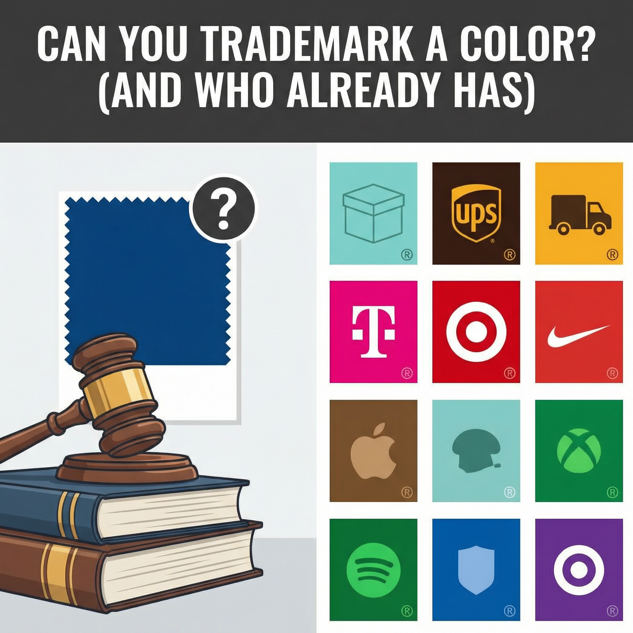
Color trademarks are real. Tiffany & Co. legally owns a specific shade of blue. UPS owns brown. T-Mobile owns magenta so aggressively that it sent a cease-and-desist to a startup just for using that color in its marketing — in a completely different industry.
Advertisement
But these brands spent decades and millions of dollars earning those rights. Color trademark protection is one of the hardest forms of IP to obtain, and one of the most misunderstood.
This guide breaks it down clearly: what a color trademark actually is, what the rules are, who has one, who tried and failed, and what this means for you as a founder right now.
Need help? Our tools can help you identify potential IP conflicts before they become costly problems.Try a free scan →
What Is a Color Trademark?
Advertisement
A color trademark is legal protection for a specific color — or color combination — as applied to a particular product or service in a specific industry.
The key phrase is "as applied to." You are not trademarking the color blue in general. You are trademarking robin's egg blue as used on jewelry packaging, like Tiffany does. You're not trademarking brown — you're trademarking Pullman Brown on delivery vehicles and uniforms, like UPS.
Color trademarks were not always possible. For decades, the U.S. Patent and Trademark Office (USPTO) refused to grant them at all. That changed in 1995, when the U.S. Supreme Court ruled in Qualitex Co. v. Jacobson Products that a color can function as a trademark — but only when it meets specific legal standards.
Advertisement
What Makes a Color Eligible for Trademark Protection?
Need help? Our tools can help you identify potential IP conflicts before they become costly problems.Try a free scan →
For a color to be trademarked, it must pass two tests simultaneously.
Test 1: Non-Functionality
Advertisement
The color cannot serve a practical purpose. If the color helps the product work, indicates what the product is, or gives a competitive advantage unrelated to branding, it cannot be trademarked.
Examples of colors courts have rejected as functional:
- Amber mouthwash (signals flavor)
- Black soft drink bottles (keeps out light)
- Pink ceramic hip implants (natural byproduct of materials)
- Yellow and orange telephone booths (visibility and safety)
- Purple sandpaper (indicates grit size)
Advertisement
Examples of colors that passed the non-functionality test:
- Pink fiberglass insulation (Owens Corning) — pink does nothing functional for insulation
- Light blue jewelry boxes (Tiffany) — the color doesn't affect the jewelry
- Brown delivery trucks (UPS) — brown doesn't make the truck work better
Test 2: Secondary Meaning
Advertisement
The color must have "secondary meaning" — which means that consumers, when they see that color in that industry, automatically think of one specific brand.
This is the harder test. It requires years of consistent, exclusive use, significant marketing spend, and ideally, evidence like consumer surveys showing that people associate the color with your brand specifically.
Need help? Our tools can help you identify potential IP conflicts before they become costly problems.Try a free scan →
The USPTO generally considers at least five years of continuous, exclusive use as a starting point for building a secondary meaning claim. For most successful color trademarks, the real timeline has been much longer.
Advertisement
The Critical Distinction Most People Miss
There is a fundamental difference between a color that appears in your trademarked logo and a standalone color trademark.
When you register a logo trademark in black and white, that registration protects the design — not the colors. Anyone can use the same colors as McDonald's red and yellow. What they cannot do is copy the arches design.
Advertisement
When you register a logo in color, you're protecting that specific design with those specific colors. You're still not claiming ownership of those colors themselves.
Need help? Our tools can help you identify potential IP conflicts before they become costly problems.Try a free scan →
A standalone color trademark — where the color itself is the brand — is an entirely separate and far more difficult thing to obtain.
Most small businesses only ever need the first kind. Almost none will qualify for the second.
Advertisement
Brands That Own Colors (And What They Actually Own)
These are confirmed, registered color trademarks — not brand colors, not common law claims, but actual federal trademark registrations.
Tiffany & Co. — Robin's Egg Blue (Pantone 1837)
Registered in 1998. Protects that specific shade on boxes, bags, and packaging used for jewelry. You can paint your house that color. You cannot sell jewelry in a box that color.
Advertisement
UPS — Pullman Brown
Registered in 1998. Applies to delivery vehicles and uniforms. A clothing company can use that shade of brown. A competing delivery company cannot.
T-Mobile — Magenta (Pantone Rhodamine Red U)
Registered and actively enforced. T-Mobile's parent company has pursued businesses in completely unrelated industries — including insurance startup Lemonade — for using magenta in their marketing materials. Lemonade changed their colors.
Owens Corning — Pink
The first color ever trademarked in the U.S. (1985/1987). Applies specifically to fiberglass insulation. A landmark case that opened the door to all other color trademarks.
Advertisement
3M — Canary Yellow
Protects the yellow color of Post-it notes.
Christian Louboutin — Red Soles
Applies specifically to red lacquered soles on women's high-heeled shoes where the upper is not also red. This one went to federal court and Louboutin won — with that one nuance.
Need help? Our tools can help you identify potential IP conflicts before they become costly problems.Try a free scan →
Other confirmed color trademark holders:
Advertisement
- Home Depot: Orange
- Fiskars: Orange (scissor handles)
- T-Mobile (Deutsche Telekom): Magenta across multiple markets
- University of Texas at Austin: Pantone 159
- University of North Carolina: Pantone 542
Brands That Tried — And Failed
This is the section most guides skip. It matters.
Advertisement
Mattel / Barbie Pink (Pantone 219)
Mattel has filed multiple trademark applications for Barbie Pink and abandoned every single one. The company claims common law rights based on decades of use, but Barbie Pink is not a registered trademark. When Mattel sued MCA Records over the "Barbie Girl" music video in 1997, the court found Mattel had not proven secondary meaning for the color. They lost.
Need help? Our tools can help you identify potential IP conflicts before they become costly problems.Try a free scan →
General Mills — Yellow (Cheerios box)
Cheerios has used yellow on its box since 1945. In a recent trademark application, the USPTO denied registration because yellow is widely used across the cereal category — meaning no single brand can claim it. Decades of use weren't enough because the color was too common in that product space.
BP — Green
The petroleum company spent 12 years trying to trademark the shade of green used in its logo and at its gas stations. It lost in 2014. Green was considered functional and/or too common in the energy/environmental context.
Advertisement
Cadbury — Purple
Cadbury won and later lost trademark protection for its distinctive purple in the UK following legal challenges from Nestlé. Color trademark protection — even when initially granted — can be challenged and overturned.
What About Color Combinations?
Color combinations are somewhat easier to protect than single colors. John Deere's green-and-yellow combination is a common example — John Deere cannot own green alone (functional for agricultural equipment), but the specific pairing of their green with their yellow serves as brand identification.
Advertisement
McDonald's has trademark protection for the red-and-yellow color combination in conjunction with its logo. The colors alone are not protected, but the combination tied to the design creates enforceable rights.
Can Two Companies Use the Same Color?
Yes — if they are in different industries and there is no likelihood of consumer confusion.
Advertisement
UPS owns Pullman Brown for delivery services. A furniture company can use that shade of brown freely. There is no reasonable chance a consumer would confuse a wooden bookshelf with a delivery truck.
Where it gets complicated: if your business is adjacent to, or expanding into, the same space as a brand that holds a color trademark, you may face enforcement action even if you're technically in a different category today.
Need help? Our tools can help you identify potential IP conflicts before they become costly problems.Try a free scan →
T-Mobile's magenta enforcement is the clearest example of aggressive cross-industry protection. They have gone after brands in insurance, tech, and media — not just telecoms.
Advertisement
How to Search for Color Trademark Conflicts
Here is something no AI answer explains well: you cannot search the USPTO database by color.
The USPTO's TESS (Trademark Electronic Search System) and its replacement TSDR do not have a visual color search. You have to search by description or keyword — for example, "the color magenta as applied to telecommunications services."
Advertisement
This makes color clearance research genuinely difficult without professional help. The practical steps are:
Need help? Our tools can help you identify potential IP conflicts before they become costly problems.Try a free scan →
- Identify the specific Pantone or hex value of your color
- Search TESS/USPTO using descriptive terms for your color in your industry class
- Search Google for "[color name] trademark [your industry]"
- Consult a trademark attorney if you're building a brand around a signature color
What to Avoid
Advertisement
Don't assume your logo trademark protects your colors. It doesn't. A trademark on your logo protects the design, not the individual colors within it.
Don't use "we've used this color for years" as your only argument. Duration of use is one factor. It is not sufficient on its own — especially if others in your industry also use the same color.
Don't ignore industry context. Colors that are common in your product category — green for health products, blue for tech, orange for food — are almost always unprotectable as standalone marks.
Advertisement
Don't assume famous brands' colors are all trademarked. Barbie Pink, Coca-Cola Red, Starbucks Green — none of these are registered standalone color trademarks. The ® on those logos protects the logo, not the color.
Don't file a color trademark application without professional guidance. Color trademark applications require evidence packages — consumer surveys, advertising expenditure data, media coverage — that most small businesses haven't built yet.
When Does a Color Trademark Make Sense?
Advertisement
Only pursue a standalone color trademark if all of the following are true:
- Your color is genuinely distinctive in your industry (not commonly used by competitors)
- The color serves no functional purpose in your product category
- You have used the color exclusively and consistently for at least five years
- Consumers already associate the color with your brand specifically
- You have significant marketing investment and documentation to prove it
- You are willing to invest in ongoing enforcement — because trademark rights you don't police can be lost
Need help? Our tools can help you identify potential IP conflicts before they become costly problems.Try a free scan →
For the vast majority of founders and small businesses: protect your name, logo, and tagline first. Those are far more achievable, faster to obtain, and more practically defensible.
Advertisement
Next Steps
- If you are in the early stages of building your brand, focus on name and logo trademark protection before considering color
- If your brand has a signature color that is central to your identity, start documenting all uses now — date-stamped marketing materials, product photos, advertising spend records
- If a competitor is using your exact color in your exact industry and consumer confusion is real, consult a trademark attorney about potential infringement claims based on common law rights, even without a registration
- If you want to search existing color trademarks, use USPTO TESS with keyword descriptions and cross-reference with Google searches in your specific product category
- If you are years into building a strong brand around a specific color, speak with a trademark attorney about whether you have built enough secondary meaning to file on the Principal Register — or whether a Supplemental Register filing now makes strategic sense as a placeholder
Color trademarks are powerful. They are also rare, expensive to build, and almost exclusively the domain of large, established brands. Understanding how they work means you can avoid legal risk — and protect what you've actually built, the right way.