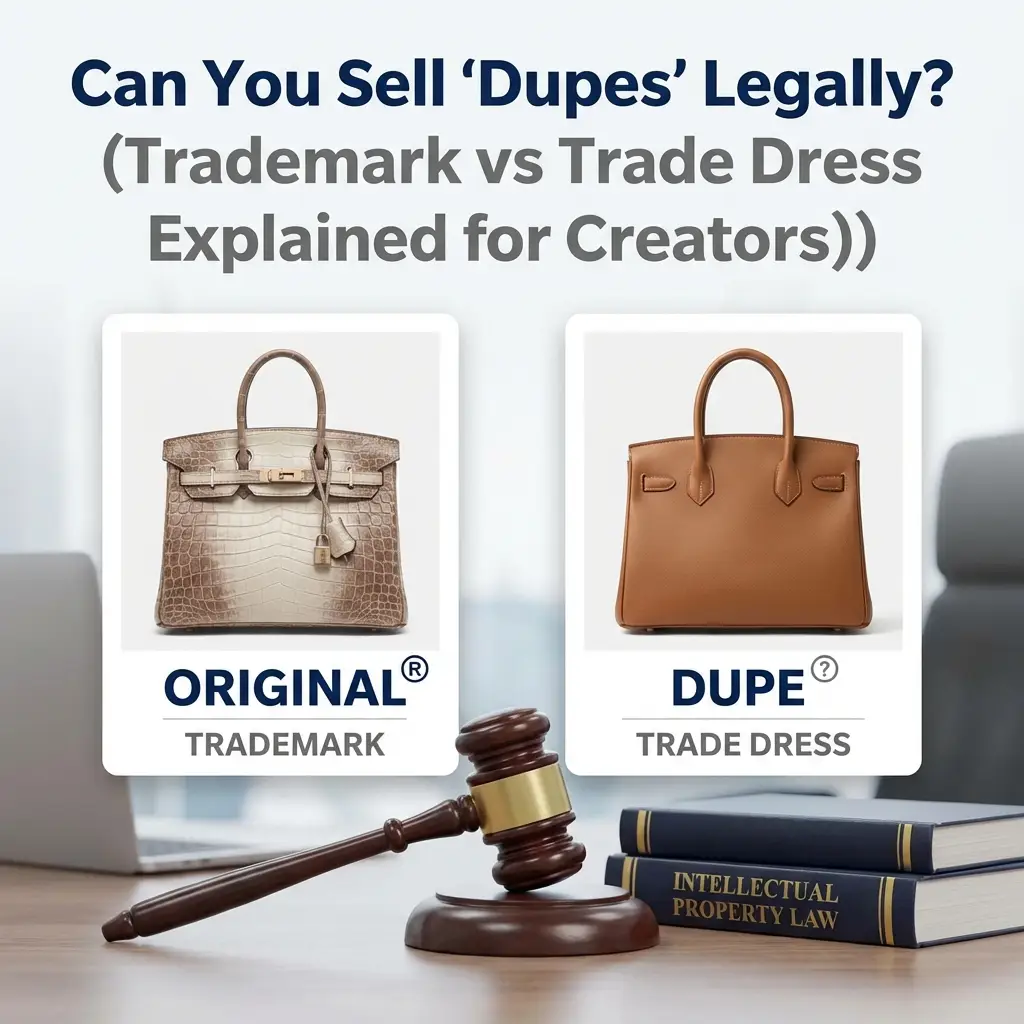
Can You Sell Dupes Legally? What Creators and Sellers Need to Know
Advertisement
If you sell products on TikTok Shop, Etsy, Shopify, or Amazon — or if you're an influencer who promotes affordable alternatives — you've probably wondered exactly where the legal line is.
The short answer: selling dupes is generally legal. But "generally legal" comes with real conditions that are getting more complex by the month. In 2025 alone, Lululemon sued Costco, Sol de Janeiro sued MCoBeauty, Smucker's sued Trader Joe's, and Lululemon registered "LULULEMON DUPE" as a trademark. Courts and brands are drawing new lines — and many small sellers and creators don't know the lines exist.
Advertisement
This guide explains what's actually protected by IP law, where dupes become legally risky, and what the new 2025–2026 enforcement landscape means for your products and content.
What Is a Dupe, and Is It the Same as a Counterfeit?
Need help? Our tools can help you identify potential IP conflicts before they become costly problems.Try a free scan →
No — and the legal difference matters enormously.
Advertisement
A counterfeit product copies a brand's name, logo, or trademark and passes itself off as the real thing. Selling counterfeits is clearly illegal under the Lanham Act and can carry federal criminal penalties including fines up to $30 million and, in extreme cases, imprisonment.
A dupe is a product that mimics the design, style, function, or aesthetic of another product — but uses its own branding. It doesn't claim to be the original and doesn't use the original brand's logo or name on the product itself. This is why Trader Joe's sells crustless peanut butter sandwiches that look a lot like Uncrustables, and why drugstore beauty brands openly release mascara that "looks just like" a prestige version.
The key legal standard for dupes is likelihood of confusion: would a reasonable consumer believe your product is made by, affiliated with, or endorsed by the original brand? If the answer is no, you're in clearer territory. If the answer starts getting murky, so does your legal exposure.
Advertisement
What Is Trade Dress, and Why Does It Matter for Dupe Sellers?
Need help? Our tools can help you identify potential IP conflicts before they become costly problems.Try a free scan →
This is where most creators get caught off guard.
Everyone knows you can't copy a brand's logo. But trade dress is a different and broader form of IP protection — and it doesn't require a logo to exist.
Advertisement
Trade dress protects the overall visual appearance of a product or its packaging that consumers associate with a specific brand. That includes:
- The shape and design of the product itself
- Color schemes and color combinations
- Packaging layout, texture, and visual arrangement
- The overall "look and feel" that signals the product's origin
Famous examples: the distinctive contour of a Coca-Cola bottle. The pink-and-black Benefit Roller Lash mascara tube. The shape of a Lululemon Define jacket. The coral packaging of Sol de Janeiro body mists.
Advertisement
Trade dress is legally protected under Section 43(a) of the Lanham Act — and crucially, it does not need to be registered with the USPTO to be enforceable. A brand can sue for trade dress infringement based on common law rights alone, as long as the trade dress meets two requirements:
- Distinctiveness — consumers associate the look with a specific brand (this is called "secondary meaning")
- Non-functional — the protected elements serve a branding purpose, not a utilitarian one
This is why copying a product's design without touching the logo can still land you in legal trouble. When Costco sold hoodies and jackets that allegedly mirrored Lululemon's distinctive silhouette, pocket architecture, and stitching — without using the Lululemon name anywhere — Lululemon still sued for trade dress infringement.
Advertisement
The New Legal Shift: False Advertising Is the New Front
Here's what almost no creator-facing content covers yet: brands are increasingly moving away from pure trade dress claims and toward false advertising as their primary enforcement weapon against dupes.
Need help? Our tools can help you identify potential IP conflicts before they become costly problems.Try a free scan →
Why? Because proving trade dress infringement requires brands to establish secondary meaning and likelihood of confusion — which is hard and expensive. False advertising claims under the Lanham Act are often simpler to prove and reach farther.
Advertisement
The trigger: when dupe sellers (or the influencers promoting them) make specific factual claims about equivalence.
Phrases like these are now being litigated:
- "This smells exactly like [brand]"
- "Performs the same as [luxury product]"
- "The same chair for 80% less"
- "It's literally identical"
- "This is a perfect dupe for [X]"
Advertisement
If those claims are factually false — and they often are when comparing a $6 product to a $29 one — that's false advertising, regardless of whether any logo was copied. Sol de Janeiro's 2025 lawsuit against MCoBeauty centers heavily on influencer videos claiming the products "smell exactly like" the originals. Williams-Sonoma sued dupe.com for falsely claiming certain furniture was "the same" as Pottery Barn pieces that are exclusively designed.
Need help? Our tools can help you identify potential IP conflicts before they become costly problems.Try a free scan →
The bottom line: even if your product doesn't infringe any trademark or trade dress, making false equivalence claims in your marketing can create its own legal exposure.
Where the Legal Lines Actually Are: A Risk Spectrum
Advertisement
Think of dupe risk on a spectrum from lowest to highest:
✅ Low Legal Risk
- Your product is in a different category or clearly different aesthetic
- You use completely original branding (name, logo, packaging, color scheme)
- You don't mention the original brand in your marketing or listings
- You compete on price and function without claiming equivalence
Advertisement
⚠️ Moderate Legal Risk
- Your product's design closely resembles a brand's trade dress (shape, color scheme, packaging)
- Your product is in the same category with a visually similar presentation
- You use the brand's name in hashtags or organic social content (not paid)
- Your marketing implies but doesn't state equivalence
🚨 High Legal Risk
Advertisement
- Your product copies distinctive product design, color, or packaging elements that consumers associate with a specific brand
- You use the brand's name in paid advertising, product listings, or affiliate marketing (especially now that Lululemon holds "LULULEMON DUPE" as a trademark)
- You or an influencer you work with claims your product "smells the same," "is identical to," or "performs the same as" a luxury product — and it doesn't
- You source products from suppliers who make items designed to closely mimic protected designs
What Platforms Actually Allow (and Don't)
Need help? Our tools can help you identify potential IP conflicts before they become costly problems.Try a free scan →
The platform rules around dupes are stricter than most sellers realize:
Advertisement
TikTok Shop explicitly prohibits sellers from "making claims anywhere in their product listing that the products are dupes, fakes, knock-offs, or anything similar." The hashtag #designerdupe is also blocked on TikTok because it frequently surfaces counterfeit goods.
Amazon has banned "dupe" as a search term entirely.
Target has prohibited the word internally in its marketing materials.
Advertisement
Etsy prohibits selling items that copy someone's trade dress or artistic style closely enough to constitute infringement, and has removed shops for this.
Need help? Our tools can help you identify potential IP conflicts before they become costly problems.Try a free scan →
Even if something would be legal in a court of law, violating platform policies can result in listing removal, account suspension, or permanent bans — without any lawsuit required.
The Influencer-Specific Liability Question
Advertisement
If you're a creator who promotes dupe products rather than making them, your legal risk depends heavily on how you're compensated.
Posting about dupes for free, not for profit: Lowest risk. Organic social commentary and personal recommendations are well-protected under existing law.
Using affiliate links: You're now in advertising territory. The FTC requires you to disclose any material benefit (including affiliate commissions) when you recommend products. If you're making claims about equivalence — "this is the exact same thing for less" — and those claims are false, you can face liability under the FTC Act and state false advertising laws.
Advertisement
Contracted brand partnerships to promote dupe products: Highest risk. Both you and the brand can be held liable for misleading claims. If a brand directs you to claim equivalence with a luxury product and the claim is false, liability can flow to both parties.
The distinction matters: an influencer who built their entire persona around finding dupes (with no paid relationships) is harder to target legally. An influencer who earns a commission every time a follower buys a "dupe" through their link — and makes false performance claims to drive those clicks — is squarely in FTC and false advertising territory.
What to Avoid: The Most Common Mistakes
Advertisement
Assuming "no logo = no problem." Trade dress protects the look, not just the name. Products with distinctive packaging or design configurations can be protected even without a logo anywhere in sight.
Using a brand's name in your product title or listing. TikTok Shop bans it by policy. Paid ads using another brand's name to describe your product create trademark issues. Organic social posts are lower risk but not zero risk.
Need help? Our tools can help you identify potential IP conflicts before they become costly problems.Try a free scan →
Making performance or quality equivalence claims you can't substantiate. "Smells exactly like," "works the same as," "identical to" — if these claims are false, they're legally actionable regardless of whether any design was copied.
Advertisement
Sourcing products from suppliers who design explicitly to copy another brand. If you're the seller on record and the product infringes trade dress, the fact that you didn't design it doesn't protect you from a takedown notice or lawsuit.
Ignoring platform policies. Even legal products can lose their listings if they violate platform rules around dupe language or visual similarity.
When to Seek Legal Guidance
Advertisement
Consider consulting an IP attorney if any of the following apply:
Need help? Our tools can help you identify potential IP conflicts before they become costly problems.Try a free scan →
- Your product's design, packaging, or color scheme closely resembles a brand that is known for enforcing its IP
- You've received a cease-and-desist letter or platform takedown notice
- You're building a product line specifically marketed as alternatives to named luxury brands
- You're a creator with a large following whose dupe content generates significant affiliate income
- You're a brand that's being duped and want to understand your protection options
Next Steps: What to Do Before You List, Launch, or Promote
Advertisement
Before selling or promoting a dupe product, run through these questions:
Does my product's visual design, packaging, or color scheme closely mirror a brand's trade dress? If yes, assess whether those elements have acquired secondary meaning in the market. When in doubt, differentiate your design.
Am I using the original brand's name in any commercial context? Product listings, paid ads, and affiliate-linked content are all commercial. Revisit the copy.
Advertisement
Are any performance, equivalence, or quality claims in my marketing accurate and substantiable? If you can't back up "works just like [brand]" with evidence, don't make the claim.
Have I checked platform policies specifically? TikTok Shop, Amazon, and Etsy all have explicit rules. Read them before listing.
Am I an influencer using affiliate links to promote dupe products? Disclose the relationship. Scrutinize the performance claims you're being asked to make.
Advertisement
Dupe culture isn't going away — but the legal landscape around it is hardening quickly. Knowing exactly where the lines are is the most practical IP education a creator or small seller can have before the next product launch.