The Short Answer Nobody Actually Gives You
Advertisement
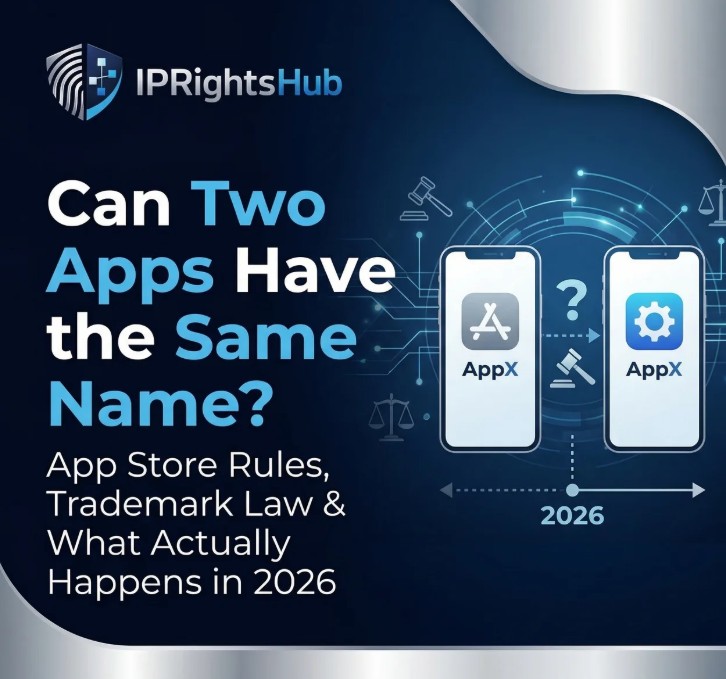
Yes, technically two apps can share the same name. But "technically allowed" and "legally safe" are two completely different things — and the space between them is where thousands of developers have lost months of work, had apps forcibly renamed, or received legal threat letters out of nowhere.
App stores have their own rules. Trademark law has its own rules. They don't talk to each other. And that disconnect is the entire problem.
Advertisement
Here's what's actually happening on each platform in 2026, why the usual "Apple says no, Google says yes" summary is dangerously incomplete, and what you should actually do depending on where you are in your launch journey.
Apple App Store: Unique Names at Submission, But It's Complicated
Need help? Our tools can help you identify potential IP conflicts before they become costly problems. Try a free scan →
Apple enforces display name uniqueness at the point of submission in App Store Connect. If the exact name you're trying to register has already been taken, you'll hit the error: "The Application Name that you provided has already been used."
Advertisement
That sounds straightforward. It's not.
What Apple is checking is the display name tied to an App Store Connect record — not just live, visible apps. A developer can reserve a name and never publish the app, and that reservation can hold for up to 180 days. So you might search the App Store, see nothing, and still get blocked at submission because of an invisible reservation you had no way of knowing about.
There's also the bundle ID vs display name distinction. Apple assigns each app a unique bundle identifier (like com.developer.appname) — that's the technical fingerprint that never changes. The display name people see in the store is separate, and while Apple enforces uniqueness on display names at submission, there are documented edge cases where near-identical names slip through, particularly across different Apple platforms (iOS vs Mac) or regions.
Advertisement
Then there's Guideline 4.1(c), which Apple updated in 2025 and caused genuine chaos in the developer community. The guideline bans naming patterns like "[MyApp] for [Service]" — so if you'd built your ASO strategy around a name like "Scheduler for Notion" or "Tracker for Shopify," that pattern is now a rejection risk. Developers who had been live for years with these names suddenly found themselves facing enforcement.
Need help? Our tools can help you identify potential IP conflicts before they become costly problems. Try a free scan →
The practical upshot: Apple's name rules are harder than Google's at launch, but they're still not trademark enforcement. The App Store approving your name means nothing legally.
Google Play: Flexible Titles, Delayed Consequences
Advertisement
Google Play doesn't enforce display name uniqueness. Multiple apps can have the exact same visible title as long as each has a unique package name (the Android equivalent of a bundle ID). You can search Google Play right now and find several apps called "Budget Tracker" or "Habit Journal" — completely different products, same name.
This feels like freedom. It can become a liability.
Google does enforce against impersonation and trademark infringement — but it does so reactively, via complaint, not proactively at submission. This means you can publish, grow an audience, build a brand around your app name, and then receive a takedown notice months or years later because someone filed a trademark complaint.
Advertisement
Google's enforcement threshold is "likely to cause confusion" — a legal standard that's fuzzier than it sounds. A competitor with a registered trademark in the same category and region as your app has a strong basis for complaint. Whether Google sides with them depends on the strength of their registration, how similar the names are, and whether there's genuine consumer confusion risk.
There's also the newer "duplicate content" policy angle, which targets clone apps and near-identical experiences rather than just name similarity. But name is still a factor in impersonation reviews.
The practical upshot: Google Play lets you in easily, but it doesn't protect you. Someone can let you build for 18 months, then file a trademark complaint and force a rebrand.
Advertisement
The Trademark Layer Nobody Explains Properly
Here's the part most articles skim past: neither Apple nor Google is a trademark court. Their decisions about whether your app can use a name are independent of whether using that name is legally defensible.
Need help? Our tools can help you identify potential IP conflicts before they become costly problems. Try a free scan →
App names are protected under trademark law, not copyright law. That distinction matters because copyright is automatic (you create something, you own the copyright). Trademark is use-based and registration-based — you build rights by actually using a name in commerce, and you strengthen those rights by registering with a trademark office (like the USPTO in the US or the IPO in the UK).
Advertisement
"Confusingly similar" is the standard that matters, and it doesn't require identical names. An app called "Spotty" in the music streaming space could face a trademark challenge from Spotify even though the names aren't the same, because consumer confusion is plausible given the category, the audience, and the visual/phonetic similarity.
Three things determine your actual risk:
Category (Nice Class): Trademarks are registered in specific classes of goods and services. An app called "Orbit" in productivity tools (Class 42) is a different legal situation than "Orbit" in casual gaming — even if both are apps. Overlap of category increases risk significantly.
Advertisement
Geography: A registered trademark in the US doesn't automatically cover the UK, EU, or Australia. But if you launch in multiple markets, you need to check each one. And if you're planning international expansion, a trademark conflict in your primary market can block your most important growth move at the worst possible time.
Need help? Our tools can help you identify potential IP conflicts before they become costly problems. Try a free scan →
Who registered first vs who used first: In the US, trademark rights come from actual use in commerce, not just registration. This creates a scenario Reddit developers know well: you launch, build an audience, start generating revenue — then someone else registers your exact name as a trademark 6 months later and demands you rebrand. Whether they can succeed depends on whether you can prove you used the name commercially first. Without that proof documented somewhere, you're in an expensive fight.
What Actually Happens When Conflicts Arise
Advertisement
The community intelligence here is more useful than any legal blog.
Scenario 1: You launch on Google Play, someone else has the same name. If neither party has a registered trademark, this is mostly a waiting game. The first person to register and use the name in commerce builds the stronger position over time. If they register a trademark and you don't, they can file a complaint and Google will likely remove your app or require a rename.
Scenario 2: You try to submit to Apple and get the "already been used" error. You can't directly see why. It might be a live app, a reserved name, or a previously deleted app whose name is still locked. Apple has an App Name Dispute form that lets trademark holders challenge an existing app name — but there's no equivalent tool for developers simply trying to understand why their desired name is blocked. Your options are to adjust the name slightly, use a subtitle for the keyword, or if you own a registered trademark for the exact name, raise a formal dispute.
Advertisement
Scenario 3: You get a threat letter. This is where most developers panic. The letter usually claims trademark infringement and demands you rename the app, pull keywords from your metadata, and often pay licensing fees. The first thing to check: do they actually have a registered trademark in your category and region? Many of these letters are fishing expeditions sent to dozens of apps using similar names. Check TESS (the USPTO's trademark database) or your national equivalent. If their registration is real, in your class, and in your territory — take it seriously and get legal advice. If it's vague or out-of-category, you have more ground to stand on than the letter implies.
Scenario 4: You scale internationally and hit a conflict. This is where the cross-border layer bites. A name that's clear in the UK might be trademarked in the US, Germany, or Canada. Once you start running paid acquisition in new markets, you're potentially infringing. Check each key market before you invest in marketing there.
The Naming Lifecycle Nobody Draws Out
Advertisement
Risk from app name conflicts isn't static. It compounds as you grow.
At the prototype stage, the risk is low and mostly theoretical. At launch, if your name is unregistered and similar names exist, your exposure starts to accumulate. At 10,000 users, you're visible enough to attract competitor attention. At 100,000 users and active revenue, you have something worth attacking — and competitors know it. At international expansion, you're crossing into legal jurisdictions where existing rights may already apply to your name.
Need help? Our tools can help you identify potential IP conflicts before they become costly problems. Try a free scan →
The cost of changing a name scales with your growth. Before launch: zero cost. After 12 months of marketing assets, community branding, and App Store reviews: potentially rebuilding your entire brand from scratch.
Advertisement
The developers who get burned aren't the ones who checked and found nothing. They're the ones who assumed that "nothing in the App Store" meant "legally safe" — and skipped the trademark search entirely.
The 2026 Reality Check
Platform rules are tightening, not loosening. Apple's 4.1(c) change hit developers who'd relied on formula naming for years. Google's impersonation enforcement is more active than it was in 2022. The number of trademark applications for app names has increased as the app economy has matured.
Advertisement
The question "can two apps have the same name?" has a technical answer that changes by platform. But the question founders actually need to answer is: "is my app name protected, and am I protected from others using it?" That answer lives entirely in trademark law, not in the App Store approval screen.
Run the trademark check before you spend money on a name. Not after.