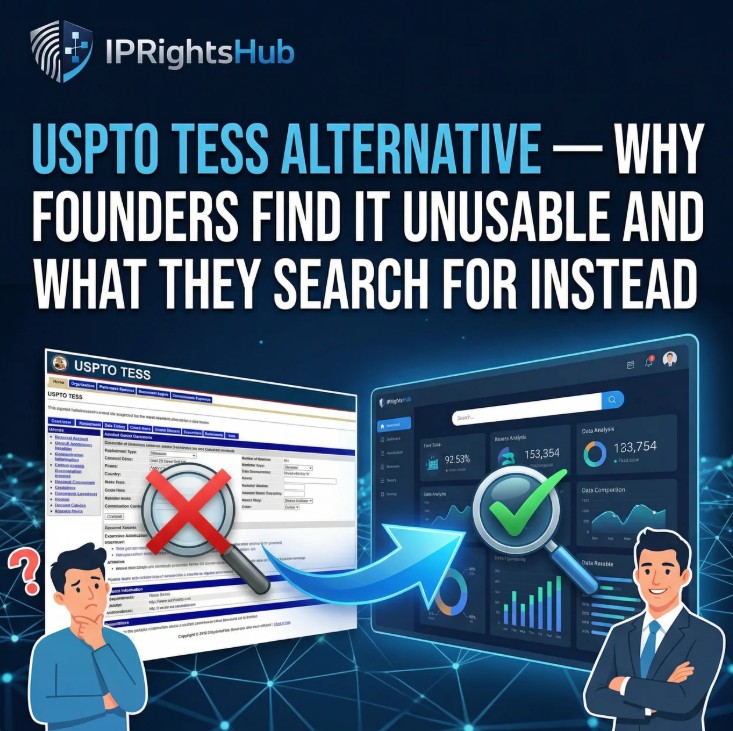
USPTO TESS Alternative: AI Trademark Search Without the Legal Degree
Advertisement
What Is USPTO Trademark Search — And Why Founders Hit Its Limits
The USPTO's trademark database is the official government record of every federally registered trademark and pending application in the United States. When TESS (Trademark Electronic Search System) was retired in November 2023, it was replaced by a cloud-based system still informally called "TESS" by most people who use it — officially it's just "Trademark Search" at tmsearch.uspto.gov. It's free, it's official, and it contains over 11.5 million trademark records. For a trademark attorney running a clearance search, it's a core professional tool.
Advertisement
The problem is that it was built for those attorneys, not for you. To use it properly, you need to understand Boolean operators, field tag syntax, Vienna design code classifications, international Nice classes, phonetic equivalency searches, and the legal standard of "likelihood of confusion" — a legal test that the tool itself doesn't apply. The system shows you data. It does not tell you whether you're safe. That interpretation gap is where founders get burned.
The Problem With USPTO Trademark Search for Founders and Creators
Need help? Our tools can help you identify potential IP conflicts before they become costly problems. Try a free scan →
It only shows you what you already know to search for. Type your exact brand name, get results for that exact string. What it won't do automatically: surface phonetically similar marks, catch spelling variants, flag marks in related industries, or warn you that "SunFuel" and "Son Fuel" are legally the same conflict. You have to run dozens of variations yourself — which is why a thorough self-search realistically takes 15–20 hours, not the 15 minutes most founders budget.
Advertisement
A clean result is not a green light. This is the single most dangerous misconception about USPTO search. Over 50% of trademark applications receive an Office Action after filing, and roughly 1 in 5 applications is hit with a Section 2(d) "likelihood of confusion" refusal — meaning the examiner found a conflicting mark you either didn't search for or didn't recognise as a conflict. The search tool shows records. The likelihood of confusion analysis is a human legal judgment it doesn't perform.
It doesn't cover the full trademark landscape. USPTO search only shows federal registrations and pending applications. It doesn't surface common law marks — brands that have been operating commercially for years without ever filing federally — and those marks can still block your application or trigger an infringement claim. It also misses state-level trademark registrations. A competitor operating in your city with a strong common law claim on your name won't appear in any USPTO search.
The design search is practically unusable without specialist training. If you need to check whether your logo conflicts with an existing one, you need to translate the visual elements into Design Code Manual codes — a classification system where five different trademark examiners would describe the Pepsi logo five different ways. The USPTO's own training acknowledges this subjectivity. If you're checking logo safety before a rebrand, USPTO's system won't give you a usable answer.
Advertisement
If you're launching a Shopify store, a mobile app, or a creator brand, and you do a quick USPTO search, see nothing, and feel safe — you've taken on legal risk you don't know you have. That's not a scare tactic. It's a documented failure mode with a paper trail of office actions and rebranding costs behind it.
Need help? Our tools can help you identify potential IP conflicts before they become costly problems. Try a free scan →
IPRightsHub vs USPTO Trademark Search: Side-by-Side
| Feature | USPTO Trademark Search | IPRightsHub |
|---|---|---|
| Cost | Free | Free (Pro Deep Scan from £2.99) |
| Sign-up required | Optional (recommended by USPTO) | No |
| Phonetic / sound-alike detection | Manual — you must search variants yourself | AI-powered — auto-detects similar-sounding marks |
| Logo / visual similarity check | Requires Vienna design code knowledge | Instant AI Logo Similarity Scanner |
| Common law mark coverage | Not included | Broader similarity signals via AI cross-referencing |
| Plain-English results | No — raw database records | Yes — results designed for non-lawyers |
| Mark strength assessment | Not provided | Indicated via similarity risk scoring |
| Time to useful result | 15–20 hours for thorough search | Under 2 minutes |
| Ongoing monitoring | Not available | IP-SAM™ — per-asset monthly monitoring |
| Guidance on next steps | None | Contextual Pro Deep Scan and IP-SAM™ paths |
| Mobile-friendly | Limited | Yes |
| Federal database coverage | Complete (11.5M+ records) | Draws from federal data + AI similarity layer |
| Suitable for pre-filing clearance | With attorney guidance | As a pre-screening / knockout tool |
Advertisement
Honest note: for a complete attorney-grade clearance search before a major filing, neither tool replaces a qualified trademark attorney. IPRightsHub is a fast, intelligent first screen — not a legal opinion.
Why IPRightsHub Works Better for Founders, Creators, and Solo Operators
The core problem USPTO search has isn't the database — it's that the database is a professional-grade instrument handed to non-professionals with no interpretation layer. IPRightsHub puts the AI interpretation layer in between, so you get an actionable answer instead of a wall of raw records.
Advertisement
The Trademark Name Scanner doesn't just match your exact search term against the federal database. It analyses phonetic similarity, visual pattern overlap, and semantic relationships — catching the kind of conflicts a basic keyword search misses. When you type your brand name, you're not just getting a yes/no on exact matches. You're getting a similarity risk signal that reflects how a trademark examiner is actually trained to think.
Here's a concrete scenario. You're three weeks from launching a SaaS product. You've already bought the domain, briefed a designer on the logo, and you need a fast pre-check before committing to the brand. With USPTO search, you'd need to: learn which of the three search modes to use, manually construct phonetic variants, understand how to cross-reference trademark classes, and interpret what "likelihood of confusion" means for your specific goods category — then probably still wonder if you got it right. With IPRightsHub, you enter the name, get an AI-powered similarity scan in under two minutes, and know whether to proceed or dig deeper. If risk flags come up, the Pro Deep Scan (£9.99) gives you a more thorough analysis. If you want ongoing protection after launch, IP-SAM™ monitors your registered assets and alerts you to new filings that could conflict with your mark — something USPTO search doesn't offer at all.
For logo safety, the Logo Similarity Scanner is a category the USPTO database essentially doesn't serve non-specialists. Visual trademark conflicts are real — they're just inaccessible to check without design code expertise. IPRightsHub closes that gap with an AI visual similarity scan that doesn't require you to know what a Vienna code is.
Advertisement
When USPTO Trademark Search Might Still Make Sense
If you're a trademark attorney, a law student learning search methodology, or someone who already understands Boolean search logic and trademark class structure — USPTO search is the primary tool, and you should use it. It's also the right place to verify specific registration details, track application status, or research what a competitor has filed. And if you need a court-admissible comprehensive clearance search before a major acquisition, funding round, or international filing, you still need a qualified IP solicitor running a full professional search. No free tool — including IPRightsHub — replaces that. What IPRightsHub replaces is the false confidence of a 10-minute basic name search that misses 80% of real conflicts.
Need help? Our tools can help you identify potential IP conflicts before they become costly problems. Try a free scan →
The Verdict
Advertisement
USPTO's trademark search is a powerful database that requires significant expertise to use accurately. For founders checking a name before launch, creators protecting a brand, or operators doing routine brand safety checks, it's the wrong tool for the job — not because it's bad, but because it was built for a different user. IPRightsHub is the fast, AI-powered first screen that gives you actionable similarity intelligence in minutes, not hours, without a law degree. Use IPRightsHub to identify real conflicts early. Use USPTO search to verify specific registration details. Use a solicitor when serious money or legal filings are on the line. Do all three, in that order, and you've got the smartest low-cost IP protection workflow available to a solo operator in 2026.
FAQ
Is USPTO trademark search free?
Advertisement
Yes, the USPTO trademark database is completely free to access at tmsearch.uspto.gov. There are no fees to search — you only pay when you file a trademark application ($225–$400 per class, depending on the application type). The cost isn't the problem; the complexity is.
Need help? Our tools can help you identify potential IP conflicts before they become costly problems. Try a free scan →
Does USPTO trademark search catch phonetically similar trademarks?
Not automatically. You have to manually search phonetic variants yourself — which means constructing separate searches for every sound-alike version of your name. The system won't warn you that "Nayke" conflicts with "Nike." IPRightsHub's AI Trademark Name Scanner detects phonetic and spelling similarity automatically as part of the base scan.
Advertisement
What's the best free trademark checker for founders in 2026?
For fast pre-screening and AI-powered similarity detection, IPRightsHub is the strongest free option for non-lawyers. It covers Trademark Name Scanner, Logo Similarity Scanner, and business name conflicts across 36 free tools — no signup required. For verifying specific federal registration records, USPTO's database remains the authoritative source and should be used alongside any AI tool.
Can I use IPRightsHub instead of USPTO trademark search?
Advertisement
For a quick knockout check and similarity risk assessment — yes, IPRightsHub is faster and more accessible. For verifying exact registration status, checking filing dates, or pulling official USPTO records for a legal proceeding — use USPTO's system directly. The two tools serve different parts of the same workflow, not the same purpose.
How accurate is AI trademark similarity checking?
AI trademark scanning is highly effective at identifying conflicts a basic keyword search misses — phonetic similarity, visual overlap, and semantic relationships. It's not a legal opinion and doesn't replace attorney-grade clearance analysis. IPRightsHub is explicitly positioned as an intelligent pre-screening tool, not a legal green light. The value is in catching real conflicts early and cheaply — before you've invested in branding, domains, and launch assets on a name that turns out to be legally exposed.