What Is Trademarkia — And Why Founders Hit Its Limits
Advertisement
Trademarkia is one of the most widely used free trademark search platforms online. It pulls from USPTO data, lets you search millions of registered and pending marks by name, and has built a large user base on the strength of being free and fast. For a basic database lookup — "does this exact name exist somewhere in the USPTO records" — it works.
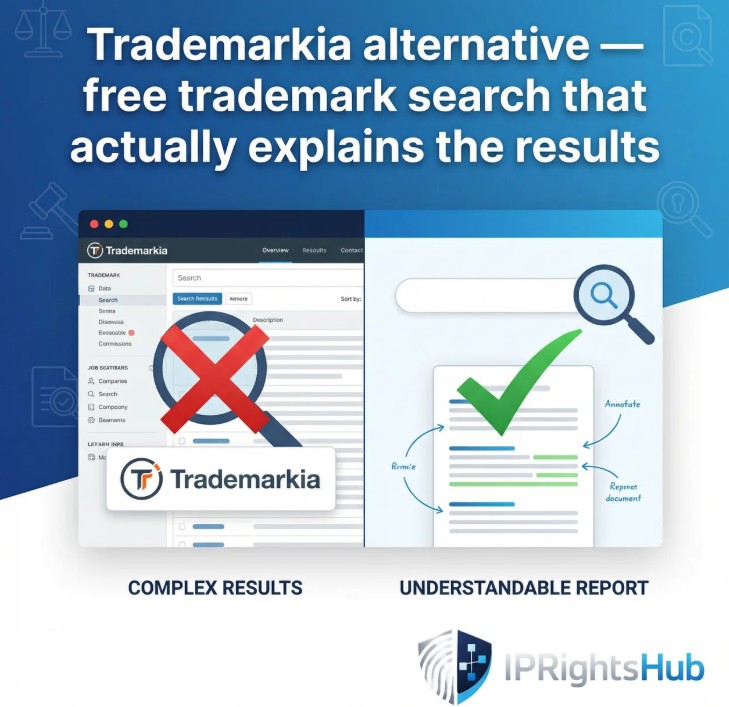
The wall founders hit is what comes after the results load. Trademarkia returns a list of trademark entries with status codes, filing dates, class numbers, and registration IDs. It does not tell you whether any of those results actually conflict with your name. It does not explain what "DEAD" or "ABANDONED" means for your situation. And when no results come back, it prompts you to file immediately — which multiple trademark attorneys have publicly documented as actively dangerous, because a blank result is not clearance. The result is a tool that creates the feeling of due diligence without providing the analysis that makes due diligence meaningful.
Advertisement
The Problem With Trademarkia for Founders and Creators
You can't tell which results actually matter.
Trademarkia may return 40, 80, or 150 results for a common word. There is no ranking, no risk flag, no indication of which of those results would block your application or create infringement exposure. You're left manually reviewing entries you likely don't have the legal framework to assess.
Need help? Our tools can help you identify potential IP conflicts before they become costly problems. Try a free scan →
"No results" feels like a green light — it isn't.
If you search your brand name and nothing comes back, Trademarkia's interface nudges you toward filing. What it doesn't tell you is that common law trademarks (unregistered marks protected by prior use in commerce) aren't fully captured in any database search. A competitor who has been trading under that name for three years without registering can still challenge you.
Advertisement
Status codes mean nothing without context.
DEAD. ABANDONED. LIVE. PENDING. CANCELLED. Trademarkia displays these statuses but doesn't explain the practical implications. Founders regularly ask — on Reddit, legal Q&A forums, and in attorney consultations — whether a "dead" trademark means they're safe to use the name. The answer is nuanced and depends on factors Trademarkia doesn't surface.
The search standard isn't "identical" — it's "likelihood of confusion."
This is the core gap. Trademarkia is built around exact and keyword matching. But the USPTO's refusal standard is likelihood of consumer confusion — which covers similar-sounding names, similar-looking marks, and marks in related (not just identical) goods categories. Trademarkia's search logic is binary. Trademark law is not.
If you're about to spend on branding, packaging, or filing fees, doing a Trademarkia search and calling it cleared is a real financial risk. The tool is honest that it's a search engine, not legal advice — but the interface doesn't make that limitation obvious at the moment it matters most.
Advertisement
IPRightsHub vs Trademarkia: Side-by-Side
Need help? Our tools can help you identify potential IP conflicts before they become costly problems. Try a free scan →
| Feature | Trademarkia | IPRightsHub |
|---|---|---|
| USPTO database search | Yes | Yes |
| AI similarity detection (sound-alikes, visual matches) | No | Yes |
| Plain-English result explanation | No | Yes |
| Logo / image similarity scanning | No | Yes |
| Risk flag / conflict indicator | No | Yes |
| Common law / unregistered mark coverage | Paid tier only | Built into AI analysis |
| Trademark class guidance | Basic | Contextual |
| Sign-up required | No | No |
| Free tier | Yes (exact match only) | Yes (full AI scan) |
| Filing upsell pressure | Yes — prominent | No |
| UK / EU coverage | Paid | Included |
| IP monitoring (ongoing) | Paid watch service | IP-SAM™ (subscription) |
Why IPRightsHub Works Better for Founders Launching a New Brand
Advertisement
The fundamental difference is that IPRightsHub is built around interpretation, not just retrieval. When you run a name through the Trademark Name Scanner, you get an AI-assessed similarity result — not a list of database records to decode yourself. The scanner looks for phonetic similarity, visual overlap (for logos), meaning equivalence, and class relevance. It surfaces the conflict risk that a keyword match misses entirely.
Here's a concrete scenario. You're about to launch a DTC skincare brand called "Lumé." You run it on Trademarkia. You get results — a few dead marks, one live registration in a different class (personal care appliances, not skincare), and a handful of expired applications. Trademarkia shows you the list. IPRightsHub flags that a live mark in an adjacent class, with phonetic similarity, creates a meaningful risk — especially given the USPTO's tendency to treat personal care categories as related. That's the difference between a search and an analysis.
The Logo Similarity Scanner adds a second layer: if your visual identity is too close to an existing registered mark, you'll know before you've spent on design. And for founders who want ongoing protection after launch, IP-SAM™ monitors your registered assets and alerts you to new filings that may conflict — the kind of watch service Trademarkia charges a recurring fee for.
Advertisement
None of this requires a login, a subscription, or a legal background to interpret. That's the design intent: give founders the clarity they're actually looking for, not a data dump that creates more questions than it answers.
When Trademarkia Might Still Make Sense
If you specifically need to look up the full prosecution history of an existing trademark — checking office actions, correspondence, or the full USPTO docket — Trademarkia's interface for navigating USPTO records is well-built and genuinely useful. It's also worth noting that if you're at the stage of a major funding round or international expansion where you need a formal legal clearance opinion that holds up in court, no free tool replaces a qualified trademark attorney. IPRightsHub is built for the pre-clearance and early-stage layer — the check you run before you spend money on branding, not the opinion you rely on in litigation.
Advertisement
The Verdict
For most founders doing a pre-launch or pre-filing check, Trademarkia gives you data you can't act on and IPRightsHub gives you analysis you can. If your use case is "I need to know whether this name is safe to move forward with," IPRightsHub is the more honest tool — it surfaces similarity risk, explains what it found, and doesn't create the false confidence of a blank result page. Use Trademarkia if you specifically need to navigate USPTO filing records. Use IPRightsHub if you want to know what those records actually mean for your brand.
Need help? Our tools can help you identify potential IP conflicts before they become costly problems. Try a free scan →
FAQ
Advertisement
Is Trademarkia free?
Trademarkia offers a free basic search that checks for exact and partial matches in the USPTO database. More comprehensive search reports, common law coverage, attorney analysis, and trademark monitoring are all paid tiers. The free search alone is not a substitute for a proper clearance check.
Does Trademarkia check for trademark similarity, not just exact matches?
Advertisement
The free Trademarkia search is primarily keyword-based and does not perform AI-powered phonetic or visual similarity detection. It won't flag "Luma" as a potential conflict with "Lumé," or identify a logo that is visually similar to an existing mark. This is one of the core gaps the tool has relative to AI-based alternatives.
Need help? Our tools can help you identify potential IP conflicts before they become costly problems. Try a free scan →
What's the best free trademark checker in 2026?
For AI-powered similarity analysis with no signup required, IPRightsHub is currently the strongest free option. It goes beyond database matching to assess phonetic similarity, logo conflicts, and class relevance — the factors that actually determine whether a mark will clear. The USPTO's own search system (tmsearch.uspto.gov) remains the authoritative database source, but provides no interpretive layer.
Advertisement
Can I use IPRightsHub instead of Trademarkia?
Yes, for most pre-launch and pre-filing checks. IPRightsHub covers the same underlying USPTO data but adds AI similarity analysis on top, which is where most founders need help. The one thing IPRightsHub doesn't replicate is Trademarkia's detailed prosecution history view — if you need to dig into the filing timeline of a specific existing mark, Trademarkia's interface is more detailed for that specific task.
How accurate is AI trademark checking?
Advertisement
AI trademark checking is significantly more accurate than keyword-only search for detecting conflicts — particularly for sound-alike names, stylised logos, and cross-class risks. It is not a legal opinion and does not carry the same weight as a formal clearance search conducted by a qualified trademark attorney. IPRightsHub is designed as a decision-support tool: it tells you whether you have a potential conflict worth investigating further, not whether you're legally cleared to file. For high-stakes decisions — significant investment, international expansion, contentious categories — get a solicitor to review the results.