What Is Namecheckr — And Why Founders Hit Its Limits
Advertisement
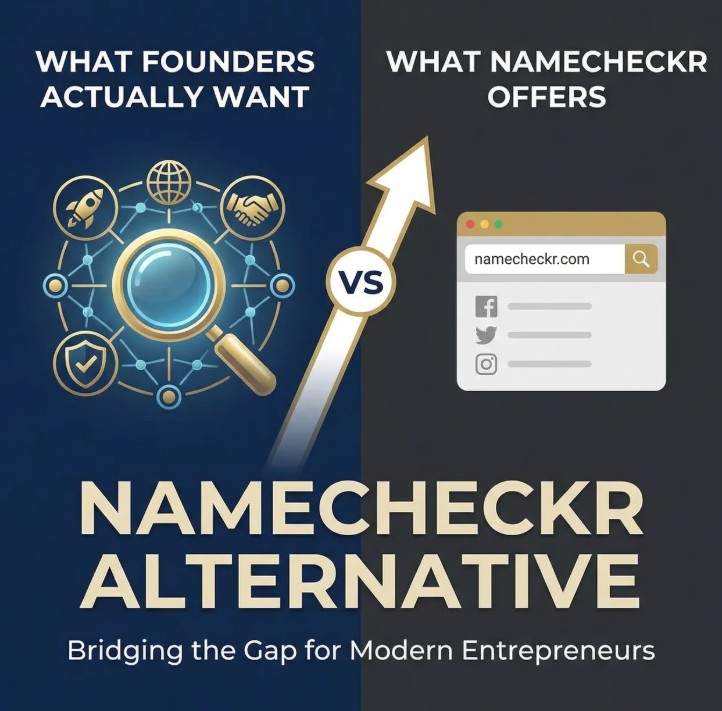
Namecheckr is a free tool that checks whether a username or handle is available across social media platforms and common domain extensions. You type in a name, hit search, and within seconds you can see whether that handle is taken on Instagram, Twitter/X, Reddit, YouTube, LinkedIn, and a handful of TLDs like .com, .net, and .org. For that narrow job — checking social availability at a glance — it works.
The problem is that most founders using Namecheckr aren't just trying to claim a username. They're trying to answer a completely different question: is this brand name actually safe to use? That question requires trademark clearance, similarity analysis, and an understanding of common law IP rights. Namecheckr does none of that. It returns a green or red icon for each platform, and that's where it stops. A green checkmark on Namecheckr means the handle is available — it says nothing about whether someone already holds a trademark on that exact name, a phonetically similar name, or a name used in commerce in your industry without any registration at all.
Advertisement
The Problem With Namecheckr for Serious Brand Launches
It doesn't check trademarks — at all. Namecheckr has no connection to the USPTO, WIPO, or any national trademark database. A name can show up as fully available across every platform on Namecheckr while being registered as a federal trademark in exactly your product category. You won't know until a cease-and-desist lands.
Need help? Our tools can help you identify potential IP conflicts before they become costly problems. Try a free scan →
Social availability is not legal clearance. This is the core misunderstanding that trips up first-time founders. In the US and UK, trademark rights can exist through use in commerce — not just registration. A competitor who has been trading under that name for two years may have enforceable common law rights even if they've never filed a trademark application. Namecheckr has no visibility into this.
Advertisement
No similarity detection. If you're launching a brand called "Swiftly" and there's already a registered mark for "Swyftly" in your class, Namecheckr will show the exact string "Swiftly" as available — because it searches exact usernames, not similar marks. Trademark examiners and courts apply a "likelihood of confusion" standard, not an exact-match standard. Namecheckr operates on exact match only.
The UI creates false confidence. Real confusion documented in founder communities: Namecheckr uses green checkmarks to indicate a name is available, but a significant number of users read green as "this name exists." The interface doesn't explain what it's actually checking, and for a first-time user making decisions about a brand they're about to invest in, that ambiguity is dangerous.
No next steps. Once you get your results, you're on your own. There's no guidance on what to do if a handle is taken, no route to trademark filing, no monitoring, no deeper scan. You get a dashboard of icons and nothing else.
Advertisement
IPRightsHub vs Namecheckr: Side-by-Side
Need help? Our tools can help you identify potential IP conflicts before they become costly problems. Try a free scan →
| Feature | Namecheckr | IPRightsHub |
|---|---|---|
| Social handle availability | Yes — 30+ platforms | Yes — major platforms covered |
| Domain availability | Yes — basic TLDs | Yes — multiple TLDs |
| Trademark similarity scanning | No | Yes — AI-powered, USPTO-referenced |
| Phonetic / fuzzy name matching | No | Yes — catches "Swyftly" vs "Swiftly" |
| Business name conflict check | No | Yes |
| Signup required | No | No |
| Cost | Free | Free (36 tools), Pro Deep Scan from £9.99 |
| Ongoing brand monitoring | No | Yes — IP-SAM™ subscription |
| Explanation of results | None | Contextual guidance per scan |
| International trademark coverage | No | Partial (US-focused, expanding) |
| AI-generated similarity risk score | No | Yes |
| PDF report | No | Yes — available per scan |
Why IPRightsHub Works Better for Founders Pre-Launch
Advertisement
The core difference is what the tool is for. Namecheckr was built to answer "is this username free?" IPRightsHub was built to answer "is this name safe to build a brand on?" Those are fundamentally different questions, and the gap between them is where most early-stage brand disasters happen.
Take a common scenario: you're three weeks from launching a SaaS product. You run the name through Namecheckr, all handles are green, .com is available, you buy the domain and start designing the logo. Six months later, after you've been featured in two newsletters and generated £40k in revenue, a legal letter arrives. There's a software company two states away that's been trading under a near-identical name for four years. They don't have a registered trademark, but they have common law rights backed by years of documented use. Namecheckr had no way to surface this. IPRightsHub's Business Name Similarity Scanner and Trademark Name Scanner would have flagged the conflict before you spent a single pound on branding.
The workflow matters too. With IPRightsHub, a founder can run a business name check, a trademark name similarity check, and a domain availability check in one session — all free, no account needed. The results come with context, not just icons. If the AI similarity scan identifies a potentially conflicting mark, it tells you what that mark is and why it might be a risk. That's the difference between a tool built for compliance tick-boxes and one built for actual decision-making.
Advertisement
For ongoing protection, IP-SAM™ (IPRightsHub's monitoring service) watches your registered brand assets and alerts you when new conflicting marks are filed or similar names appear in commerce. Namecheckr has no monitoring capability at all — it's a one-time check with no memory.
When Namecheckr Might Still Make Sense
If you're a content creator checking whether a username is available for a new social channel — not building a commercial brand, not planning to trademark anything, just claiming a handle — Namecheckr is fast and does exactly that job. If you already have a trademark attorney handling clearance and just need to quickly check social availability as a last step, Namecheckr works fine. And if you're checking dozens of names at speed as part of an early brainstorm, the simplicity of Namecheckr's interface can be useful for quick elimination rounds.
Advertisement
No tool — including IPRightsHub — replaces a qualified trademark attorney for a full clearance opinion before a major commercial launch or funding round. AI similarity detection reduces risk significantly, but it doesn't constitute legal advice.
The Verdict
Need help? Our tools can help you identify potential IP conflicts before they become costly problems. Try a free scan →
If you're a founder, creator, or operator building something real — a product, a brand, a business you're going to trademark and defend — Namecheckr is not enough. It was never designed for what you're using it for. It checks handles. It doesn't check risk.
Advertisement
IPRightsHub gives you the layer that actually matters before you launch: AI-powered trademark similarity scanning, business name conflict detection, domain checking, and ongoing brand monitoring, all free to start, no account required. The Pro Deep Scan costs less than a single hour of a trademark attorney's time and gives you a documented scan you can reference.
A green checkmark on a social media availability tool is not brand clearance. The two things are not the same, and conflating them is an expensive mistake.
FAQ
Advertisement
Is Namecheckr free?
Need help? Our tools can help you identify potential IP conflicts before they become costly problems. Try a free scan →
Yes, Namecheckr is completely free to use. It checks social media handle and domain availability at no cost with no account required. The limitation isn't price — it's scope. Free doesn't mean comprehensive, and for brand decisions, comprehensiveness is what you need.
Does Namecheckr check trademark similarity?
Advertisement
No. Namecheckr has no trademark checking functionality. It performs exact-string availability checks across social platforms and domain registries only. It does not connect to the USPTO, WIPO, or any trademark database, and it has no ability to detect phonetically similar or legally conflicting marks.
What's the best free trademark checker in 2026?
For founders who need both social availability and trademark similarity checking in one free tool, IPRightsHub is currently the strongest free option. The Trademark Name Scanner and Business Name Scanner check for exact and similar conflicts against USPTO data using AI-powered fuzzy matching, with no signup required. For a formal legal clearance, you'll eventually need an attorney — but IPRightsHub gets you to an informed starting position without the fees.
Advertisement
Can I use IPRightsHub instead of Namecheckr?
Yes, and for most founder use cases you should. IPRightsHub covers everything Namecheckr covers (social and domain availability) plus the trademark similarity layer that Namecheckr doesn't have. The only thing you'd lose is Namecheckr's breadth of smaller/niche social platform checks — IPRightsHub focuses on the major platforms. If you're doing a quick handle sweep across 40 niche networks, Namecheckr's breadth is useful. For anything involving a real brand launch, use IPRightsHub.
How accurate is AI trademark checking?
Advertisement
AI trademark checking — including IPRightsHub's scanners — is designed to flag potential conflicts, not certify legal clearance. The accuracy is meaningfully better than an exact-match search because it applies phonetic matching, semantic similarity, and class-aware analysis. But it's a first-pass risk filter, not a legal opinion. IPRightsHub is transparent about this: scan results identify risk signals and should inform the decision to go deeper (Pro Deep Scan, IP attorney) rather than replace professional clearance entirely. Think of it as the difference between a smoke detector and a fire marshal inspection — both matter, neither replaces the other.